Why Tap Water Tastes Like Chlorine
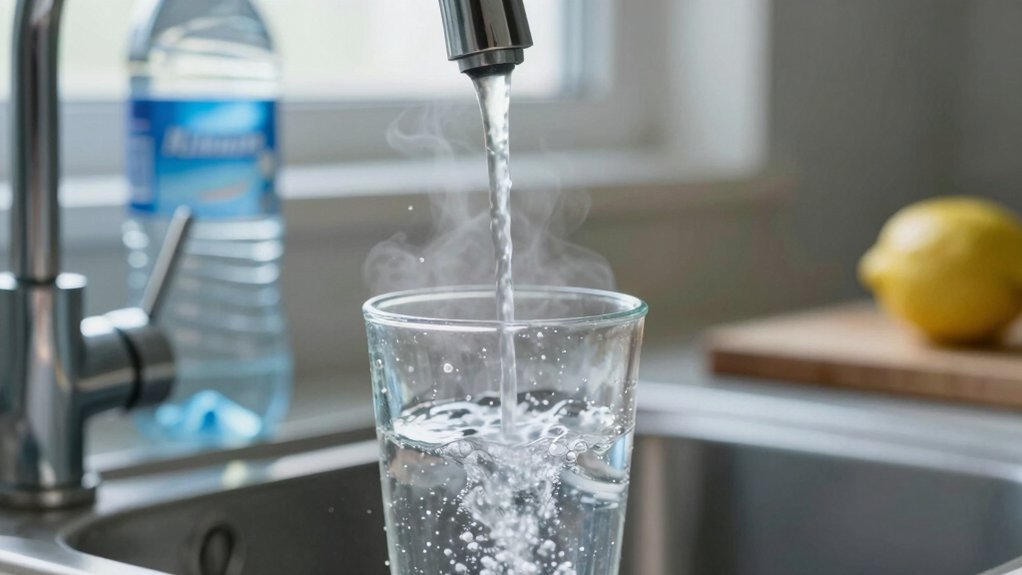
Your tap water tastes like chlorine because municipal systems add free chlorine (typically about 0.04–2.0 ppm) to kill microbes and leave a residual in the distribution lines. That residual, plus treatment byproducts, pipe material, temperature, and distance from the plant creates a bleach-like flavor.
Boiling and rapid chilling in glass can volatilize much of the free chlorine, but reboiling or slow cooling can concentrate nonvolatile byproducts. Keep going to learn practical testing and mitigation steps.
Quick Overview
- Municipal systems add chlorine as a disinfectant, and residual free chlorine can give water a bleach-like taste. Higher chlorine flavor is common near treatment plants where target residuals are set to prevent microbial growth: 0.2–2.0 ppm.
- Perception varies by person, water temperature, and contact time. Warmer water often smells and tastes stronger.
- Old pipes, storage tanks, or plastic containers can interact with chlorine and change the water’s taste profile. Boiling then rapidly chilling water in glass reduces volatile chlorine taste, while testing with DPD strips verifies actual levels.
City Water Chlorine Levels (ppm)
How much chlorine is in your city tap water depends on regulatory targets and how far the water travels from the treatment plant. You’ll usually see free chlorine around 0.5–2.0 ppm at typical municipal taps; treatment-exit targets often start near 0.2–0.5 ppm to ensure a detectable residual.
Distance, water age, and peak demand shift that range; this explains variable chlorine taste between neighborhoods.
| Location | Typical free chlorine (ppm) |
|---|---|
| Treatment exit | 0.2–2.0 |
| Far end of distribution | 0.04–0.8 |
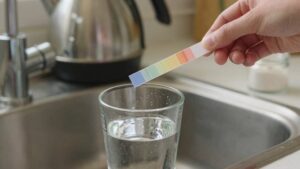
You can test with DPD tablets or strips. Additionally, consult your Consumer Confidence Report to correlate measured values with perceived chlorine taste.
Maximum Residual Chlorine Limits
Why do regulators cap residual chlorine levels in drinking water? You need limits because chlorine provides microbial protection but poses sensory and chemical trade-offs. Maximum residual chlorine limits balance disinfection efficacy with consumer acceptability and byproduct control. You should know limits are evidence-based, tied to distribution distance, system demand, and monitoring frequency.
Public-health rationale: prevent regrowth while minimizing DBP formation. Analytical control: routine sampling ensures compliance with numerical maxima.
pH interactions: regulatory thresholds consider how pH alters free chlorine potency and byproduct speciation. Taste perception: limits aim to keep concentrations below levels that cause noticeable bleach odor or flavor.
These caps follow risk-assessment frameworks and documented exposure-response data.
Boil-And-Chill Removal Method
You can reduce free chlorine by boiling water, since the gas volatilizes and escapes during heating. Cool the water rapidly in glass to limit reabsorption and preserve the volatile-compound loss. Note that repeated reboiling can concentrate nonvolatile byproducts and increase off-flavors.
Choose glass over plastic to minimize chemical reactions that amplify medicinal or rubbery tastes.
Boil-Off Chlorine Reduction
Curious whether boiling will get rid of that bleachy taste? You can reduce free chlorine by exploiting boil off dynamics: heating accelerates volatilization of molecular chlorine and hypochlorous acid, decreasing residual free chlorine concentration. Boiling for several minutes lowers sensory-active chlorine but doesn’t remove chloramines efficiently; so confirm disinfectant type before relying on this method.
After boiling, chilling reduces re-equilibration rates and helps stabilize taste. However, cooling speed will be discussed later. As a taste mitigating strategy, combine boiling with brief aeration or transfer between containers to increase surface area and off-gassing. Use objective testing (colorimetric or ORP meters) to verify reduction since perceived taste correlates imperfectly with measured residuals and with reactions to plumbing materials.
Cooling Speeds Matter
Cooling Speeds Matter
How quickly you cool boiled water affects how much of the volatile chlorine and hypochlorous acid stay dissolved: rapid chilling limits re-equilibration with ambient air and reduces redissolution, while slow cooling lets residual free chlorine re-dissolve from vapor and prolongs sensorily detectable concentrations. You should cool rapidly if your goal is minimizing chlorine-related taste perception after boiling.
Rapid chilling truncates gas–liquid mass transfer time; this lowers Henry’s-law-driven uptake and preserves lower dissolved-free-chlorine concentrations measured post-treatment. Slow cooling increases headspace residence time and enhances back-diffusion, which raises transient free-chlorine values that the tongue detects. For practical control, use an ice bath or rapid refrigeration to achieve quick temperature descent. Monitor with chlorine test strips to confirm that cooling speeds produce the desired reduction in perceived chlorine taste.
Volatile Compound Release
When you boil chlorinated tap water and then rapidly chill it, volatile disinfectant compounds like free chlorine and hypochlorous acid are driven off as gases and kept from re-dissolving, reducing the residual taste. This boil-and-chill method leverages heat-driven volatilization followed by rapid temperature drop to limit Henry’s law-mediated re-equilibration with the headspace.
You accelerate evaporation dynamics by increasing temperature and surface-area exposure; this converts dissolved chlorine species to gaseous forms that escape. Rapid chilling minimizes back-transfer by lowering solubility and kinetic energy; it interrupts scent reaction pathways that produce odoriferous byproducts.
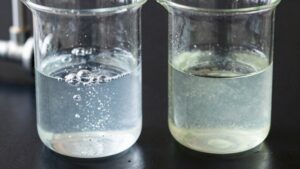
Empirical studies show significant reductions in measured free chlorine and sensory rating after boil-and-chill versus static cooling. You should note effectiveness varies with initial chlorine speciation, contact time, and vessel geometry.
Reboil Risks Increase
Why might reboiling chlorinated water increase risks rather than help? You might assume repeated boiling drives off more chlorine, but reboil myths overlook chemical dynamics and concentration effects. Boiling converts free chlorine to volatile compounds and reactive byproducts. Subsequent cooling and reheating can concentrate nonvolatile disinfection byproducts (DBPs) and mobilize metals from kettle surfaces.
You’ll also see taste persistence because some chlorinated-organic compounds resist thermal degassing and become more perceptible after evaporation concentrates remaining solutes. From a risk perspective, repeated thermal cycles can increase DBP concentration per volume and accelerate kettle corrosion, raising ingestion of trace metals. Evidence-based practice favors single controlled boiling or carbon filtration rather than iterative boil-and-chill routines to mitigate both taste and chemical risk.
Glass Versus Plastic
Because repeated boiling can concentrate disinfection byproducts and leach metals from kettle surfaces, the choice of vessel for a boil-and-chill method matters for both taste removal and contaminant behavior. You should prefer glass containers when chilling boiled water intended to reduce chlorine-related flavors: glass is inert, won’t off-gas, and minimizes sorption or additional chemical reactions that can amplify medicinal notes.
Plastic containers can absorb volatile compounds and release organics, altering taste and potentially reintroducing compounds formed during boiling. Use food-grade, low-permeability plastics only if glass isn’t available, and avoid heated plastic exposure. Empirical comparisons show lower volatile-organic transfer in glass versus plastic; therefore, you’ll achieve more reliable sensory outcomes and reduced secondary contaminant interactions by storing chilled, boiled water in glass containers.
Storage Time Effects
How long you store boiled-and-chilled water meaningfully changes its chlorine-derived flavors. As time passes, volatile chlorine species and some disinfection byproducts dissipate, reducing antiseptic and medicinal notes. However, longer storage can also allow re-equilibration with container materials or microbial regrowth if residual disinfectant is fully dissipated.
You’ll note rapid decline in free chlorine-related odor within hours at low temperature, consistent with volatilization kinetics. However, semi-volatile byproducts like chlorophenols can persist and drive taste degradation over days. Use inert, low-permeability containers and cold storage to minimize sorption and off-gassing. Monitor storage time: store no longer than 24–48 hours for optimal sensory quality unless you use sterile, sealed vessels.
For longer holding, periodically test residual disinfectant and microbial load.
Frequently Asked Questions
Can Cooking With Chlorinated Water Affect Food Flavor?
Yes, cooking with chlorinated water can alter cooking flavor by imparting a chlorine taste to foods and liquids. Chlorine and chloramine react with organic compounds during heating; this concentrates medicinal or bleach-like notes in broths, boiled vegetables, and beverages.
You can remove these off-flavors with carbon filtration, reverse osmosis, or by aerating and boiling water before use. Testing disinfectant levels confirms whether treatment adjustments are needed.
Do Water Softeners Remove Chlorine Taste?
No, standard ion-exchange water softeners won’t provide effective chlorine removal. You’ll still notice chlorine taste because softeners exchange calcium/magnesium for sodium or potassium. This addresses water softness but not oxidative disinfectants.
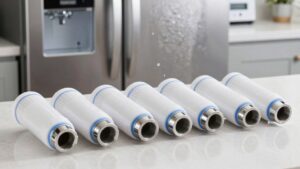
For evidence-based chlorine removal, use activated carbon filters or reverse osmosis systems downstream. These adsorb or reduce free chlorine and chloramines. Test treated water to confirm chlorine reduction and maintain filters per manufacturer specs for consistent performance.
Is Bottled Water Free of Chlorine Taste?
Yes, bottled water is generally free of a chlorine taste. You’ll find bottled water marketed for taste neutrality because most producers use filtration (carbon, RO) and dechlorination steps to reduce chlorine perception.
Regulatory processing and sealed packaging aid odor elimination. Therefore, residual disinfectant levels are typically below sensory thresholds. If you still detect chlorine, test for chlorinated compounds or choose brands specifying activated-carbon or reverse-osmosis treatment.
Can Chlorine in Showers Irritate Skin or Lungs?
Yes, chlorine irritation in showers can affect your skin and lungs. Short-term exposure may dry or redden sensitive skin and aggravate asthma or respiratory irritation from inhaling vapors and aerosols.
Shower safety includes using lower-temperature, shorter showers; improving bathroom ventilation; and installing carbon or vitamin-C filters to remove chlorine or chloramine. Those with dermatitis or respiratory issues should test alternatives and consult providers if symptoms persist despite mitigation.
How Quickly Does Chlorine Dissipate After Filling a Pitcher?
You’ll see how chlorine in water dissipates quickly: the initial drop occurs within 30–60 minutes, with significant reduction over 2–24 hours depending on temperature, surface area, and aeration.
Dissipation rate increases with warmer temperature, larger surface area, and agitation (pouring or stirring). At room temperature in a typical pitcher left uncovered, expect most free chlorine to be gone within 4–8 hours; trace levels may persist longer without filtration.
Conclusion
You’re likely tasting chlorine because municipal systems keep free chlorine at measurable ppm levels to control microbes; this often occurs near regulatory maximums. That residual is volatile and soluble, so heating drives off some but not all.
Boiling then rapid cooling reduces chlorine faster than slow cooling; repeated reboiling lessens efficacy. Glass preserves flavor better than plastic, and longer storage lets remaining volatiles dissipate.
Adjusting contact time or using activated-carbon filtration reliably removes the chlorine taste.