Water Test Strips Accuracy and Limitations
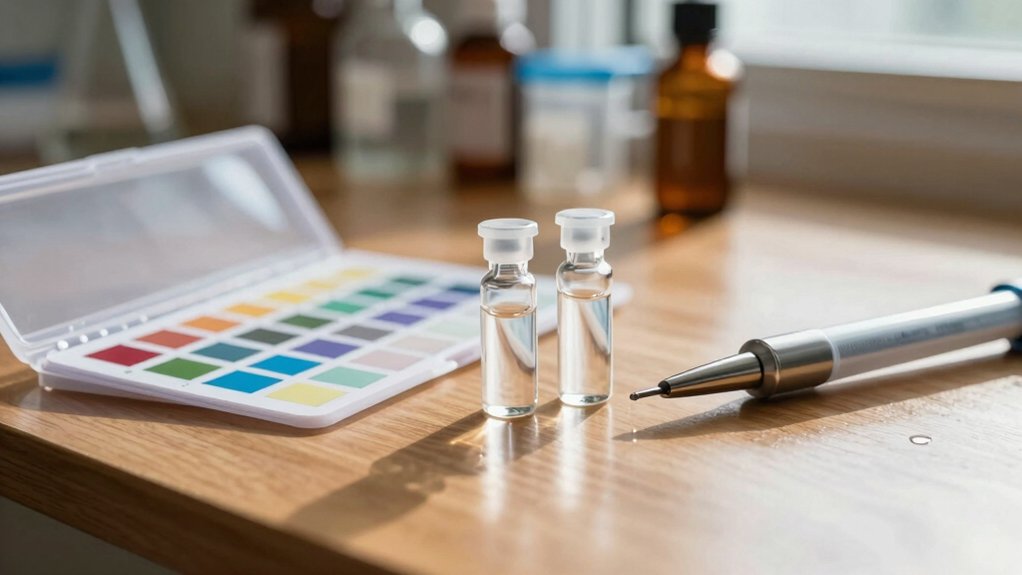
You can get quick, rough pH estimates with water test strips, but expect errors typically from about ±0.1 up to ±1.5 pH depending on strip type and care.
Accuracy drops with poor storage, heat, humidity, expired strips or inconsistent timing. Read each pad within the manufacturer window (often 15–60s) under neutral light and note temperature. Early or late reads bias results.
If you want practical limits, handling tips and troubleshooting next, keep going.
Quick Overview
- Test-strip accuracy varies by type: aquarium kits ~±0.0–0.2 pH; commercial multi-test ±0.1–1.0; pool strips ±1.0–1.5 pH.
- Strips are best for routine screening. Use laboratory analysis for regulatory, low-concentration, or critical decisions.
- Proper storage (cool, dry, sealed, 15–25°C, desiccant) and avoiding sunlight preserve strip accuracy.
- Read color changes within the manufacturer’s timing window (typically 15–60 seconds) to avoid underdevelopment or fading.
- Environmental factors (temperature, humidity, lighting) and inconsistent timing can shift results. Document conditions and duplicate tests for reliability.
pH Accuracy Comparison Chart
How accurate do pH test strips really get? You’ll see varied pH accuracy across strip types. Pool and commercial multi-test strips perform best, while litmus and some multi-parameter pads show >1 pH error. You should weigh strip usability, clarity of color pads, and timing against stated precision before relying on results.
| Strip Type | Typical Error (pH) | Practical Note |
|---|---|---|
| Pool strips | High usability; fast read | |
| Commercial multi-test | 0.1–1.0 | Good precision with triplicates |
| Litmus/Dual | >1.0–1.5 | Low usability; smearing risk |
| Aquarium kits | 0.0–0.2 | Narrow-range reliable |
Use strips for routine screening. Send samples to labs for regulatory or low-concentration concerns.
Test-Strip Storage Conditions
Where should you keep test strips to preserve accuracy? Store them in a cool, dry place away from sunlight and heat sources; temperature swings accelerate storage degradation and alter reagent stability. Keep original container seals intact until use to limit moisture and oxygen exposure that skew results. Monitor expiration dates and discard strips showing discoloration or clumping.
- Room: Stable 15–25°C, low humidity to minimize hydrolysis and reagent drift.
- Light: Opaque storage to prevent photodegradation of indicators.
- Handling: Touch pads minimally; oils and moisture cause localized degradation.
- Transport: Rigid packaging with desiccant and intact container seals to prevent accidental humidity ingress.
Follow manufacturer storage specs; deviations reduce accuracy and increase false readings.
Color-Reading Timing Window
You should compare the strip color to the chart at the manufacturer’s specified optimal timing window. Many reactions stabilize within a narrow 15–60 second interval.
Reading too early risks underdevelopment and false lows. Reading too late invites dye fading or secondary reactions that produce false highs. Use a consistent timing technique and account for temperature and lighting. Environmental factors can shift reaction kinetics by measurable amounts.
Optimal Timing Window
When should you read a test strip’s color to get a reliable result? Read each pad within the manufacturer’s specified window: typically 15–60 seconds. This is because timing correlates directly with measured concentration. Deviating earlier gives false negatives; waiting longer causes color bleed and overestimation.
Use a stopwatch and consistent lighting to minimize subjective drift. Avoid topic drift into unrelated metrics like temperature unless the instructions specify correction factors. For multi-parameter strips, record each pad at its own endpoint rather than a single snapshot, since reaction kinetics differ across reagents.
If results sit near a decision threshold, repeat the test or send a sample to a lab. Treat timing as a controlled variable: precise timing reduces user error and improves agreement with reference methods.
Early Read Risks
Building on the timing guidance above, reading strips earlier than the manufacturer’s specified window systematically underestimates concentrations because many reagent reactions require the full allotted time to develop. Studies show early reads can shift results by one to several gradations on color charts; this produces false negatives for chlorine and ammonia and masks low-level metal presence.
You should wait the full interval: truncated development time skews color intensity and compresses dynamic range. In practice, early reads degrade user reliability and confound simple strip calibration checks. If you need faster feedback, validate a rapid-read protocol against lab results first. Document ambient lighting and timing during each test to detect systematic bias, and discard readings that occur outside recommended windows to avoid underreporting hazards.
Late Read Degradation
How long should you wait before comparing a strip to its color chart? You should follow the manufacturer’s specified window (commonly 15–60 seconds) because a late read increases uncertainty. If you wait beyond that window, color development plateaus and then shifts due to oxidation, hydrolysis, or dye migration. Those degradation effects produce systematically lower or higher apparent concentrations.
Empirical comparisons show results drift measurably after the recommended interval, reducing agreement with laboratory methods; this is especially true for chlorine and pH. You can quantify risk by testing replicate strips at set intervals to determine when readings diverge beyond acceptable error bounds. Treat any result from a late read as provisional. If critical, confirm with a fresh strip or laboratory analysis.
Consistent Timing Technique
Why does timing matter so much for strip-based tests? You must read color pads within the manufacturer’s specified timing window because chemical reagents follow an abstract cadence: color development progresses predictably, then stabilizes or degrades. Measure multiple parameters with a stopwatch or app to hit each chart’s target interval; deviations as small as ±15 seconds can increase user error and shift categorical results (safe/unsafe).
Use consistent lighting and a neutral background. Transfer strips promptly and avoid multitasking between dips. Log the exact read time for each strip to detect systematic bias. When you standardize timing, concordance with laboratory methods improves for robust parameters (pH, hardness) and reduces false positives for marginal analytes.
Environmental Timing Effects
After you’ve standardized read times, account for environmental factors that shift the color-reading timing window: ambient temperature, humidity, and light intensity each alter reagent kinetics and perceived hue. You should measure and note temperature and humidity during each test because reaction rates can vary 10–20% per 10°C change; this shifts optimal read windows by several seconds to minutes.
Use consistent, neutral lighting or a light box. Direct sunlight and fluorescent spectra change perceived hue and introduce systematic bias. Track kit variance by testing duplicate strips from different batches to quantify inter-kit timing shifts. When results approach decision thresholds, repeat testing under controlled conditions or send samples to a lab.
Treat rapid-field readings as screening data, not definitive measurements.
Frequently Asked Questions
Do Test Strips Detect PFAS or Pesticides in Drinking Water?
No, you can’t rely on test strips for PFAS detection or pesticide screening. Consumer strips lack sensitivity and cannot detect PFAS, pesticides, VOCs, or low-concentration toxins.
You’ll need professional laboratory analysis for those contaminants; labs provide quantitative, validated results with much higher precision and detection limits. Use strips only for basic parameters (pH, chlorine) as a preliminary screen. Then, confirm any concern with certified lab testing.
Can Test Strips Reliably Identify Lead or Other Heavy Metals?
No, you can’t reliably identify lead or most heavy metals with test strips. Lead testing pitfalls include low sensitivity under 1 ppm; high false negatives; and color-matching errors. Consumer limitations mean strips lack laboratory precision. You should treat strip results as preliminary screening only.
For accurate, quantitative detection of lead, iron, arsenic, or other heavy metals, send samples to an accredited lab that reports limits of detection and confidence intervals.
How Do Lighting Conditions Affect Color-Match Accuracy?
Lighting accuracy strongly affects your color-match results. Poor or uneven light creates colorimetric bias, pushing readings toward adjacent shades and reducing precision. You’ll see larger variability under yellow or low-light conditions and between indoor bulbs versus daylight.
To minimize error, you should use consistent, neutral daylight-equivalent illumination, flat backgrounds, and immediate timed comparison. Even then, expect residual subjectivity; repeats or lab analysis remain necessary for critical decisions.
Are Bacteria or Viral Contaminants Detectable With Test Strips?
No, you can’t reliably detect bacteria detection or viral contamination with consumer test strips. At-home strips lack sensitivity and specificity for microbes; pathogens and low-concentration toxins escape their chemistry.
You’ll need professional laboratory analysis (culture, PCR, or advanced assays) for valid results. Use strips only for basic chemistry screening (pH, chlorine). If you suspect microbial contamination, collect samples and order accredited laboratory testing immediately for accurate, actionable data.
When Should I Choose Laboratory Testing Over Home Strips?
You should choose laboratory testing when you need laboratory validation or when results will guide health, legal, or remediation actions. Use professional testing if you suspect pesticides, VOCs, PFAS, heavy metals, pathogens, or low-concentration toxins. You should also choose laboratory testing if home strips give borderline or uncertain readings.
Labs deliver higher precision, comprehensive contaminant breakdown, and defensible data. Rely on them for regulatory compliance, medical concerns, or when screening indicates potential contamination.
Conclusion
You’ve seen how pH accuracy varies by strip brand and storage: improperly stored strips can shift readings by ±0.3–0.8 pH units.
Timing matters. Read within the optimal window (usually 15–60 seconds depending on manufacturer) to avoid early false highs or late degradation toward neutral. Use a consistent timing technique and control temperature and lighting.
Treat strip results as indicative, not definitive; confirm critical decisions with calibrated instruments or laboratory tests.