Reverse Osmosis Membrane Gpd Ratings Explained
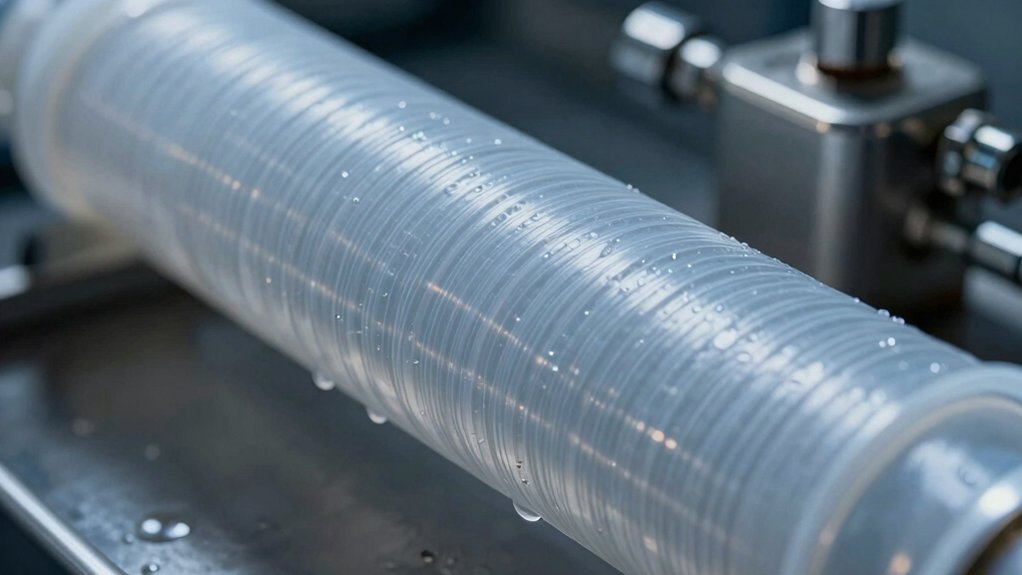
RO membrane GPD ratings tell you the nominal permeate produced under specific lab conditions (usually 77°F, defined feed TDS and pressure). You’ll get far less flow if your feed TDS is higher, temperature is lower, or operating pressure is below the test point. Conversely, higher temp or pressure raises flux but can change rejection.
GPD is separate from salt rejection, which depends on membrane chemistry and test method. Keep going to see how adjustments and field checks map to rated values.
Quick Overview
- GPD rating is the membrane’s laboratory-rated permeate production (gallons per day) under specific temperature, pressure, and feed-TDS conditions.
- Real-world permeate differs: measure actual flow at operating pressure and temperature; apply correction factors for accurate GPD.
- Higher feed TDS and lower temperature reduce permeate. Increasing pressure raises flux but may change salt rejection.
- Match GPD category to application: residential (25–500 GPD), tap systems (225–2,500 GPD); brackish/seawater is much higher and requires higher pressure.
- GPD is separate from salt rejection. Verify manufacturer test method, feed conditions, and certification to ensure expected performance.
RO Membrane Flow Chart
Why choose a specific RO membrane type? You’ll match membrane specs to feed water quality, required GPD, and membrane age expectations to ensure target rejection and lifespan. Use the flow chart to select categories: residential, tap, brackish, seawater, or low-fouling membranes based on TDS and operating pressure.
| Membrane Category | Typical GPD Range | Operating Pressure (psi) |
|---|---|---|
| Residential | 25–500 | 50–70 |
| Tap Water | 225–2,500 | 100–150 |
| Brackish/Seawater | 300–13,000 / 250–7,500 | 100–225 / 800–1,200 |
Prioritize restrictor matching and monitor membrane age. Poor feed water quality accelerates fouling and lowers GPD.
Permeate Flow Rate Checklist
Wondering whether your RO system is delivering the expected output? You should verify permeate flow against rated GPD under your actual pressure and temperature. Regular checks protect membrane longevity and maintain energy efficiency by avoiding overwork.
- Measure actual permeate volume over a fixed period at normal operating pressure (40–60 PSI) and temperature; compare to rated GPD adjusted for conditions.
- Record inlet temperature and TDS. Use correction factors since low temperature and high TDS reduce flow.
- Inspect for fouling, scale, or pressure drop across prefilters; replace elements to restore nominal flow and protect membrane longevity.
- Monitor recovery rate and wastewater. Abnormal decline signals fouling or integrity loss affecting energy efficiency.
Log results and schedule maintenance based on measured deviation.
Salt Rejection Thresholds
Now you’ll evaluate salt rejection thresholds, starting with basic definitions and how they’re quantified in lab and field tests. You’ll compare measurement methods and note how temperature and membrane material shift rejection percentages.
Finally, you’ll examine testing protocols and certification claims to gauge real-world performance versus rated values.
Salt Rejection Basics
Because salt rejection defines how effectively a membrane removes dissolved salts, you should treat GPD ratings and rejection figures as separate but related specs when evaluating RO performance. You’ll focus on rejection percentage thresholds (e.g., 90–99+%) that indicate retained dissolved solids rather than throughput.
Consider operational conditions: pressure, temperature, and feed TDS shift rejection downward even if GPD stays nominal. Don’t let subtopic irrelevance or extraneous metrics, like blanket flow numbers without rejection context, drive your selection.
For practical assessment, set minimum rejection targets based on feedwater chemistry and health requirements. Then confirm membrane compatibility with expected pressures and temperatures. You’ll prioritize membranes meeting those rejection thresholds under real operating conditions, not just idealized lab ratings.
Measurement Methods Explained
Having set minimum rejection targets and matched membranes to expected pressures and temperatures, you should next examine how salt rejection is measured and reported so you can interpret those targets reliably. You’ll see two primary lab methods: feed/permeate conductivity ratio and standardized synthetic brine challenge; both yield percentage rejection figures at defined TDS, temperature, and pressure.
Manufacturers quote thresholds (e.g., 90–99%) based on specific protocols; check test conditions before comparing membranes. Field testing uses portable TDS meters but lacks lab accuracy; correlate field data to lab thresholds cautiously.
Don’t conflate rating differences with unrelated topic claims. Finally, consider socioeconomic impact: overly optimistic ratings can drive poor system selection in low-resource settings, so prefer transparent, condition-specified rejection data.
Effects Of Temperature
When water temperature falls below the standard 77°F used for GPD and rejection testing, membrane permeability and salt rejection shift predictably: colder feed reduces permeate flux and typically raises percentage rejection up to a point. Warmer feed increases flux but can lower rejection due to reduced solute-solvent viscosity and membrane selectivity.
You’ll see temperature effects act nearly linearly on permeation rates; 50°F approximates a 50% GPD loss versus 77°F. Rejection thresholds move slightly upward with cooling as diffusion slows.
Account for pressure interactions: higher operating pressure can partly restore flux at low temperatures but may exacerbate rejection loss at high temperatures by forcing convective transport. In practice, adjust setpoints and expect trade-offs between throughput and salt rejection across temperature ranges.
Membrane Material Differences
Lower feed temperatures reduce permeate flux, but they can raise salt rejection slightly; membrane material then becomes a dominant factor in how much rejection changes across operating conditions. You’ll evaluate polyamide thin-film composite versus cellulose acetate variants by their intrinsic pore chemistry and rejection cutoff.
Polyamide typically exhibits higher nominal salt rejection and stability at standard GPD-rated flow rate conditions. Cellulose acetate shows reduced fouling tolerance and lower rejection as temperature and pressure deviate. When you specify a membrane, compare manufacturer rejection curves versus TDS and temperature to predict real-world performance.
Also consider scaling, chlorinated feed susceptibility, and mechanical durability. These properties shift the effective salt rejection threshold more than nominal GPD. Select the material that preserves required rejection across expected feed and flow rate ranges.
Testing And Certification
Why does salt rejection matter to your RO system’s certification and real-world performance? You need specific thresholds because certifying bodies test membranes for percent rejection at set TDS, pressure, and temperature. Certification ties GPD to salt rejection: a membrane rated 100 GPD may meet production specs but fail stricter 98% NaCl rejection criteria.
You should compare lab protocols (NaCl concentration, 77°F, 60 PSI) to expected field conditions; otherwise, test results become an unrelated topic or an irrelevant concept. Manufacturers must report both GPD and rejection under standardized methods (ANSI/NSF or equivalent). During procurement, require test certificates showing method, feed TDS, pressure, and measured rejection. That lets you predict performance, compliance, and maintenance cadence with quantified confidence.
Frequently Asked Questions
How Does Water Temperature Affect Membrane Lifespan?
Higher temperatures accelerate degradation; you’ll see reduced membrane life as temperature rises. Temperature impact: chemical reactions, biofouling, and scaling rates increase, stressing polymer structure and weakening pores.
Cooler feed water slows aging. Cold reduces flux but preserves membrane life. You’ll balance performance and longevity: operate near rated 77°F for design output but avoid prolonged high-temperature exposure to maximize membrane life and maintain consistent rejection and service intervals.
Can I Boost GPD With a Booster Pump?
Yes, you can boost GPD with a booster pump. You’ll increase feed pressure, raising flow proportionally and recovering closer to rated GPD under low-pressure conditions.
Check pump compatibility with your RO membrane, fittings, and prefilter housing to avoid damage. Expect improved efficiency, but monitor recovery and waste rates: higher GPD can reduce recovery percentage and shorten membrane lifespan.
Install pressure control and a check valve for stable operation and protection.
Does Higher GPD Increase Wastewater Volume?
Yes, higher GPD often increases wastewater volume. You’ll face high GPD tradeoffs: faster output but typically lower membrane efficiency and reduced recovery; so a smaller fraction becomes purified water. Boosting pressure or using larger membranes raises production but generally wastes more feed water unless you choose high-efficiency designs.
You should evaluate operating pressure, temperature, and membrane specs to balance output, recovery rate, and long-term performance.
Are GPD Ratings Valid for Softened Water?
Yes, GPD ratings remain valid for softened water, but you’ll see differences. Softening lowers hardness and scale, improving membrane performance and often raising actual GPD compared with hard water under identical temp/pressure. Your rated GPD still assumes standard test conditions; so expect variations from temperature, pressure, and TDS.
For accurate sizing, use two word discussion ideas: “pressure effects” and “feed salinity” when evaluating membrane performance and expected output.
How Often Should I Replace a High-Gpd Membrane?
You should replace a high-GPD membrane every 2–3 years under normal conditions. Sooner if you see pressure drops or water quality decline. Use two word discussion ideas like “monitor indicators” and “service schedule” to track membrane durability.
Test TDS and flow monthly for early warning. Shorten intervals to 12–18 months with heavy use, high TDS, softened feed, or poor prefiltration to preserve performance and avoid premature failure.
Conclusion
You’ve now seen how RO membrane GPD ratings relate to permeate flow, salt rejection, temperature, and material. When you test or specify membranes, use standardized measurement methods and certified data to avoid overestimating capacity.
Account for feed temperature and composition, and prioritize membranes whose material and testing history match your application. Apply the permeate flow checklist and salt-rejection thresholds to predict real-world performance rather than relying solely on nominal GPD ratings.