Kdf Media in Water Filters Explained
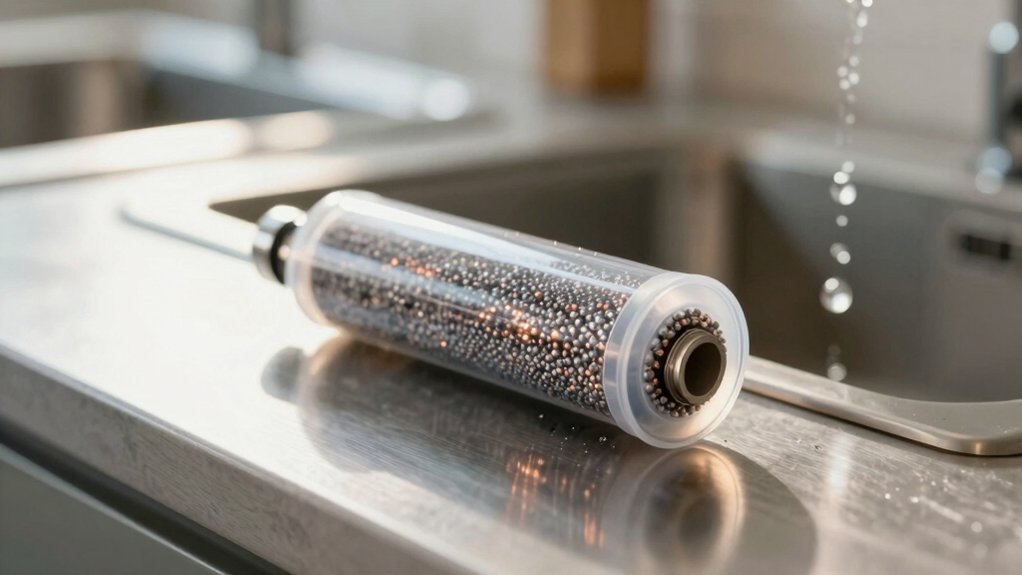
KDF copper-zinc media let you remove chlorine, control taste/odor, and reduce soluble metals or iron/H2S by redox and adsorption. Choose KDF-55 for chlorine and metal reduction; choose KDF-85 for iron/H2S and higher iron loads. Operate within pH ~6.5–8.5 and 35–212°F. Install per manufacturer specs, monitor effluent (chlorine, turbidity, metals), backwash to 20–40% bed expansion, and track service dates.
Follow monitoring and maintenance guidance to ensure reliable performance. Learn practical application details.
Quick Overview
- KDF media (copper-zinc alloy) reduces chlorine, taste/odor, and soluble heavy metals via redox reactions in filter beds. KDF-55 targets chlorine and aesthetic contaminants; KDF-85 is optimized for iron and hydrogen sulfide removal over a wider pH range.
- Install per manufacturer specs, maintain recommended EBCT, and protect media from acids, oxidizers, and sunlight. Monitor effluent regularly (free chlorine, turbidity, dissolved metals) and use breakthrough or pressure differential to trigger maintenance.
- Backwash and replace based on performance loss. Typical service life is 3–7 years under normal conditions.
KDF-55 vs KDF-85 Specs
When choosing between KDF-55 and KDF-85, focus on the contaminants you need to remove and the operating conditions. KDF-55 targets chlorine, taste/odor, and soluble heavy metals and maintains effectiveness in hot water. KDF-85 is optimized for dissolved iron and hydrogen sulfide across a wider pH range and supports higher iron loadings (up to ~5 ppm) with recommended dissolved-oxygen ratios for effective oxidation.
You’ll select KDF-55 for chlorine and aesthetic control; it’s NSF Standard 42 certified and tolerates hot water. Choose KDF-85 for iron/H2S removal; note KDF 85 limitations in maximum iron load and required DO ratios.
Assess media compatibility when pairing with activated carbon or softeners to extend life and prevent interference.
| Property | Value |
|---|---|
| Primary targets | Chlorine / Iron |
| pH range | 6.5–8.5 |
| Temp | 35–212°F |
| Cert | Std 42 / Std 61 |
KDF Micron Ratings Guide
How fine is KDF media and why does micron rating matter for your system? You need micron ratings to predict particle capture, flow resistance, and how long the media will control dissolved minerals before requiring attention. KDF isn’t a depth mechanical filter alone; its granule size and bed packing determine effective micron equivalence and contact time for redox reactions.
Choose coarser beds for high flow; choose finer beds for particulate polishing. Monitor pressure drop to infer media lifespan.
- Coarse granules: high flow, ~100+ micron equivalence
- Medium granules: balanced flow/contact, ~50–100 micron
- Fine granules: particulate polishing, ~10–50 micron
- Packed bed density: increases contact time; reduces breakthrough
- Surface fouling: raises pressure drop; shortens media lifespan
Copper-Zinc Bed Maintenance Intervals
You should inspect copper-zinc beds regularly based on system use and incoming water quality, typically every 3–12 months, to check for channeling or fouling.
Backwash schedules and frequencies must match flow rate and sediment load; set automated backwashes or manual routines to prevent pressure drop and restore contact efficiency.
Plan media replacement using measured performance indicators (chlorine breakthrough, metal removal decline, pressure differential) rather than fixed dates.
Monitor influent/effluent chemistry to adjust intervals.
Inspection Frequency Recommendations
Why check your copper-zinc KDF bed on a set schedule? You establish inspection intervals to monitor media lifecycle degradation, fouling, and redox performance decline. Inspect every 3–6 months for high-use or contaminated sources; inspect every 6–12 months for typical municipal water.
During each inspection, verify bed depth, uniformity, pressure differential, and presence of channeling or biofilm. Record conductivity or chlorine breakthrough where applicable to quantify performance loss.
Replace or regenerate when media lifecycle indicators cross vendor-specified thresholds: significant pressure drop, >10–20% volume loss, or measurable contaminant breakthrough. Keep a log correlating inspection intervals with operating conditions (flow rate, turbidity, feed chemistry) so you can adjust frequency and predict end-of-life accurately.
Media Backwash Intervals
Inspection findings should inform your copper-zinc bed backwash schedule: observed fouling, channeling, pressure drop, or contaminant breakthrough indicate when to initiate cleaning cycles. You should set backwash frequency based on measured headloss, turbidity spikes, and cumulative treated volume rather than fixed calendar intervals.
Monitor pressure differential and sample effluent. Trigger backwash when differential exceeds design tolerance or when contaminant removal efficiency drops. Maintain an appropriate media to water ratio during backwash: sufficient flow to expand the bed 20–40% prevents channeling without fluidizing granules.
Record cycle duration, flow rate, and settled bed depth to refine intervals. For variable influent loads, implement adaptive scheduling: increase backwash frequency with higher solids or biofouling indicators; reduce it when water is stable.
Replacement Timeframes Guidance
When should you plan to replace a copper-zinc bed? You should base replacement intervals on measured performance loss and water quality parameters rather than fixed calendar dates. Monitor outlet contaminant levels, pressure differential, and flow stability. When chlorine breakthrough, rising heavy-metal counts, or sustained pressure drop exceed system limits, schedule media exchange.
Typical replacement intervals range from 3 to 7 years under normal domestic use; however, hard water, high contaminant loads, or reduced backwash frequency shorten life. Maintenance considerations include documenting influent chemistry, loading rates, and backwash protocol to predict exhaustion. During replacement, follow manufacturer procedures for safe disposal and avoid media cross-contamination.
Keep analytical records to validate intervals and optimize procurement timing for uninterrupted filtration performance.
Flow Rate Impact
Having established replacement triggers based on measured performance, you should next assess how flow rate affects copper‑zinc bed exhaustion and maintenance intervals. You’ll find bed contact time is inverse to flow rate: higher flow rates shorten residence time, reducing redox conversion efficiency and accelerating exhaustion of active surface sites.
Calculate equivalent empty-bed contact time (EBCT) for your system and target contaminant removal to set conservative maintenance frequency. Also, account for hydraulic loading spikes. Intermittent high flow pulses compound wear.
Backwashing frequency interacts with flow rate; aggressive backwashing at high flows can fluidize media, increase attrition, and redistribute plated metals. Insufficient backwashing promotes channeling and localized exhaustion.
Optimize nominal flow rate and controlled backwashing schedules to maximize service life and maintain predictable replacement intervals.
Water Quality Monitoring
Why monitor water quality regularly? You’ll detect declines in KDF copper-zinc bed performance before contaminants breakthrough. Implement scheduled water testing for indicators: free chlorine, turbidity, metal concentration, and microbial counts.
Use chlorine monitoring to verify KDF 55 conversion efficiency; rising free chlorine suggests media exhaustion or channeling. Measure dissolved copper and zinc periodically to ensure regulatory limits aren’t exceeded and to track plating activity on granules.
Base maintenance intervals on measured contaminant load, flow rate, and breakthrough trends rather than fixed timelines. Record test results and compare to baseline performance; replace or regenerate beds when chlorine removal falls below specification or metal/particulate counts increase.
Consistent data-driven monitoring optimizes KDF lifespan and protects downstream treatment stages.
Storage And Handling
How should you store and handle copper‑zinc KDF beds to preserve performance and safety? You should keep sealed KDF media in a cool, dry environment, away from acids, strong oxidizers, and direct sunlight to prevent premature oxidation and contamination.
During storage handling, use inert containers and avoid metal tools that can abrade granules; nylon or plastic scoops are preferred. Once installed, establish maintenance intervals based on feedwater quality: inspect monthly for channeling or fouling and perform backwashing or replacement every 6 to 24 months depending on sediment load and contaminant burden.
For copper zinc safety, wear gloves and eye protection when changing media. Rinse new media to remove fines and document service dates. Follow manufacturer guidelines and test effluent regularly to confirm performance.
Frequently Asked Questions
Does KDF Affect Water Taste or Odor Beyond Chlorine Removal?
Yes, KDF reduces more than chlorine. You’ll find KDF taste and KDF odor improvements because the redox reactions convert chloramines, some sulfur compounds and oxidizable organics into less odorous, water-soluble forms. That lowers metallic and rotten-egg flavors when combined with backwashing or downstream carbon polishing.
KDF won’t remove volatile organic compounds (VOCs) fully; you’ll still need activated carbon or RO for certain tastes and odors.
Can KDF Media Release Copper or Zinc Into Water Over Time?
Yes, under normal conditions, KDF copper release and zinc leaching are minimal and within regulatory limits. You’ll see negligible copper or zinc ions because high-purity copper-zinc granules form stable redox films that inhibit metal dissolution.
Extended acidic or very soft water can increase zinc leaching and copper release rates. Therefore, you should monitor water chemistry and replace or flush media per manufacturer guidelines to keep released metal concentrations below health-based thresholds.
Is KDF Safe for Aquarium or Fish Tank Use?
Yes, KDF can be safe for aquarium use if you monitor aquarium safety and control metal ion leaching. You’ll need to use certified, fully rinsed media and limit contact time; or use it upstream of the tank to prevent copper or zinc release.
Test water regularly for copper and zinc concentrations. Maintain proper flow and pH, and replace media per manufacturer specs to avoid toxic accumulation affecting fish and invertebrates.
How Does KDF Perform in Very Low-Temperature Conditions?
You’ll find KDF temperature tolerance is good down to near-freezing water. The media’s copper-zinc granules don’t degrade chemically at low temperatures. Performance slows slightly because reaction kinetics are temperature-dependent; thus, contaminant conversion rates drop as water cools.
You’ll preserve KDF longevity by preventing freeze-thaw cycles and maintaining flow to avoid channeling. For sustained low-temperature use, monitor pressure drop and consider larger bed volumes to compensate for reduced reaction rates.
Can KDF Be Recycled or Disposed of Safely?
Yes, you can recycle or dispose of KDF media with care. For recycling options, contact local metal recyclers or hazardous-waste facilities; copper-zinc granules may be reclaimed.
If recycling is unavailable, follow disposal safety: seal spent media in labeled containers. Avoid landfill leachate by using municipal hazardous-waste programs and comply with local regulations. Don’t incinerate or dump. Treat spent media as metal-containing waste to prevent environmental contamination.
Conclusion
You’ve seen how KDF-55 and KDF-85 differ in composition, micron performance, and target contaminants. You have also seen how copper-zinc beds behave under varied flow and water chemistry. Inspect the media regularly, backwash per manufacturer guidance, and store unused media dry and sealed.
Replace or replenish according to service life, pressure drop, and contaminant breakthrough rather than calendar time alone. Monitor influent/effluent water quality and adjust flow rates to maintain contact time and treatment efficacy.