How to Choose the Right Water Filtration Type for Your Home
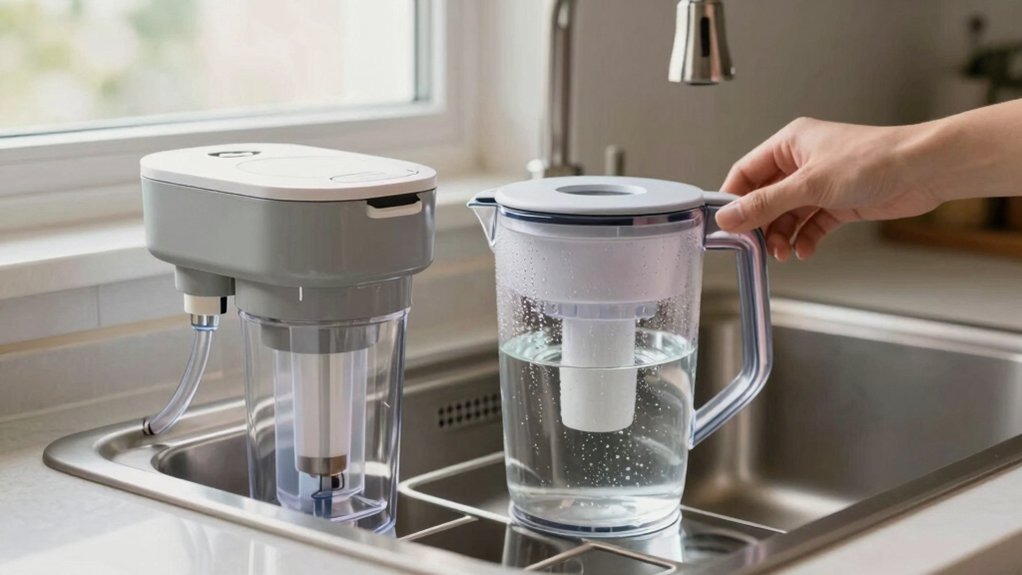
You should match filters to the contaminants you actually have.
Size systems for peak household GPM and verify NSF/ANSI certs for claimed reductions.
For chlorine or chloramine, pick carbon + KDF tanks whole-house or a carbon post-filter POU.
Use RO for fluoride and dissolved solids and TAC or softening media for scale in specific setups.
Check flow vs. simultaneous fixture demand and pressure limits so performance won’t drop.
Keep going to see sizing, certs, and installation tips.
Quick Overview
- Identify your target contaminants (chlorine/chloramine, VOCs, fluoride, dissolved solids, hardness) before selecting media or technology.
- Match contaminant to filter: carbon + KDF tank for whole-house chlorine/chloramine; carbon post-filter for point-of-use.
- Use RO for fluoride and most dissolved solids. TAC or specific scale-control setups are suitable for hardness prevention.
- Size whole-house systems by peak household GPM. Include 10–20% headroom to avoid pressure loss during simultaneous use.
- Verify NSF/ANSI certifications and listed test protocols/numbers for the specific contaminants claimed.
Contaminant Removal Comparison Chart
Wondering which whole-house or point-of-use filter fits your home and water source best? You’ll use a contaminant removal comparison chart to match needs to technology: carbon/KDF for chlorine, chloramine, VOCs; RO for fluoride and most dissolved solids; TAC for scale. This subtopic relevance helps prevent unrelated comparison mistakes; for example, equating cartridge lifespan to tank capacity.
| Contaminant | Best Whole-House | Best Point-of-Use |
|---|---|---|
| Chlorine/Chloramine | Carbon + KDF (tank) | Carbon post-filter |
| Fluoride/TDS | Tank + RO pre-treatment | Reverse osmosis |
Use flow-rate and capacity specs (GPM, gallons) to confirm system sizing and maintenance intervals before buying.
NSF/ANSI Standards Summary
After you match contaminants to filter types using the comparison chart, the next step is to verify performance claims against recognized standards. You’ll rely on NSF/ANSI standards to confirm a product reduces the specific contaminants you care about. Look for certified test numbers and scope: NSF/ANSI 42 for aesthetic effects, 53 for health-related contaminants, 58 for RO systems, and 401 for emerging contaminants.
Contaminant verification means checking lab reports, reduction percentages, and test conditions to ensure real-world relevance.
- Verify the exact NSF/ANSI protocol cited on the label.
- Compare certified reduction rates to your target contaminants.
- Confirm testing labs and test water conditions.
- Keep certification numbers for installer or warranty records.
Filter Flow Rate Requirements
You’ll want to size filtration by required gallons per minute to match your household’s peak demand timing. Account for simultaneous fixture use (showers, laundry, dishwashers) and how system pressure affects delivered flow.
Also plan for future flow scaling so upgrades or additional bathrooms don’t cause pressure loss.
Required Gallons Per Minute
How many gallons per minute (GPM) your filtration system needs depends on household size, peak simultaneous demand, and the type of system you choose. Calculate baseline GPM by summing fixture demands (showers ~2.5 GPM, faucets 1–2 GPM, appliances per spec) and add a margin for simultaneous use. Avoid relying on unrelated metrics like daily gallons per day for instantaneous sizing.
Match whole-house systems to peak flow to prevent pressure loss; 9–12 GPM suits small homes, and 15–20 GPM for larger houses with multiple bathrooms. For under-sink or RO units, ensure point-of-use flow meets appliance requirements, not aesthetic considerations like slow faucet feel. Verify manufacturer flow ratings at expected pressure to choose appropriately.
Peak Demand Timing
When do most peak water demands happen in your home, and why does that matter for filter flow rates? You’ll typically see peaks in the morning and evening: showers, dishwashers, and laundry overlap. Design for worst-case peak demand.
Calculate cumulative simultaneous flow needs and choose a whole-house or point-of-use system with a rated flow that exceeds that peak demand to avoid pressure drops. Consider timing constraints: short high-flow events (pressure washer, filling tubs) require higher instantaneous GPM than steady uses.
Match filter media and housing size to transient surges; cartridge clogging and head loss increase under heavy intermittent flow. Specify systems with headroom (typically 10–20% above calculated peak) to maintain performance and longevity.
Fixture Simultaneous Use
Where do simultaneous fixture demands matter most? Can your chosen filter keep up when several outlets run at once? You need to calculate fixture simultaneity: estimate how many fixtures will operate together during peak use (showers, dishwasher, laundry). Match that to the filter’s rated flow rate in GPM so filtration media and bypass valves don’t cause drop-offs.
Verify the system’s plumbing capacity; pipe size, manifold, and valves must support the combined flow without turbulence or cavitation. For whole-house units, aim for a flow rate exceeding peak simultaneous demand (e.g., 15–20 GPM for larger homes). For under-sink or point-of-use, ensure dedicated branch lines or pressure regulators prevent downstream starvation when multiple fixtures draw water.
System Pressure Impact
Why does system pressure matter for filter performance? You rely on adequate system pressure to push water through media without starving fixtures or forcing excessive bypass. Low pressure reduces throughput and can undermine contaminant reduction in RO membranes and tight carbon beds. High pressure can damage housings or accelerate media wear.
Assess your household peak demand, required GPM, and minimum operating pressure of candidate systems. Match filter pressure ratings to your supply, factoring in pressure drops across sediment pre-filters and multi-stage assemblies. Install pressure gauges upstream and downstream to monitor real-time performance.
Use pressure regulators or booster pumps only when needed. Design for flow optimization by selecting systems whose rated flow and pressure curves align with your plumbing and usage patterns.
Future Flow Scaling
How will your home’s water demand change over the next 5–15 years? Can your chosen filtration system scale to meet that demand without pressure loss or premature media exhaustion? Assess projected household growth, appliance additions, and landscaping needs to estimate future flow. Match filter sizing to peak simultaneous draw: showers, laundry, irrigation. Choose systems rated above that peak to avoid pressure drop.
For tank-based and cartridge systems, verify GPM and total capacity. For RO or point-of-use units, confirm feed requirements and storage. Account for scaling concerns like media compaction and shortened run-times when flow exceeds design.
Plan redundancy or modular expansion: parallel vessels, upsized cartridges. This way, you can increase capacity with minimal downtime.
Frequently Asked Questions
How Often Should I Pressure-Wash or Sanitize Filtration Tanks?
You should pressure-wash or sanitize filtration tanks every 12 months, and after any contamination event or major media change. For filter maintenance, perform visual inspections and pre-filter replacements quarterly. Sanitize tanks during annual service or when biofilm, odor, or turbidity appears.
Use manufacturer-approved sanitizers; follow NSF guidelines. Isolate systems, flush thoroughly, and record procedures. If you have well water or recurring microbiological issues, sanitize semi-annually and monitor with TDS and bacterial testing.
Can I Connect a Whole-House Filter to My Refrigerator Ice Maker?
Yes, you can connect a refrigerator ice maker to a whole-house filter, but you’ll face whole house connection challenges like pressure drop, flow rate limits, and potential bypass needs. You’ll want a dedicated cold-water branch after the main filtration with proper shutoffs. Also, use a pressure-rated saddle or tee and an NSF-certified post-filter or RO for taste-sensitive ice.
Test flow (GPM) and maintain filter replacement to avoid clogging and reduced ice production.
Do Filters Affect Water Temperature or Heating Costs?
No, filters won’t meaningfully change water temperature or raise heating bills. You’ll see negligible thermal loss across typical carbon, sediment, RO, or TAC systems. Only long plumbing runs or insulated tanks affect temperature.
In filters vs heaters terms, filtration adds minimal hydraulic resistance but not heat load; therefore, energy impact is negligible. If you add UV or booster pumps, account for their electrical draw, not the passive media itself.
Are There Eco-Friendly Ways to Dispose of Used Filter Cartridges?
Yes, you can handle used cartridges responsibly. You’ll check manufacturers for eco friendly recycling programs or mail-back options. Some brands separate plastic housings from media for recycling.
For disposal alternatives, you’ll compost harmless sediment (if confirmed inert) and send spent carbon or RO reject media to hazardous-waste facilities when contaminated. Local recycling centers or household hazardous waste events often accept filters. Document instructions and follow local regulations.
Can Pets Be Harmed by Water Treated With UV or KDF Media?
No, UV safety and KDF media won’t harm pets when systems are installed and maintained properly. You’ll rely on UV safety to inactivate microorganisms without adding chemicals. Additionally, you will use KDF media to reduce chlorine, chloramine, and some heavy metals.
Ensure correct lamp shielding, replacement intervals, and pre-filtration to prevent fouling. Minimize pet exposure to bypassed or untreated lines. Follow manufacturer specs and certifications to keep water safe for animals.
Conclusion
Now that you’ve compared contaminant removal, NSF/ANSI standards, flow rates, and peak demand, you can pick the filtration type that meets both water quality and household hydraulics.
Prioritize systems certified for the contaminants you face; size them for required gallons per minute; and ensure they are rated for your household pressure and simultaneous fixture use. Allow headroom for future flow increases.
Install or upgrade with certified components and test post-installation to confirm performance and compliance.