How Long Chlorine Dioxide Takes to Treat Water
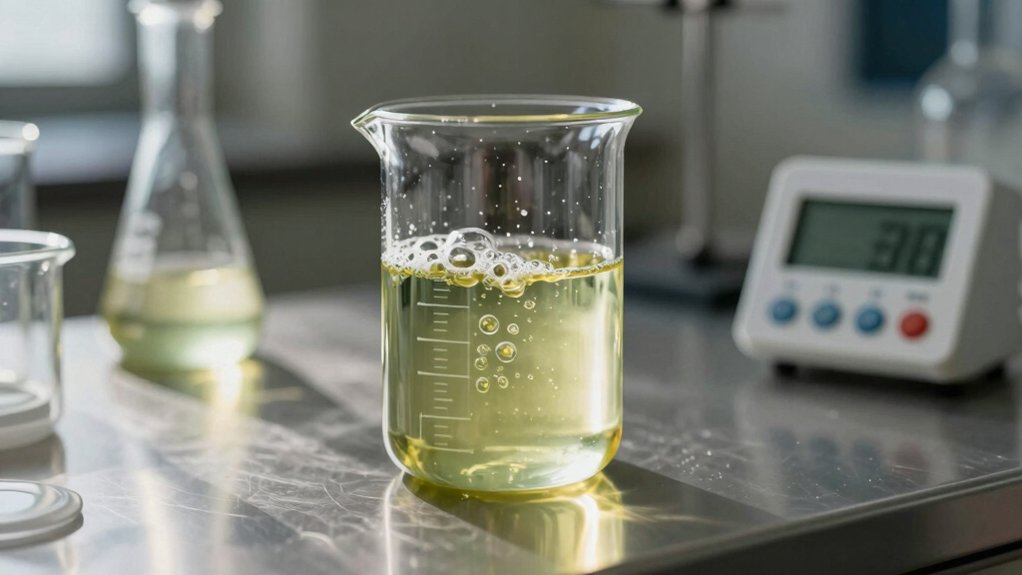
You’ll typically need under 1 minute up to ~20 minutes of contact time with chlorine dioxide to achieve disinfection, depending on concentration, temperature, pH, and organic load. Higher doses (up to ~5 ppm) cut contact time but prolong residual persistence and byproduct risk. Higher pH slows decay while higher temperature speeds reactions.
Use CT (concentration×time) targets and monitor residuals to avoid chlorite/chlorate exceedances. Keep going to see specific CT tables and temperature adjustments.
Quick Overview
- Typical CT targets require contact times from 1 minute (rapid kill) up to 20 minutes depending on microbial log reduction goals and concentration.
- Higher chlorine dioxide concentrations reduce required contact time but increase residual persistence and byproduct risk.
- Warmer temperatures accelerate reactions; they often halve required contact time per ~10°C increase via Arrhenius behavior.
- High pH slows chlorine dioxide decay; this extends residual tail and effective contact duration.
- Industrial reactors aim for ≤6–10 minutes dwell. Portable water systems commonly use 15–20 minutes at standard temperatures.
Residual Concentration vs Time
How long will a chlorine dioxide residual persist in your system? You’ll see an initial rapid decay followed by a slower tail dependent on upstream sourcing, temperature, pH, organic load and initial residual concentration. You’ll monitor to meet regulatory thresholds and avoid exceedances of chlorite/chlorate.
| Factor | Effect | Typical Outcome |
|---|---|---|
| pH (high) | Slower decomposition | Longer tail |
| Temperature ↑ | Faster decay | Shorter persistence |
| Organic matter | Consumptive demand | Reduced residual |
You’ll target up to 5 ppm for wastewater disinfection; higher initial residuals prolong persistence. Continuous monitoring is mandatory because conversion to chlorite/chlorate signals upset conditions and triggers immediate action per regulatory thresholds.
Contact Time Tables
Because effective disinfection depends on both concentration and exposure, contact time tables translate required CT (mg·min/L) targets into practical dosing and dwell times for different applications and temperatures. You’ll use tables to pick dose × time pairs that meet CT targets for potable, industrial, or surface sanitation without guessing.
Tables list conditions (temperature, turbidity), required CT, and matched concentrations with minimum contact minutes. They prevent off topic ideas and unrelated topics from diluting protocol decisions.
- Portable water: 15–20 min at standard temp (CT adjusted per dose).
- Industrial generation: ≤6 min for generation; ≤10 min in tower reactors to avoid degradation.
- Rapid kill uses: 1 min for 5-log bacteria with correct dosing.
Temperature-Dependent Reaction Rates
You’ll see reaction rates accelerate with temperature following Arrhenius behavior. Higher thermal energy lowers effective activation barriers and shortens required contact times. Use the Arrhenius equation to quantify rate constants and predict CT adjustments; since a 10°C rise can often double reaction rates for many redox processes.
Control temperature to manage residual persistence and prevent premature breakdown in concentrated solutions. Keep tower reactor contact times below 10 minutes and storage dilutions cooler to extend usable life.
Reaction Rate Basics
Why does temperature matter for chlorine dioxide’s reaction rates? You’ll see reaction kinetics accelerate with temperature; rate constants typically increase several-fold per 10°C. That means contact time requirements drop: portable treatments moving from near-freezing to ambient reduce dwell from hours to minutes.
You must account for irreversible side reactions that consume available ClO2 at higher temperatures, producing chlorite/chlorate and shortening effective life. In process design, you’ll quantify CT (concentration × time) targets against measured rate constants and incorporate safety margins for regulatory delay in dosing or sampling.
Use empirical decay curves from tower reactors and storage conditions (diluted versus concentrated) to model residual concentration versus time. Calibrate controllers to maintain CT targets under varying thermal loads.
Activation Energy Effects
Having established that reaction kinetics accelerate with temperature and that side reactions consume ClO2, we now quantify how activation energy governs those temperature-dependent rate changes. You’ll assess activation energy as the energy barrier controlling molecular collisions that produce disinfection versus degradation products.
Lower activation energy for target microbial inactivation means faster kill rates as temperature rises. Higher activation energy for competing chlorite/chlorate pathways shifts product distribution with T. You’ll use measured rate constants at multiple temperatures and apply Arrhenius use rigorously to extract activation energies and pre-exponential factors.
From those parameters, you can predict contact time adjustments (CT) across operating temperatures, set conservative dosing margins, and define maximum reactor residence times to avoid excess decomposition while ensuring required log reductions under field thermal conditions.
Arrhenius Equation Use
How does temperature quantitatively alter chlorine dioxide’s reaction rates? You’ll apply the Arrhenius equation, k = A·e^(-Ea/RT), to predict rate constants across temperatures. Use measured Ea for relevant pathways (oxidation, microbial inactivation) to compute k ratios. A 10°C rise often approximates a 2–3× increase; however, compute precisely from Ea.
Fit experimental contact-time data (CT targets) to extract A and Ea. Then model required contact times at different temperatures. Flag subtopic irrelevance when kinetic regimes switch; for example, mass transfer-limited systems should be avoided to prevent applying Arrhenius blindly.
Don’t conflate unrelated topics like residual decay mechanisms. Focus on temperature dependence of intrinsic reaction rates and on translating k(T) into adjusted contact times for achieving regulatory CT values.
Temperature And Residuals
What changes in chlorine dioxide residuals when water temperature shifts? You’ll see reaction rates accelerate with rising temperature: according to Arrhenius behavior, a 10°C increase can roughly double decay rates, reducing measurable residuals faster.
Temperature variability forces you to adjust contact time or dose to maintain target CT and residuals. At low temperatures, decay slows; thus, residual tracking shows prolonged presence but slower microbial kinetics, requiring longer dwell for equivalent inactivation.
Implement routine residual tracking (ppm over time) across temperature bands to quantify loss rates and calibrate dosing models. Use short-interval sampling during rapid temperature transients. Quantify activation energy empirically for your system to convert temperature into predicted residual decay and optimize dosing without over- or under-chlorination.
Practical Temperature Control
Why does temperature control matter so much for chlorine dioxide dosing? You must account for strong temperature dependence: reaction rates accelerate with heat, lowering required contact time and increasing degradation to chlorate/chlorite.
In practice, maintain target temperatures to hit CT targets (for example, EPA CTs at 15°C) and avoid over- or under-dosing. For batch versus continuous systems, you calibrate dosing kinetics differently: batches need strict dwell-time control and rapid dispensing of concentrated solutions; continuous systems can compensate with flow-adjusted feed and PID temperature control.
Monitor solution temperature, residence time, and residuals in real time. Use dilution in storage tanks to extend usable life and automated alarms to prevent thermal excursions that shorten effective contact time or produce byproducts.
Frequently Asked Questions
Is Chlorine Dioxide Safe to Ingest at Residual Levels Over Time?
Yes, at regulated residual levels you can ingest chlorine dioxide safely over time, provided monitoring and limits are met. Chlorine dioxide safety relies on maintaining low residual ingestion concentrations (typically
You should follow local regulations, assure consistent dosing, and monitor chlorite/chlorate byproducts. Chronic exposure above standards increases health risks; therefore, operational controls and routine testing keep long-term residual ingestion within safe bounds.
Can Chlorine Dioxide Remove Chemical Contaminants Like PFAS?
No, chlorine dioxide chemistry won’t remove PFAS effectively. It oxidizes some organic and inorganic compounds; however, PFAS are highly persistent. You should treat PFAS with adsorption (activated carbon), ion exchange, or high-pressure membrane processes.
In water treatment timelines, expect adsorption or ion exchange systems to require contact or column run times and periodic regeneration. Meanwhile, membranes need continuous operation and periodic cleaning. Combine treatments and monitoring for regulatory PFAS targets.
How Does Chlorine Dioxide Affect Taste and Odor of Drinking Water?
You’ll see a quick taste impact: chlorine dioxide oxidizes organics and sulfides, reducing off-flavors without leaving a strong chlorinous taste.
Odor suppression is rapid and measurable. Sulfurous and musty compounds drop substantially at typical dosages (0.2–0.5 mg/L). At higher doses, you’ll get sustained residuals that prevent re-formation of odors. Monitoring CT and residual ensures efficacy while avoiding overdosage that could create secondary byproducts.
Are There Special Precautions for Treating Private Wells?
Yes. You should take special precautions with private wells: test water quality first, isolate and purge the well, and calculate dosing based on volume and demand.
Use appropriate contact time and temperature corrections; avoid exceeding tower-reactor limits. Dispense concentrated chlorine dioxide immediately. Monitor chlorite/chlorate byproducts, maintain residuals in distribution lines, and retest post-treatment.
Keep records and follow local regulations and manufacturer safety guidance.
What Personal Protective Equipment Is Required When Handling Concentrates?
You should wear full protective equipment when handling concentrates: chemical-resistant gloves, splash goggles or face shield, impermeable apron or suit, and closed-toe chemical-resistant boots.
Use a respirator (N95 minimum; P100 or supplied-air for high concentrations) if ventilation is inadequate. Ensure eyewash and safety shower access. Handle concentrates in a fume hood or well-ventilated area.
Follow SDS limits, and monitor for leaks or spills with appropriate containment and neutralization materials.
Conclusion
You’ve seen how chlorine dioxide decay and disinfection depend on residual concentration, contact time, and temperature. Use contact time tables and Arrhenius-based adjustments to predict required exposure: longer t or higher Ct is needed at low temperature or with higher demand.
Quantify reaction rates via k (s–1) and Ea to model residuals over time. Validate with field monitoring. For practical control, keep target residuals and temperature records to ensure consistent microbial inactivation.