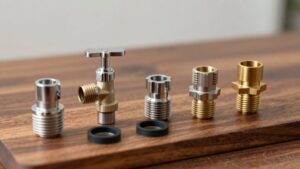
Faucet Aerator Thread Sizes Chart
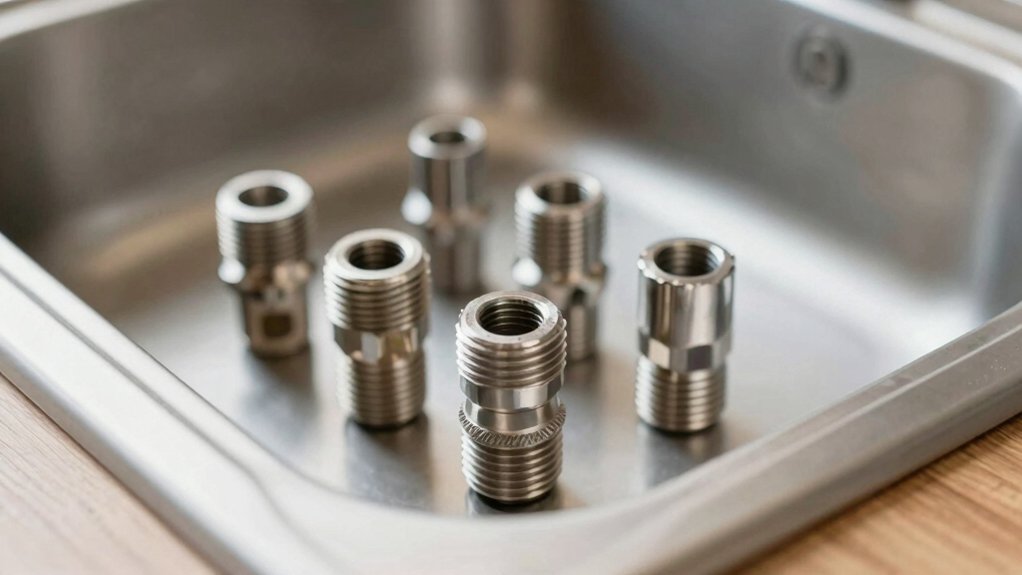
To match a faucet aerator, measure outside diameter for male (external) threads or inside diameter for female (internal) threads. Then confirm pitch: imperial uses TPI (common 55/64″-27 female and 15/16″-27 male); while metric uses millimetres with 1.0 mm pitch (common M22x1, M24x1).
Don’t rely on appearance; verify diameter and pitch and note dual-thread or manufacturer exceptions. Check sealing type (O‑ring, washer, PTFE) and torque for leak-free fit. More specifics follow.
Quick Overview
- Determine male (external) or female (internal) thread first. Measure OD for male and ID for female.
- For imperial aerators, common sizes are 15/16″-27 male and 55/64″-27 female; confirm with TPI.
- For metric aerators, common sizes include M22x1 and M24x1; these typically have 1.0 mm pitch.
- Measure diameter and pitch (TPI or mm) rather than relying on appearance to ensure compatibility.
- Use adapters or dual-thread fittings when sizes or thread forms (metric vs imperial) do not match.
Male/Female Thread Size Chart
How do you tell male from female aerator threads at a glance? You look for external versus internal threads: male threads are external and insert into female receptacles. You’ll use measurements (inch or metric) and thread pitch to confirm fit. Avoid unrelated topic digressions and focus on practical matching for current fixtures and future innovations.
| Thread Type | Typical Size Examples |
|---|---|
| Male | 15/16″-27 (≈23.8mm), 13/16″-27 (≈20.6mm), M16x1 |
| Female | 55/64″-27 (≈21.8mm), 3/4″-27 (≈19.05mm), M22x1 |
Measure OD for male; measure ID for female. Compare to coins or a printed chart. Note dual-thread options and adapter requirements for nonstandard or manufacturer-exception threads.
Common Aerator Thread Standards
Most household faucets use a small set of standardized aerator threads, so you can usually match replacements by checking a few key measurements: thread type (male or female), imperial size with threads-per-inch (commonly 55/64″-27 female and 15/16″-27 male), or metric diameter with 1 mm pitch (typical hidden sizes like 16.5 mm, 18.5 mm, 21.5 mm, 24 mm). You’ll check male vs female, common inch sizes (55/64″-27, 15/16″-27, junior variants) and metric options used in hidden/CACHÉ fittings.
Avoid topic drift to unrelated pairing details like faucet finish or flow rates when identifying threads. Use clear measurements and a physical template or caliper to confirm fit before ordering adapters or replacements.
- Verify thread type (external vs internal)
- Measure OD or ID precisely
- Note TPI for imperial threads
- Check metric diameter and pitch
Metric vs. Imperial Threading
You’ll see two main thread systems on aerators: imperial (inch-based, e.g., 55/64″-27 and 15/16″-27) and metric (millimeter pitches like M22x1, M24x1, and hidden sizes 16.5–24mm with 1.0mm pitch). Identify them by measuring outside diameter and pitch (threads per inch for imperial, millimeters and pitch for metric) or by coin/colour quick checks. Then compare to the chart.
When converting or mixing systems, use dual-thread fittings or the exact-size adapters and verify sealing (washers, tape, or tapered threads) to prevent leaks and ensure proper fit.
Thread Standard Differences
Curious about why some aerator threads won’t mate even when diameters look similar? You’re facing two incompatible standards: imperial (inch) threads with threads-per-inch (TPI) and metric threads with pitch in millimeters. Don’t confuse this with an irrelevant topic or treat it as an unrelated concept. The difference is functional: pitch geometry, helix angle, and crest/root form differ.
Imperial aerators commonly use 27 or 24 TPI; metric uses 1.0 mm or rarer 1.5 mm pitch. That mismatch prevents proper engagement and seals, even at similar OD. You should check both diameter and pitch before pairing or selecting adapters. Using the correct standard avoids cross-threading, leaks, and damaged aerator seats.
Metric Thread Identification
How can you tell whether an aerator uses metric threads instead of imperial ones? You’ll perform metric identification by measuring diameters and pitch: metric aerators use millimetres and typically 1.0mm thread spacing. Remove the aerator if hidden. Then measure the outside diameter (OD) to the nearest 0.5mm. Common hidden aerator sizing includes 16.5mm, 18.5mm, 21.5mm, and 24mm.
Inspect thread pitch with a metric gauge or compare it to an M16x1, M18x1, M21.5×1, or M24x1 standard. Colour-coded inserts (yellow, green, red, grey) often indicate hidden metric sizes. If you find ~22mm OD with 1mm pitch, you likely have M22/M24 metric. If spacing differs (e.g., 1.5mm), note manufacturer exceptions like Moen and source a specific adapter.
Imperial Thread Identification
After checking for metric diameters and a 1.0 mm pitch, verify whether threads are imperial by measuring diameter in inches and counting threads per inch (TPI). You’ll use a caliper to record outside diameter (for male) or inside diameter (for female) and a thread gauge or visual count to confirm -27 or -24 TPI common in faucets.
Note imperial quirks: nominal fractions (55/64″, 15/16″, 13/16″) don’t align neatly to metric millimeters. Therefore, rely on measured inches and TPI rather than names. Don’t assume compatibility based on appearance; compatibility myths persist because similar diameters can have different TPI.
Record male vs female type and standard TPI before selecting adapters or replacements.
Conversion And Compatibility
Why check both diameter and pitch before swapping parts? You’ll avoid mismatches: metric threads use millimeters and 1.0mm pitch commonly, while imperial threads use inches and threads-per-inch (e.g., -27 or -24). When you convert, measure outside diameter and thread spacing, not just visual fit.
Use two word discussion ideas like “diameter accuracy” and “pitch matching” to focus checks. Remember standard regular 55/64″-27 ≈ 22mm×1 and many metric aerators are M22×1 or M24×1. Some parts are interchangeable; others need adapters.
Dual-threaded aerators provide faucet compatibility for male/female mixes. For uncommon spacing (Moen 1.5mm) or odd sizes, use dedicated adapters or replacement aerators sized to exact measurements.
Sealing And Fit Considerations
Which seal type will actually stop leaks depends on whether your aerator uses metric or imperial threads. You’ll select a gasket, O-ring, or tape based on thread form and pitch. Metric Mx1 threads often seal with a thin rubber O-ring; inch 27 threads commonly use PTFE tape or a flat washer.
Check sealant compatibility with plating and elastomer materials to avoid swelling or degradation. Match male/female seating faces. Dual-threaded aerators may need one sealing method for the outer thread and another for the inner.
Control installation torque: over-torquing crushes gaskets and strips threads; under-torquing leaks. Use calibrated torque or firm hand-tight plus quarter-turn guidance. Test under pressure after installation for a secure, leak-free fit.
Frequently Asked Questions
Will My Aerator Adapter Affect Water Pressure or Flow Rate?
Yes, your aerator adapter can change pressure and flow. If you use an adapter that keeps aerator compatibility and follows proper thread standardization, you’ll preserve designed flow restrictions. Mismatched or narrow adapters may add backpressure, reduce flow, or cause turbulence.
Also, note adapter-mounted flow restrictors or dual-threaded units alter GPM. Measure threads and choose correct adapters to maintain intended hydraulic performance. This will help avoid leaks or flow loss.
Can I Replace a Vandal-Proof Aerator Without Special Tools?
Yes, you can sometimes replace a vandal-proof aerator without special tools, but it depends. You’ll need to inspect the fastener type; some use a concealed hex or rectangular slot requiring a matching key or bit.
For true tool-free replacement, look for twist-off or snap-in vandal-proof cartridges designed for tool-free aerator installation. If not, use the manufacturer’s key or a proper adapter to avoid damage during aerator installation.
Do Aerator Sizes Change With Faucet Manufacturers Over Time?
Yes, aerator sizes can shift as manufacturers update designs. You’ll see aging faucets with deprecated threads; there are manufacturer variations across eras, regions, and product lines. You should measure thread diameter and pitch rather than assume compatibility.
You’ll encounter dual-thread adapters or metric variants, hidden/vandal-proof exceptions, and occasional nonstandard spacings (e.g., Moen). Keep spare adapters and channeled measurements to ensure precise replacements.
Are There Universal Adapters for Mixed Metric and Imperial Threads?
Yes, you can use universal adapters for mixed threads, but they’re not truly one-size-fits-all. You’ll find dual-threaded adapters and metric-imperial converter rings that handle common combos (55/64″ ↔ 22mm, 15/16″ male options).
They work for standard and junior sizes; however, exceptions exist (Moen 1.5mm spacing, vandal-proof shapes). Measure threads, pick the correct converter, and expect to use sealant or tape for reliable, leak-free joins.
How Do I Identify Internal Hidden Aerators Without Removing Them?
You can identify hidden aerators without removing them by performing an internal inspection with a flashlight and inspection mirror or borescope. Look for a recessed screen, keyed slots, or colored plastic indicators (yellow, green, red, grey).
Measure visible throat diameter with calipers or compare to coin sizes. Note any tamper-proof pinholes or rectangular openings indicating CACHÉ or vandal-proof types. Record dimensions for correct adapter selection.
Conclusion
You now know how male and female aerator threads pair. You also understand which common standards (M/metric and BSP/UN/imperial) you’ll encounter, and how metric and imperial threading differ. Use pitch, diameter, and thread form to identify standards. Check conversions and adapter availability before buying.
Prioritize correct sealing; washers, O-rings, and tapers affect fit more than nominal size. With precise measurement and the right adapter, you’ll ensure a leak-free, compatible aerator installation.