Chlorine Vs Chloramine in Tap Water
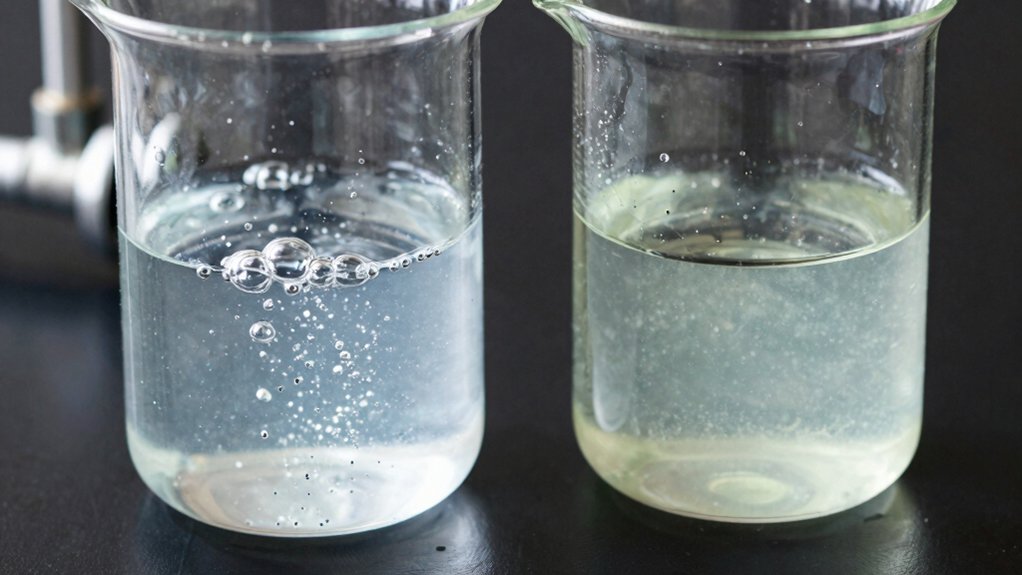
You’ll get stronger, short-lived oxidizing residuals with chlorine and longer-lasting, steadier residuals with chloramine.
Utilities keep free chlorine often 0.5–3.5 mg/L and chloramine near 1.5–2.5 mg/L to balance microbial control and taste.
Chlorine yields more volatile THMs and HAAs quickly; this is driven by NOM, pH, temperature and bromide.
Meanwhile, chloramine reduces THMs but raises nitrogenous DBP risks like nitrosamines under long residence times.
Keep monitoring source chemistry and distribution residuals to manage DBP profiles. More technical details follow.
Quick Overview
- Chlorine provides rapid, strong disinfection but decays quickly; it often causes a noticeable chlorinous odor and metallic taste.
- Chloramine produces a longer-lasting residual in distribution systems with milder, subtler taste and odor impacts.
- Chlorine forms higher levels of regulated THMs and HAAs, especially with high NOM and bromide concentrations. Chloramine reduces THMs/HAAs but increases nitrogenous byproducts (e.g., NDMA) that are more persistent and harder to remove.
- Utilities balance residuals, MRDLs, and source chemistry when choosing disinfectant to control microbes and minimize harmful byproducts.
Residual Levels Comparison
How do residual disinfectant levels compare in distribution systems? You’ll find free chlorine typically measures 0.5–3.5 mg/L at taps, but it decays rapidly. Utilities report minimums around 0.2 mg/L and running averages up to 4.0 mg/L.
Chloramine averages ~1.5–2.5 mg/L (≈2.0 mg/L) and holds above the >1.0 mg/L threshold needed for control. This demonstrates notable chloramine stability and reduced biofilm formation.
| Parameter | Typical Range |
|---|---|
| Free chlorine (tap) | 0.5–3.5 mg/L |
| Reported minimum/avg | 0.2 mg/L min; up to 4.0 mg/L avg |
| Monochloramine | 1.5–2.5 mg/L (avg ~2.0) |
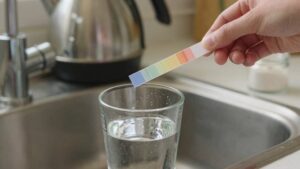
Measure with DPD/iodometric/amperometric methods. Expect substantial decay for free chlorine versus near-constant chloramine residuals.
Maximum Allowed Residuals
Why do regulators set specific maximum residual limits for disinfectants in distribution systems? You need limits to balance microbial safety with chemical exposure risks: limits prevent suboptimal disinfection and minimize harmful byproduct formation.
Regulatory frameworks (e.g., EPA) specify maximum residual disinfectant levels (MRDLs) for chlorine and chloramine, informed by toxicology and exposure data. You should note practical considerations:
- Monitoring frequency and sampling locations to ensure residuals remain above minimums but below MRDLs.
- Instrumentation accuracy and calibration requirements to reliably assess taste comparison and odor perception thresholds alongside chemical concentrations.
- Operational controls (dose, contact time) to maintain consistent residuals without exceeding health-based limits.
You’ll apply these limits to optimize public health protection and maintain consumer acceptability.
Breakdown: Byproduct Formation
When you compare chlorine and chloramine, focus on the specific disinfectant byproducts they form and the chemical pathways that generate them. Chlorine reacts rapidly with natural organic matter to form trihalomethanes (THMs) and haloacetic acids (HAAs).
Chloramine tends to produce lower THM/HAA levels but creates nitrosamines and other nitrogenous DBPs via reactions with ammonia and organic precursors. You’ll need to consider precursor concentration, reaction time, and water chemistry to predict which byproducts will dominate.
Disinfection Byproduct Types
What forms when disinfectants meet organic matter depends on the chemistry of the disinfectant and the composition of the source water. You’ll see distinct DBP classes: trihalomethanes (THMs), haloacetic acids (HAAs), nitrosamines (e.g., NDMA), chlorinated phenols, and chloramines-derived N-DBPs.
Chlorine favors volatile carbon-halogen DBPs like THMs and HAAs; chloramine suppresses those but forms more nitrogenous DBPs, including NDMA and chlorinated aminated byproducts. Each class has different physicochemical properties, health endpoints, and removal challenges. Taste odor and consumer perception often correlate with volatile THMs and chlorinated phenols rather than low-volatility N-DBPs.
You should evaluate DBP speciation against regulatory limits, treatment goals, and distribution residence time to choose disinfection and mitigation strategies.
Trihalomethane Formation Pathways
Building on how different disinfectants favor distinct DBP classes, trihalomethane (THM) formation pathways describe the specific chemical reactions by which free chlorine converts natural organic matter (NOM) into volatile carbon-halogenated species. You should understand that hypochlorous acid (HOCl) and hypochlorite (OCl–) electrophilically halogenate activated aromatic and aliphatic sites on NOM, producing chlorinated precursors that undergo oxidative cleavage and rearrangement to yield chloroform, bromodichloromethane, dibromochloromethane, and bromoform.
Reaction kinetics depend on pH, temperature, chlorine dose, and bromide concentration; higher pH favors substitution over addition, altering speciation. Monitor taste comparison and odor dynamics since THM volatility influences sensory detection and off-gassing during boiling or aeration. This informs mitigation and sampling strategies.
Haloacetic Acid Production
Haloacetic acids (HAAs) form when disinfectants like free chlorine or chloramine react with natural organic matter (NOM), yielding a suite of mono-, di-, and trihaloacetic species through electrophilic substitution, oxidation, and cleavage pathways. You should expect reaction rates and speciation to depend directly on disinfectant type, dose, contact time, pH, temperature, and ambient bromide levels.
You’ll find free chlorine generally produces higher total HAA concentrations faster due to stronger electrophilic chlorination. In contrast, chloramine yields lower initial HAAs but can produce different speciation over prolonged contact. Monitoring data show HAA formation correlates with dissolved organic carbon and bromide; it shifts toward bromo-HAAs with elevated bromide. Regulatory control and treatment adjustments affect consumer perception and can interact with taste preference, even when HAA levels remain below health-based limits.
Nitrosamine Formation Risks
The same chemistry that governs HAA formation also influences nitrosamine risks, because both arise from reactions between disinfectants and organic or inorganic precursors under conditions set by dose, contact time, pH, temperature, and bromide or nitrite presence.
You should know chloramine, particularly monochloramine, has a higher propensity than free chlorine to form nitrosamines (e.g., NDMA) when secondary amines or nitrite are present. Formation kinetics are favored at higher pH and longer distribution residence times; catalytic surfaces and chloramine decay increase precursor conversion.
Analytical detection requires low‑ppt sensitivity and isotopic standards. From a utility standpoint, control options include precursor reduction, nitrite management, and optimized chloramine dosing.
Be aware nitrosamine risks aren’t tied to taste implications or odor perceptions; sensory cues don’t indicate contamination.
Reaction With Organic Matter
How do chlorine and chloramine interact with natural organic matter (NOM) in treated water to produce byproducts? You should know that chlorine reacts rapidly with NOM, generating a broad suite of halogenated disinfection byproducts (DBPs) such as trihalomethanes and haloacetic acids. Formation is driven by NOM character, chlorine dose, and contact time.
Chloramine yields fewer regulated DBPs but favors formation of nitrogenous byproducts, including nitrosamines, especially from amino-nitrogen precursors. You’ll assess DBP speciation by measuring precursor concentrations, oxidant type, and reaction kinetics.
Don’t treat this as an unrelated topic or a random aside: these mechanistic differences determine monitoring priorities, regulatory compliance, and treatment choices. Control strategies must target precursor removal and appropriate oxidant selection to minimize harmful byproducts.
Influence Of Water Chemistry
Why does water chemistry so strongly steer disinfection byproduct (DBP) formation when you switch between chlorine and chloramine? You must consider precursor concentration, pH, temperature, and bromide/iodide presence: higher natural organic matter and bromide favor brominated DBPs with chlorine. Chloramine shifts speciation toward nitrogenous DBPs like NDMA.
pH alters reaction kinetics; chlorine-driven halogenation accelerates at higher pH. Chloramine stability increases at neutral to slightly alkaline pH, extending contact time. Temperature and residence time amplify formation.
These chemical controls also influence consumer-experienced taste comparison and odor impact: chlorine reactions yield stronger chlorinous odor and metallic taste. Chloramine often produces subtler taste changes but more persistent nitrogenous byproducts.
You should monitor source water chemistry to predict and manage DBP profiles.
Frequently Asked Questions
Do Home Pitchers Remove Chloramine Effectively?
No, standard home pitchers don’t remove chloramine effectively. You should use home filtration with catalytic carbon or reverse osmosis plus catalytic prefilter to reduce chloramine. Ordinary activated-carbon pitcher cartridges have limited effectiveness and minimal taste impact.
For reliable chloramine removal, choose systems specifying catalytic carbon contact time, proper sizing, and validated test data. Otherwise, you’ll see persistent chemical taste and incomplete contaminant reduction.
Can Chloramine Cause Skin or Eye Irritation?
Yes, chloramine can cause skin irritation and eye irritation in some people. You’ll see reported symptoms like redness, itching, or dryness after showering or swimming in chloraminated water.
Evidence indicates sensitive individuals, those with respiratory conditions, or with compromised skin barriers are more likely to be affected. Reducing exposure with shower filters containing catalytic carbon, limiting contact time, or consulting a clinician can help manage persistent or severe reactions.
Are Fish or Aquarium Pets Affected by Chloramine?
Yes, chloramine harms fish and aquarium pets. You should prioritize fish health and pet safety because chloramine is toxic and persists longer than chlorine. It binds ammonia, releasing toxic compounds that damage gills, impair respiration, and stress aquatic life.
Use catalytic carbon, reverse osmosis with catalytic prefilter, or validated dechloraminating conditioners; allow appropriate contact time to neutralize chloramine before introducing water to tanks.
Is Chloramine Safe for Dialysis Patients?
No, Ischloramine safety is a significant concern. Dialysis considerations require removal of chloramine before treatment. You need dialysis water systems with catalytic carbon or specialized dechlorinators and routine monitoring. Chloramine can cause hemolysis and methemoglobinemia in patients.
Facilities must follow AAMI standards, perform regular residual testing, and maintain service protocols. You should never connect untreated municipal water directly to dialysis equipment.
How Do I Remove Chloramine for Brewing or Cooking?
Use catalytic carbon or reverse osmosis with catalytic prefiltration to remove chloramine for brewing water. These methods break the chloramine bond and avoid flavor impacts. Boiling or standard activated carbon won’t reliably eliminate chloramine.
You can also chemically neutralize chloramine with campden tablets (sodium metabisulfite) at controlled doses as a practical, evidence-based chlorine alternative for brewing and cooking. This ensures proper contact time and dosage monitoring.
Conclusion
You should expect chlorine to leave higher free residuals; however, it forms more regulated trihalomethanes and haloacetic acids when organic matter is present. Chloramine typically yields lower regulated DBP levels; yet, it can produce nitrosamines and persistent combined residuals that react differently with distribution system chemistry.
Choose treatment and monitoring based on target residuals, local organic nitrogen content, and temperature/pH. Continuous, targeted monitoring and bench-scale DBP formation tests will give the most reliable, site-specific guidance.