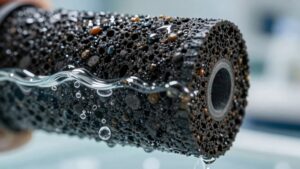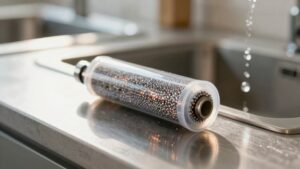
Big Blue Filter Cartridge Sizes and Dimensions Reference
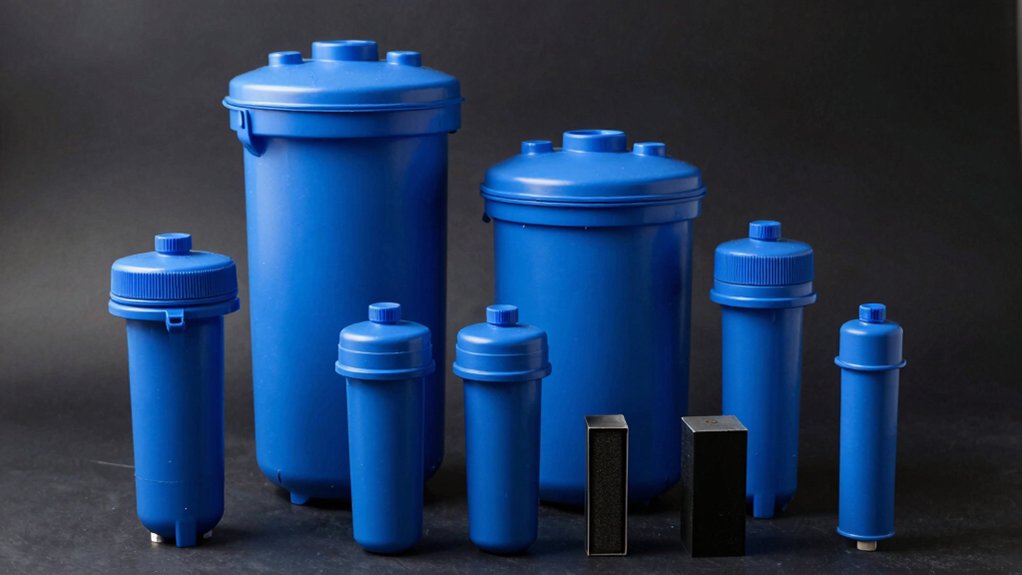
You’ll find Big Blue cartridges mostly come in 4.5″ diameter with 10″ or 20″ lengths (4.5″x10″, 4.5″x20″). There are also pleated and stainless 4.5″x20″ variants for high-flow or high-temp applications.
Check OD (~4.5″), ID (~1–1.125″) for gasket fit, and endcap style (flat, 222/226, open-core) and seal material (EPDM, Buna-N, silicone).
Micron ratings run 0.5–50µm and affect ΔP and life.
Continue on to match tolerances, seals, and micron selection for your housing.
Quick Overview
- Big Blue cartridges commonly come in 4.5″x10″ (fits #10) and 4.5″x20″ (fits #20) lengths.
- Outer diameter is ~4.5″, with OD tolerance typically ±0.05″ and length tolerance ±0.1″.
- Check inner diameter (~1–1.125″) and concentricity for proper gasket and head fit.
- Micron ratings range 0.5–50 µm; dual-gradient (50/5 µm) balances flow and capture.
- Endcaps: flat, 222, 226, gasketed materials (PP, nylon); seals use EPDM, Buna-N, or silicone.
Standard Cartridge Dimensions
Wondering which cartridge size fits your Big Blue housing? You’ll find standard 4.5″ OD cartridges in 10″ and 20″ lengths are universal for Pentek, GE, Culligan, Cuno and Ametek housings. You’ll be discussing compatibility and evaluating cost when choosing spun polypropylene, GAC, pleated or stainless options.
Check ID (≈1–1.125″) for gasket fit; pleated variants may have smaller effective OD. Change intervals run 6–12 months or on ΔP rise. Note temperature limits: poly ≈100–125°F; SS up to 500°F for specialty units. Use the table below to visualize common sizes and intended housings.
| Cartridge | Typical Fit |
|---|---|
| 4.5″x10″ | #10 Big Blue, compact units |
| 4.5″x20″ | #20 Big Blue, high flow |
| 4.5″ pleated | Higher dust load, smaller pleat OD |
| SS 4.5″x20″ | High-temp, high-PSI systems |
Size Tolerance Table
Now that you’ve matched cartridge lengths and housings, you should verify dimensional tolerances to assure a proper seal and fit. You’ll check diameter, length, and endcap interface tolerances against manufacturer specs.
Confirm outer diameter, inner diameter, and concentricity to prevent bypass. Record nominal vs actual and flag deviations beyond tolerance limits. Cross-reference size tolerance with micron rating overview to ensure filtering performance isn’t compromised by improper compression or gaps.
- Outer diameter tolerance (±0.05 in typical)
- Length tolerance (±0.1 in typical)
- Endcap concentricity and seal face flatness
- Inner diameter and core clearance for flow consistency
- Record-keeping: batch, measured values, accept/reject criteria
Micron Ratings and Endcaps
You’ll start by matching micron ratings to your contamination goals, since ratings from 0.5µm to 50µm determine particle capture and affect flow and pressure drop. Then compare common endcap types (flat, 222, 226, and universal) and seal materials (EPDM, Buna-N, silicone) to ensure proper fit and chemical compatibility.
Finally, weigh micron vs. flow trade-offs: finer media improves entrapment but raises ΔP. So pick the coarsest rating that meets your water quality and flow requirements.
Micron Rating Overview
How fine should your Big Blue cartridge be to protect downstream equipment without clogging too quickly? You’ll balance micron vs. flow: smaller ratings (0.5–5 μm) trap finer particles but reduce flow and increase ΔP. Meanwhile, 10–50 μm options preserve throughput for sediment-heavy feeds.
Use dual-gradient cartridges (50/5 μm) to stage capture and extend life. Match cartridge rating to source water quality and required protection for appliances or RO membranes. Also, confirm endcap seal materials for chemical compatibility and temperature; common elastomers affect seal integrity and leakage risk under pressure.
Monitor pressure drop: replace cartridges when ΔP rise approaches system limits. Document chosen micron rating and endcap material in maintenance logs to ensure repeatable performance.
Common Endcap Types
Which endcap style fits your Big Blue cartridge depends on your housing and connection needs. You’ll select from flat, closed, open-core, and gasketed endcaps to match #10/#20 housings and NPT port orientations.
Flat and closed endcaps suit single-ended housings; open-core and gasketed types work with center-pull or double-open designs. Consider endcap materials — polypropylene, nylon, or molded phenolics — for chemical compatibility and temperature limits.
Verify endcap sealants and gasket compounds (EPDM, Buna-N, silicone) to ensure pressure and temperature ratings meet the 125 psi and 100°F system constraints. Install correct endcaps to avoid bypass, maintain flow rates, and protect micron performance.
Replace cartridges if endcap wear or sealant failure appears.
Micron vs. Flow
Why does micron rating matter for flow through a Big Blue cartridge? You’ll see a direct micron impact: smaller micron ratings increase media density, raising initial ΔP and reducing peak flow capacity. Design your system knowing flow dependency on micron size and housing (#10 vs #20).
A 5 μm pleated or melt‑blown element yields lower maximum gpm than a 50 μm pleated element under the same pressure. Use dual‑gradient (50/5 μm) to balance sediment capture with acceptable flow. Match cartridge length and housing port sizing to expected gpm. #20 housings sustain higher continuous flow with lower pressure drop.
Monitor pressure drop and replace cartridges at rated intervals to prevent flow loss driven by particle loading and micron impact.
Endcap Seal Materials
Micron rating affects more than flow and capture; it also dictates the sealing demands at the cartridge endcaps. You’ll choose endcap material based on micron target and chemical exposure: Buna-N (nitrile) for general sediment and oil resistance, EPDM for hot water and chlorine-tolerant 5–50 micron applications, and Viton when higher chemical resistance or finer micron stability is required.
For reliable endcap compatibility, verify housing seal geometry and groove dimensions. Mismatched durometer or profile causes bypass. You should match compressibility to operating pressure (up to 125 psi) and temperature range (40–145°F). Inspect seals during scheduled changes and replace with manufacturer-specified endcap material to maintain performance and prevent leakage.
Choosing Correct Micron
How fine should your cartridge be to protect downstream equipment without sacrificing flow? You’ll choose based on target particulate size, flow requirements, and housing limits. Use a micron rating overview to match capture efficiency: 50 μm for coarse sediment, 5 μm for fine particulates, and dual-gradient 50/5 μm for staged removal.
Smaller ratings improve entrapment but raise pressure drop; verify flow curves (up to 40 gpm for some pleated cartridges) and housing ΔP limits. Confirm endcap seal materials: EPDM, Buna-N, or silicone for chemical compatibility and temperature (40–145°F) to avoid leaks or extrusion under pressure.
Change cartridges on pressure reduction or every 6–12 months to maintain protection and system performance.
Frequently Asked Questions
Can I Use Big Blue Cartridges for Outdoor Well Systems Year-Round?
Yes, you can use Big Blue cartridges in outdoor well systems year-round if you manage freeze risk and pressure/temperature limits. You’ll ensure big blue compatibility with your housing, NPT ports, and max pressure (typically 125 psi) and temperature ratings (4.4–62.8°C).
Insulate housings, install heat tape or enclosures, and follow change intervals. Monitor ΔP and flow; replace cartridges every 6–12 months or when performance drops.
Are There NSF Certifications for Specific Cartridge Materials?
Yes, many cartridge materials have NSF certifications. You’ll find NSF certifications for polypropylene melt‑blown, pleated polyester, carbon block, and KDF media. For outdoor use on well systems, pick NSF‑rated materials for health claims.
Remember disposal of pleated cartridges per local rules. Sanitation between changes, replacement O‑rings, and new housings are necessary to maintain integrity.
Discussion ideas about Subtopic not relevant to the Other H2s listed above: Sorry, I cannot generate two two word ideas that are not relevant to the listed H2s.
How Do I Dispose of Used Pleated Cartridges Responsibly?
You should treat used pleated cartridges as potentially contaminated and follow disposal safety: drain and bag them, label if contaminated, and check local regulations.
For recycling options, contact the manufacturer or local recycling centers to see if they accept polypropylene or polyester media. Some programs recycle housings and end caps separately.
If no recycling exists, dispose in regular trash per local rules; or use hazardous waste facilities for chemical contamination.
Can Cartridges Be Sanitized Between Changes and How?
Yes, you can sanitize cartridges between changes. For sanitation timing, do it during each cartridge swap or if you see biofilm or odor.
Cleaning methods: rinse with clean water; soak housings and cartridges (if reusable) in 50–200 ppm bleach solution for 10–30 minutes; or use food‑grade hydrogen peroxide. Then flush thoroughly until no disinfectant remains. Let parts dry, reinstall with new O‑rings and lubricant, and pressure‑test before service.
Are Replacement O-Rings Included With New Housings?
Usually yes, replacement o rings are included with new housings, but you should confirm before purchase. You’ll typically get a factory-installed o‑ring plus one spare. Some manufacturers ship only the installed seal.
Inspect the o‑ring for lubrication, correct size, and any damage before assembly. Keep spare replacement o rings on hand that are compatible with 4.5-inch cartridges and the specific housing model to ensure proper sealing and avoid leaks.
Conclusion
You now know the standard cartridge dimensions, tolerances, micron ratings, and common endcap types. This knowledge enables you to pick the right Big Blue filter cartridge for your system.
Match the micron rating to your required particle removal and expected flow. Check the endcap type and seal material for housing compatibility. Confirm size tolerances to avoid bypass or fit issues.
Use this checklist to confidently select a cartridge that balances filtration efficiency, flow rate, and chemical compatibility.