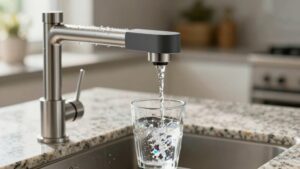
Whole House Vs Faucet Filter Differences
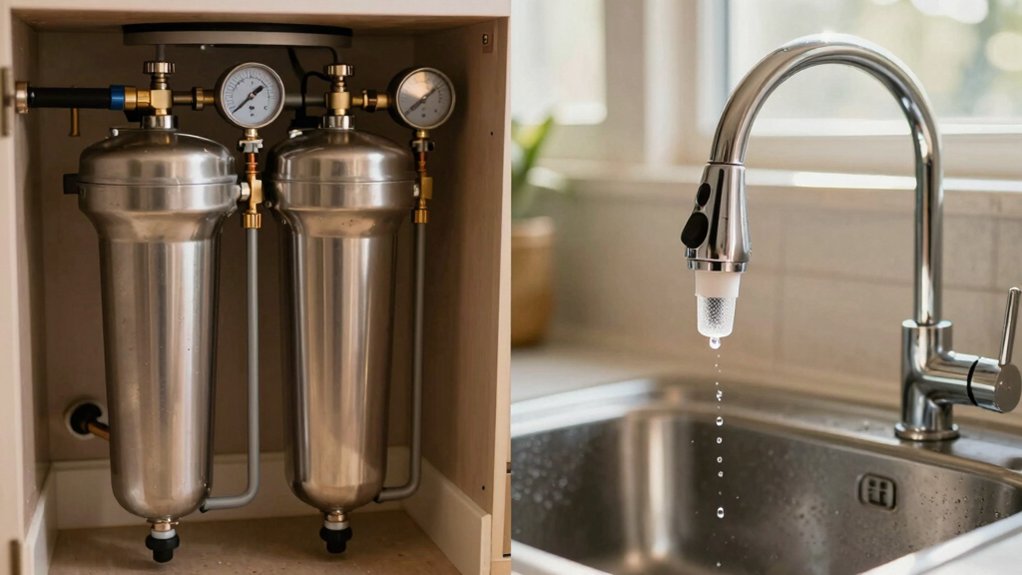
You’ll pick a faucet filter for low-cost, point-of-use removal at a single tap, accepting reduced flow (30–50% drop) and shorter cartridge life. It’s compact and easy to install under a sink.
Choose a whole-house system when you need certified contaminant control for all fixtures. It offers high continuous flow (10–20 GPM), longer service life (up to 100k–1M gallons), and more installation space and maintenance access.
Keep going to see detailed trade-offs and specs.
Quick Overview
- Whole-house systems treat all water at the entry point for consistent filtration across showers, appliances, and multiple fixtures.
- Faucet filters install at individual taps and protect only that outlet, leaving the rest of the house untreated.
- Whole-house units handle 10–20 GPM with minimal pressure loss; faucet filters typically reduce flow 30–50% at the tap.
- Whole-house cartridges last far longer (up to 100,000–1,000,000+ gallons or ~10 years) than faucet filters, lowering lifecycle cost.
- Whole-house systems require significant space, shutoffs, and service clearance. Faucet filters need minimal under-sink or faucet compatibility.
Flow Rate & Lifespan Chart
Start with the flow-rate numbers: whole-house systems typically deliver 10–20 GPM with minimal pressure loss. Faucet filters cut flow by about 30–50%; this creates a noticeable bottleneck at the tap. You’ll choose whole-house if you need high flow durability across showers, appliances, and simultaneous fixtures. The system sustains performance when properly sized.
Faucet filters give localized filtration but reduce delivery and don’t protect plumbing. Lifespan favors whole-house: many systems reach 100,000–1,000,000 gallons or 3–10 years. This lowers replacement frequency and lifecycle cost. Match capacity to household peak demand and maintenance schedules to preserve pressure and filtration efficacy.
| Item | Typical Value |
|---|---|
| Flow (Whole-house) | 10–20 GPM |
| Lifespan | Up to 1,000,000 gal / 10 yrs |
Micron Ratings & Certifications
Flow rate and lifespan affect how often filters must be changed and whether a system maintains particle removal over time. You should next examine micron ratings and certifications to verify performance claims. You’ll compare rated particle sizes, validated reduction percentages, and third-party test reports against your flow rate and lifespan chart to match capacity with needs.
- Check micron ratings: Lower microns indicate finer particulate removal; confirm manufacturer test conditions and real-world flow rate impacts.
- Verify certifications: NSF/ANSI standards (e.g., 53, 42, 401) indicate tested contaminant reductions; look for report IDs.
- Assess trade-offs: Finer micron media often reduces flow and shortens lifespan; consult lifespan chart for replacement intervals.
- Demand documented evidence: Lab reports, pressure-drop data, and warranty terms support claims.
Installation Space Requirements
You’ll need to assess available space at the main entry point because whole house systems require a dedicated footprint and vertical clearance in garages, basements, or crawlspaces.
Under-sink and faucet filters have minimal footprints but can’t fit spray-style or pull-out taps. You should measure cabinet depth and pipe routing before purchase.
Also consider pipework routing complexity and access for maintenance: tight ceiling joists or long runs increase installation time and cost.
Space Needed At Entry
How much room do you need at the main water entry point for a whole-house filter? You’ll need to evaluate space requirements and entryway routing before purchase. Measure clearance for the filter body, bypass valve, pressure gauge, and service access. Typical single-canister systems require 18–30 in vertical and 8–12 in lateral clearance; multi-stage systems need 36–60 in vertical and extra depth.
Allow 6–12 in clearance for wrench access and panel removal. Confirm routing for incoming and outgoing mains, shutoffs, and condensate/drain lines. Maintain straight pipe runs of at least 6–12 in for fittings. Verify overhead or wall mounting points and local code access for installers.
Plan for service space to replace cartridges without relocating piping.
Under-Sink Footprint
Where will the under-sink filter sit and how much clearance will you need for installation and service? You’ll measure the under sink footprint to confirm the available installation space: depth, width, and vertical clearance from the cabinet floor to the sink pan and disposal.
Typical single-cartridge housings require 10–15 inches height and 4–6 inches diameter; multi-stage systems need 18–24 inches and 12–18 inches lateral space. Allow 2–4 inches clearance for inlet/outlet fittings and 3–6 inches front clearance to remove cartridges. Verify space for a wrench, shutoff valves, and tubing runs to the faucet.
Document measurements and compare with manufacturer specs. Inadequate under sink footprint increases installation time, risk of improper service access, and potential for leaks.
Ceiling And Crawlroom Access
Need ceiling or crawlspace access? When evaluating whole house versus faucet filters, you’ll need realistic installation space planning. Whole house units are typically installed near the main shutoff and often require ceiling access or crawlspace access to route supply and return lines, mount brackets, and provide service clearance.
You’ll want unobstructed access panels, stable mounting surfaces, and enough room to isolate the main line during installation. Faucet filters avoid those constraints; they attach at point-of-use and don’t require ceiling access or crawlspace access. Inspect existing piping run locations and measure reachable distances before committing.
Evidence from installer guides shows restricted access increases labor time and cost. Plan for accessible routes to minimize disruptions and ensure compliant plumbing work.
Vertical Clearance Requirements
When planning installation, account for vertical clearance above and below the whole house unit so you can remove and replace cartridges, service valves, and mounting brackets without obstruction. You’ll need clearances specified by manufacturers: typically 12–36 inches above filter housings for cartridge removal and wrench use. Measure ceiling access and nearby obstructions like joists, ductwork, or water heaters before placement.
Verify floor mounting and room height to ensure filter heads and bypass valves remain reachable for shutoff and maintenance. Provide service space for future upgrades and replacement canisters; insufficient height clearance forces awkward disassembly or relocation. Document required clearances on your plumbing plan and confirm with the installer to avoid rework, service interruptions, or unsafe maintenance conditions.
Pipework Routing Complexity
How will the house piping need to be rerouted to accommodate a whole house filter? You’ll often need to interrupt the main supply line, install shutoffs, bypass valves and a mounting manifold, and reconfigure branch feeds so the filter precedes all downstream fixtures.
Pipework routing must follow code for slope, support, and freeze protection; that frequently means rerouting in basements, crawlspaces, or utility closets to provide straight runs and minimize fittings.
Plan installation access for filter housing, valves, and pressure gauges: technicians need clear working space for isolation, depressurization, and future servicing. Evidence from plumbing best practices shows that poorly planned routing increases leak risk and service time.
Budget for professional layout and potential relocations of adjacent utilities to meet access and routing constraints.
Filter Replacement Clearance
Why will you need clear working space around a whole house filter? You need access to change cartridges, inspect seals, and service valves; manufacturers specify minimum clearance for safe filter replacement. In tight basements or garages, clearance constraints can prevent proper removal of housings or use of filtration tools, increasing labor time and risk of damage.
Plan a service envelope that accommodates the largest cartridge length and wrench clearance, plus 50–100 mm for hand access. Compare this to faucet filters, which require negligible space and minimal disassembly. Documented installation guides and local codes often mandate access routes and shutoff valve locations.
Design for maintenance: sufficient clearance reduces replacement time, lowers plumber costs, and maintains performance by enabling correct, uncontested filter replacement.
Frequently Asked Questions
Do Whole House Filters Remove Chlorine Taste and Odor for Showers?
Yes, a properly sized whole house filter will reduce chlorine; it improves taste and removes shower odor. You’ll want a system with activated carbon or catalytic carbon media rated for chlorine reduction and sized for your flow rate and chlorine load.
Performance depends on contact time, media quality, and maintenance. Replace media per manufacturer specs. Test post-installation to verify chlorine reduction and expected taste improvement in shower water.
Can Faucet Filters Handle Ice Maker and Refrigerator Water Lines?
Yes, you can, but it’s limited. If your smart faucet or ice maker draws from the faucet you’ve fitted, a faucet filter will treat that water. However, most refrigerator ice maker lines branch at the main or under-sink supply and bypass faucet-mounted filters.
You’ll need a dedicated inline or under-sink point-of-use filter installed on the ice maker or refrigerator feed to guarantee certified contaminant reduction and consistent flow without compromising ice production.
How Do Filters Affect Water Pressure for Lawn Irrigation Systems?
Filters can reduce irrigation pressure if flow capacity or clogging restricts throughput. You’ll see small drops with fine media; significant loss indicates undersized units or blocked elements.
Monitor filter life and follow maintenance schedules to prevent buildup and pressure loss. Use pressure-rated, high-flow models and install bypass or parallel filters for large systems.
Regular testing quantifies head loss and guides replacement intervals to maintain designed sprinkler performance.
Are There Health Benefits for Babies From Whole House Filtration?
Yes, whole house filtration can benefit baby health by reducing contaminants in all water used for drinking, formula, bathing, and cleaning. Whole house filtration lowers chlorine, heavy metals, and organics that can irritate skin, lungs, and developing systems.
You’ll reduce dermatitis and ingestion risks; protect appliances; and limit chronic low-dose exposures. Choose certified systems and test water pre/post-installation to quantify contaminant reductions and ensure/guarantee efficacy for infants.
What Warranty and Service Options Come With Each Filter Type?
You get different warranty options and service plans for each. Faucet filters usually include short manufacturer warranties (90–365 days) and limited service plans; replacements and DIY repairs are your responsibility.
Whole house systems often offer longer warranties (1–10 years) and professional service plans covering installation, maintenance, and filter replacement. Examine terms for parts, labor, prorated coverage, and required service schedules to keep warranties valid. Ensure documented performance.
Conclusion
You’ll choose based on needs: whole-house filters give higher flow rates, longer life, and broader micron reduction with certified performance. However, they demand entry-point space, vertical clearance, and more complex piping access in ceilings or crawlspaces.
Faucet/under-sink units need minimal clearance, simple routing, and smaller footprints. They have lower flow, shorter cartridge life, and limited micron capability. Match certification and replacement access to your site constraints and water-use profile to optimize performance and maintenance.
You may also like: Vs Under Sink Water Filtration — a related guide worth bookmarking.