How to Size a Whole House Water Filter System
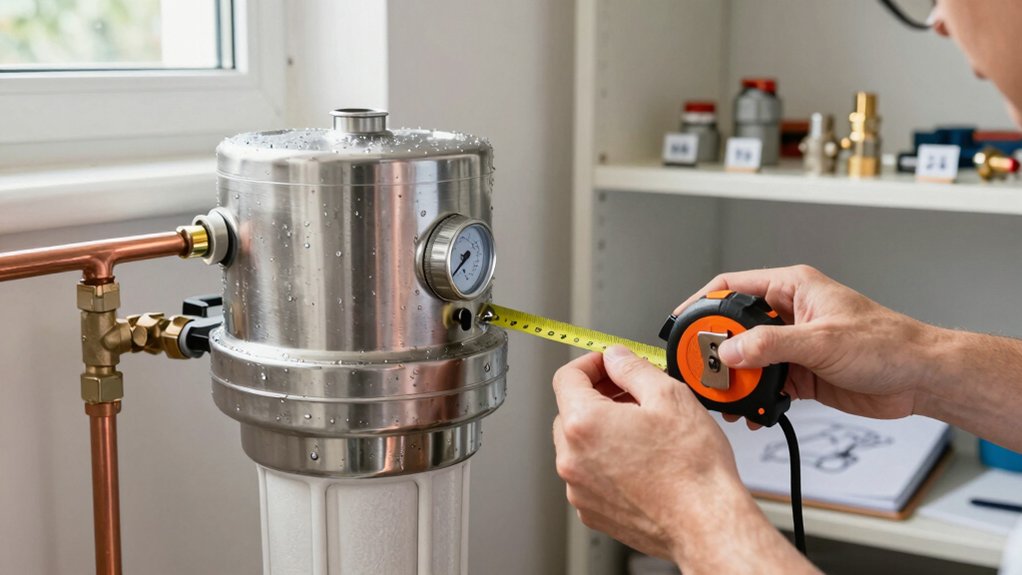
You size a whole-house filter by matching your peak household GPM and contaminant load to tank/media volume and valve capacity so pressure drop stays within available supply. Start at a 10 GPM baseline; add 1–2 GPM per extra resident. Use fixture counts (6–10 GPM small; 12–15 GPM medium) to pick flow capacity.
Choose media and tank volume to handle peak simultaneous draws. Pick a valve sized for that GPM and set backwash frequency; more details follow.
Quick Overview
- Estimate peak household flow (GPM) from occupants and bathrooms: small 6–10 GPM, medium 12–15 GPM. Adjust +1–2 GPM per additional resident.
- Match filter capacity and media volume to peak simultaneous draw to avoid excessive pressure drop at target GPM.
- Verify incoming pipe diameter and source pressure (psi) to ensure the system can deliver required flow without bottlenecks.
- Determine backwash/regeneration frequency from media type and sediment load. Use ΔP triggers (commonly 7–10 psi) or manufacturer intervals.
- Choose valve type and control (automatic preferred) sized for flow, chemical compatibility, and serviceability. Allow isolation ports for testing.
Flow Rate vs. Household Size
How many gallons per minute will your household actually need at peak times? You’ll size systems by matching fixture demand to household profile to preserve flow reliability and steady water pressure. Start at a 10 GPM baseline; add 1–2 GPM per extra resident; and use bathroom count: 1–2 baths (6–10 GPM), 3–4 baths (12–15 GPM), 5+ baths (15–20+ GPM).
Verify pipe diameter and incoming psi to avoid bottlenecks.
| Household | Typical Peak GPM | Typical Fixtures |
|---|---|---|
| Small (1–2 baths) | 6–10 | 1 shower + faucet |
| Medium (3–4 baths) | 12–15 | 2 showers + washer |
Measure real-world pressure loss at target GPM before final selection.
Gallons-Per-Minute Capacity Chart
Wondering what flow rate you actually need? Use a GPM capacity chart to match fixture demand to system capability. Read the chart by total simultaneous draw and plumbing port size; it reflects flow dynamics and pressure loss at target GPM.
Pick a tank and media volume that maintain required GPM without exceeding acceptable PSI drop. Factor peak simultaneous events (showers, laundry, irrigation) and assign a safety margin.
- Match GPM to number of fixtures for peak usage.
- Check port size vs. published flow curves.
- Ensure media replacement intervals align with calculated load.
- Verify PSI drop at intended GPM to prevent pressure issues.
Use measured peak GPM and media volume to select a system that meets performance needs.
Backwash Frequency and Valves
You’ll need to set backwash frequency based on media type, contamination load, and household peak flow to protect capacity and prevent channeling.
Choose valve types: automatic multiport, motorized, or manual ball/selector valves by balancing convenience against complexity and maintenance needs. Size cycles so regeneration doesn’t exceed available pressure and flow.
I’ll cover automatic versus manual operation, recommended cycle timing for common media, and how pressure/flow constraints dictate valve selection and backwash duration.
Backwash Frequency Guidelines
When should you schedule backwash cycles to keep media clean without wasting water? You’ll base backwash scheduling on raw water turbidity, contaminant load, and daily flow volume. Start with manufacturer-recommended intervals: often 3–7 days for high-sediment supplies and 7–14 days for moderate loads. Adjust using measured pressure differential across the bed.
Trigger backwash when ΔP reaches the specified PSI rise, commonly 7–10 psi, or when cumulative treated gallons approach media capacity. For ion-exchange or catalytic media, include full media regeneration cycles after a defined service volume or time period to restore performance.
Log cycles and inspect effluent clarity; shorten intervals if fines escape. Lengthen only when sustained low ΔP and stable water quality confirm reduced loading.
Valve Types Overview
After you set backwash intervals based on ΔP and treated gallons, pick the valve type that reliably executes those cycles with minimal maintenance. You’ll choose among multiport, motorized, or piston-style valves; match actuator speed and seal design to your backwash duration and frequency.
Verify valve materials for chemical compatibility and wear resistance: bronze, stainless, and engineered polymers perform differently with chlorinated or acidic feedwater. Consider flow capacity, pressure drop, and serviceability: replaceable seals and modular spindles reduce downtime.
For procurement, evaluate sourcing options: OEM, reputable distributors, or aftermarket vendors; confirm parts availability and documentation. Install accessible service ports and isolation valves so you can test timing, adjust cycles, and swap components without system downtime.
Automatic Versus Manual
How often should the system backwash: automatically on a timer or manually triggered by you depends on water quality, maintenance resources, and desired consistency of performance. You’ll weigh automatic discussion against manual discussion when specifying valve type and backwash control.
Automatic systems use motorized or pneumatic valves with timers or demand sensors, giving repeatable cycle timing and reduced operator error; this is good for high-suspended-solids or variable occupancy. Manual systems rely on ball or multiport valves you actuate, reducing upfront cost and complexity but increasing risk of missed cycles and variable performance.
Choose automatic if consistent flow, predictable media life, and minimal user intervention matter. Choose manual if you have reliable maintenance discipline, skilled personnel, and desire lower capital expense.
Sizing Backwash Cycles
Why should you match backwash frequency to both media type and actual loading rates? Because incorrect timing reduces removal efficiency or overloads media. You’ll set backwash scheduling based on media characteristics (resin, carbon, KDF) and measured contaminant mass flux, not arbitrary days.
Calculate hydraulic loading and organic/inorganic accumulation to define cycle duration and interval that restore bed porosity without excessive water use. Choose valve types rated for the calculated cycles-per-day; softer seals and motors wear faster, so match actuation duty to valve longevity specifications.
Program auto valves for peak and off-peak runs; incorporate manual override for inspection, and log cycles to validate assumptions. Proper scheduling preserves media life, minimizes downtime, and controls operating costs.
Pressure And Flow Impact
Where will your system lose pressure during a backwash cycle, and how will that loss affect flow to fixtures and valve operation? You’ll see the greatest pressure drop across the media bed and through the backwash valve when regeneration begins. This drop reduces available GPM to fixtures and potentially triggers sensitive control valves.
Calculate expected pressure drop at peak flow; then apply valve sizing that maintains minimum system flow (typically ≥10 GPM) during backwash. Specify valves with low internal resistance and appropriate port size to limit transient losses. Coordinate backwash timing with non-peak hours or use parallel vessels to eliminate service interruption.
Document PSI drop curves for your chosen media and valves so you can verify performance without guessing during installation.
Maintenance And Troubleshooting
When should you schedule backwash cycles and select valve types to keep performance consistent and minimize downtime? You plan backwash intervals based on media volume, contaminant load (from water tests), and peak flow patterns; smaller beds need more frequent cycles.
Use programmable automatic valves for high-demand homes and manual or semi-automatic valves where usage is predictable. Schedule backwash during low-use windows and log cycles to avoid maintenance pitfalls like media channeling or premature exhaustion.
For troubleshooting, discard common troubleshooting myths that blame pressure loss solely on valves. Inspect tank media, inlet screens, and pressure differentials first. Keep spare seals and a validated valve diagnostics checklist on hand.
Regularly verify cycle timing, rinse durations, and valve actuation to sustain capacity and reduce downtime.
Frequently Asked Questions
What Media Removes Chloramines Effectively Without Catalytic Carbon?
Catalytic carbon aside, you’ll use combined-media beds: KDF plus high-quality granular activated carbon (GAC) or powdered activated carbon (PAC) to achieve media removal with strong chloramines effectiveness. KDF oxidizes chloramines and protects carbon; GAC adsorbs residual compounds.
You’ll size media volume based on contact time and chloramine concentration. Maintain appropriate flow rates and monitor breakthrough. For stubborn levels, consider permanganate or chloramine-specific oxidizing media in series with carbon.
How Does Municipal Fluoridation Affect Whole-House System Choice?
Municipal fluoridation means you’ll need specialized whole house filtering if you want fluoride removed. Standard carbon won’t do it. You should choose media like activated alumina, bone char, or reverse osmosis (RO) staged for point-of-entry treatment, sized for peak GPM and media bed volume.
Verify influent fluoride levels from your water test, calculate required media cubic feet, and confirm pressure/port sizing so the system maintains flow without excessive PSI drop.
Can a Filter System Protect Water-Using Appliances Long-Term?
Yes, a properly sized whole-house system can provide appliance protection and extend filter longevity when matched to your water test and peak flow. You’ll choose media (softening resin, catalytic carbon, KDF) and tank volume to remove scale, chlorine, and corrosives.
Maintain recommended service intervals, monitor pressure drop, and confirm flow rates to prevent bypass or pressure loss. That technical alignment preserves appliances and maximizes filter longevity.
What Warranties Cover Media Degradation or Flow Loss?
Warranties coverage typically protects manufacturing defects and premature media degradation for a specified period; however, it rarely covers normal media wear or flow loss from fouling. You should expect limited-term guarantees on tanks and valves. Additionally, you can anticipate prorated or conditional coverage for media if testing proves a defect.
Insist on written terms specifying duration, replacement procedures, exclusions for fouling or clogging, required maintenance, and documented flow-rate criteria to validate claims.
Are Proprietary Tanks Compatible With Standard Replacement Cartridges?
Sometimes proprietary tanks aren’t compatible with standard replacement cartridges. You’ll need to verify filtration compatibility before buying. Check manufacturer specs for cartridge dimensions, port patterns, and seal types. Ask about replacement cartridges discussability: whether third-party parts are supported or certified.
If specs match industry housings, you can use off-the-shelf cartridges. Otherwise, expect OEM-only parts, higher costs, and limited service options unless an adapter or custom solution exists.
Conclusion
To size your whole-house filter, match flow rate to household demand, use GPM charts, and account for backwash needs.
Pick valves (automatic for convenience, manual for control) based on usage and maintenance ability. Set backwash cycles per water quality and system capacity. Remember, pressure affects flow and cleaning efficiency.
Maintain valves; check pressure drops and troubleshoot leaks or sediment buildup promptly. Follow rated capacities and service intervals to ensure reliable performance.
You may also like: Of Use Filtration Decision Framework — a related guide worth bookmarking.