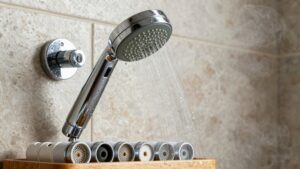
Shower Filter Cartridge Types and Connection Sizes Reference
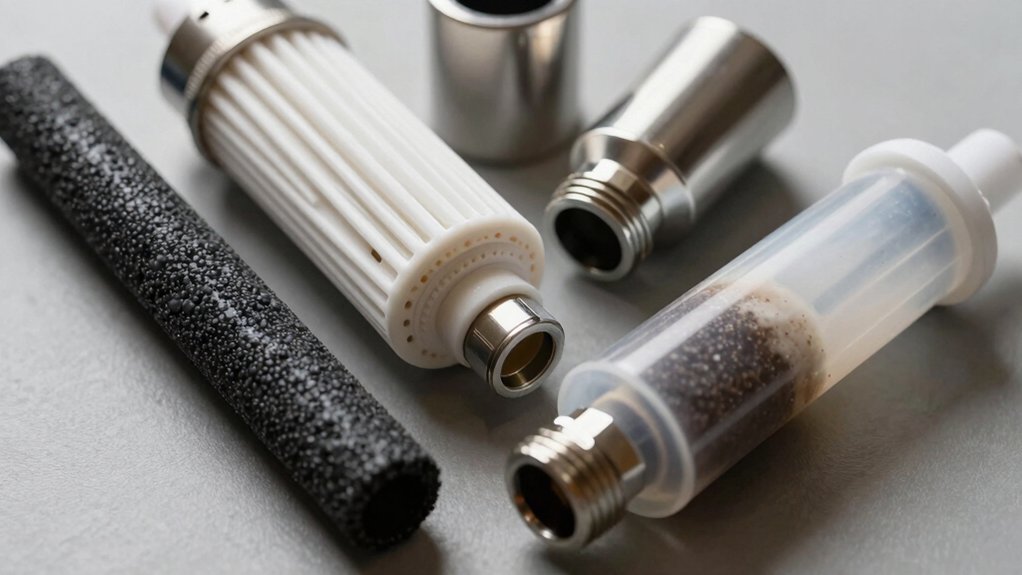
You’ll match shower filter cartridges by thread standard (NPT vs BSP), pitch and major diameter, and the O‑ring cross‑section and ID to ensure a proper seal. NPT uses 60° flattened peaks; BSP uses 55° rounded peaks and they’re not interchangeable. Measure threads with calipers and verify TPI or metric pitch. Then select O‑ring material (nitrile, EPDM, silicone, Viton) and hardness for water chemistry and temp.
Continue for step‑by‑step sizing, groove and installation guidance.
Quick Overview
- Common shower filter cartridges use inline, drop-in, or screw-in housings with standard connector types (NPT in US, BSP elsewhere).
- Match thread form and pitch precisely: NPT (60°) is not compatible with BSP (55°) without an adapter.
- Measure major diameters and thread pitch (TPI or mm) with calipers to confirm nominal vs actual sizes.
- O-ring seals require correct cross-section and ID per AS568/ISO3601 and compatible material (EPDM, nitrile, silicone, Viton).
- Verify groove dimensions and allow 20–30% static squeeze.
- Pressure-test at operating temperature to ensure leak-free performance.
/2″ NPT Vs BSP Comparisons
Wondering which thread standard your shower fittings use? You’ll find NPT compatibility differs from BSP: NPT has 60° flat threads, while BSP uses 55° rounded threads. Therefore, they’re not interchangeable and won’t seal properly if mixed. Check the table below for a quick comparison.
| Feature | NPT | BSP |
|---|---|---|
| Thread form | Flattened peaks | Rounded peaks |
| Flank angle | 60° | 55° |
You shouldn’t force metal threads together; the fit feels smooth, then grates. Plastic parts might sometimes work with lots of PTFE tape, but usually weep. If unsure, use a thread gauge or rely on geographic default: US = NPT. For mixed systems, install BSP adapters or purpose-made NPT-to-BSP adapters to ensure a reliable seal.
Thread Pitch & Diameters
After you confirm whether your fittings are NPT or BSP, the next step is to match thread pitch and major diameter so parts seal and thread smoothly. You’ll measure thread pitch (TPI or mm) and major diameters with calipers. Mismatches cause leaks or galling. Check compatible rubber o ring dimensions separately; don’t assume one size fits all.
- Verify thread pitch against manufacturer spec sheets before ordering.
- Measure diameters with calipers and confirm nominal vs. actual values.
- Cross-reference standard o ring sizes when selecting o ring materials.
- Note o ring hardness ratings for compression set and compatibility.
- Follow measuring o ring dimensions and o ring installation tips to prevent extrusion.
Match threads precisely. Pair correct o rings and materials for reliable seals.
Rubber O-Ring Dimensions
You’ll want to inspect O-ring material (EPDM, nitrile, silicone, Viton) to match chemical resistance and temperature for your filter. Measure standard sizes by cross-section and inner diameter with calipers. Note hardness (shore A) and refer to ISO/AS568 or BS standards for replacements.
When installing, lubricate with a compatible silicone grease; avoid twisting and verify compression to prevent leaks.
O-Ring Material Types
One key consideration when selecting shower filter O-rings is material compatibility with chlorine, temperature, and repeated compression. Choose EPDM for excellent resistance to hot chlorinated water and steam; choose nitrile (Buna-N) for general-purpose use with moderate chlorine exposure. Silicone is suitable for high-temperature flexibility but has poorer chemical resistance. Use Viton (FKM) when you need superior chemical and temperature resistance against aggressive additives.
You’ll specify O-ring material types based on water chemistry, operating temperature, and expected compression cycles. EPDM suits municipal chlorinated hot water; nitrile balances cost and oil resistance where minor additives exist. Use Viton for systems with oxidizers or high-temperature service. Silicone fits non-chemical, high-temperature seals but swells with some solvents.
When you design or retrofit, confirm compatibility with thread type and sealing method. Include NPT vs BSP comparisons to ensure you select the correct seal cross-section and gland geometry.
Standard O-Ring Sizes
What dimensions matter most when you pick an O-ring? You focus on cross-section (cord diameter) and inside diameter; those two define sealing geometry and compression. Standard o ring lists (AS568 for imperial, ISO 3601 for metric) give nominal IDs and cross-sections so you can select by specification, not guesswork.
You verify size compatibility with groove dimensions: groove width, groove depth, and gland clearance determine squeeze and stretch limits. Also, check tolerances and material swell allowances to ensure the installed compression stays within design range across temperature and water exposure.
For shower filter cartridges, use charted standard o ring sizes tied to cartridge models or adapter fittings to guarantee a reliable seal and prevent leaks without over-compressing elastomeric material.
Measuring O-Ring Dimensions
How do you accurately measure a rubber O-ring to ensure a proper seal? You measure three parameters: cross-section (thickness), inside diameter (ID), and, when needed, outside diameter (OD). Use calipers for ID and OD to 0.01 mm resolution. Squeeze the ring only for cross-section measurement with a micrometer or calculate CS = (OD – ID) / 2. Record units and tolerance.
If you extract rings from housings, measure multiple samples to detect wear and ovality. Discard visibly hardened or cracked rings. For documentation, note material and durometer elsewhere: this subtopic is not relevant here.
If you consult online resources, prefer calibrated Video measurements only as a supplement to physical caliper/micrometer readings; do not use them as a replacement.
O-Ring Hardness Ratings
Why does O-ring hardness matter? You rely on correct durometer to balance compression, sealing force, and wear in shower filter joints. Harder compounds resist extrusion and swell less; softer compounds seal at lower gland compression.
Specify O-ring material (EPDM, NBR, silicone, Viton) by compatibility with hot water, chlorinated water, and any cartridge media. Use standard O-ring sizes for repeatable gland fit; cross-reference AS568 or ISO size tables when selecting durometer.
Typical shower-service durometers range 60–90 Shore A; 70–80A is common for reliable sealing and longevity. Test assemblies at operating temperature and pressure to verify no leakage or extrusion. Record durometer, material, and size on maintenance sheets for consistent replacement and procurement.
O-Ring Installation Tips
Having selected the proper durometer and material for your shower filter O-rings, next focus on correct dimensions and installation to ensure reliable sealing under hot, chlorinated water. Measure cross-section and inner diameter; verify tolerances against groove geometry to maintain 20–30% squeeze for static seals. Inspect grooves for burrs and clean thoroughly.
For O ring removal, use a plastic pick to avoid nicking the seal or groove. Lightly lubricate compatible silicone or fluorosilicone grease for assembly to prevent rolling and reduce friction; avoid petroleum-based products on elastomers that swell. Seat the O-ring uniformly, rotate slightly during seating to equalize strain, and confirm no twists.
After installation, pressure-test at operating temperature to check for creep, extrusion, or leakage before returning to service.
Frequently Asked Questions
Do Cartridges With KDF-55 Inhibit Bacterial Growth Inside Filters?
Yes, KDF-55 bacteria activity helps inhibit bacterial growth inside filters. You’ll find KDF-55 uses a redox process that converts chlorine to chloride and creates an environment that’s bacteriostatic. As a result, microbes are less likely to colonize media.
Don’t confuse this with sterilization; KDF-55 reduces microbial proliferation but doesn’t guarantee complete elimination. Beware of filtration myths that overstate KDF-55’s antimicrobial reach or claim permanent, total disinfection.
How Often Should Carbon-Block Cartridges Be Replaced for Best Performance?
You should replace carbon-block cartridges every 4–6 months for optimal replacement frequency and carbon block performance. If your household has higher chlorine, sediment, or heavy use, swap cartridges closer to 3–4 months. Low-use or certified high-capacity units can stretch to 6 months or to the rated gallon capacity (e.g., 8,000–12,000 gal).
Monitor flow reduction or odor/taste changes and change immediately if performance declines.
Do Vitamin C Filters Affect Water pH or Skin Sensitivity?
Yes, Vitamin C filters minimally affect pH and usually do not increase skin sensitivity. Vitamin C neutralizes chlorine via ascorbate chemistry, producing chloride with negligible pH effects in typical shower volumes.
You will see improved skin feel because oxidative chlorine is removed, lowering irritation potential. If you have extreme water chemistry, such as very low alkalinity or high chlorine, monitor pH and skin sensitivity. Adjust treatment or consult water testing for precise control.
Which Filters Reduce VOCS and Chloramine, Not Just Chlorine?
Activated carbon and carbon block filters provide VOC reduction and some chloramine removal, though chloramine removal is limited unless combined with catalytic carbon or KDF-55. KDF-55 enhances chloramine removal via redox and offers bacteriostatic benefits. Catalytic carbon improves chloramine reactivity.
For reliable VOC reduction plus chloramine removal, choose systems specifying catalytic carbon or KDF-55 with carbon block stages and validated lab or NSF/IAPMO performance data.
Are Replacement Cartridge Costs Typically Lower for Inline Units?
Yes, replacement costs are typically lower for inline units because they use simpler, often smaller carbon block cartridges and cost-effective designs. You’ll still weigh replacement frequency; higher-flow or heavy-use setups need swaps sooner.
Inline units rarely use specialty vitamin C filters, which raise costs. For VOC reduction or chloramine control, expect pricier cartridges or combined media. Standard inline carbon blocks remain the most economical recurring option.
Conclusion
You now know how 1/2″ NPT and BSP differ, how thread pitch and diameters affect fit, and why correct O-ring dimensions, materials, and hardness matter for reliable seals. Measure inner diameter, cross-section, and cord diameter precisely. Choose compatible rubber compounds for temperature and chemical exposure.
When installing, seat O-rings cleanly without twisting; lubricate appropriately, and verify thread engagement to prevent leaks and preserve cartridge life.
You may also like: Water Filters Vs Oem Filters — a related guide worth bookmarking.