What Affects Water Filter Lifespan and Capacity
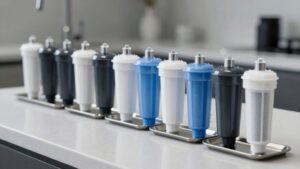
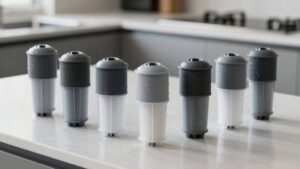
You’ll find a filter’s lifespan and capacity depend mainly on micron rating, contaminant load, flow rate and media type.
Finer (sub‑micron) media remove bacteria and cysts but foul and drop flow far faster than coarse cartridges.
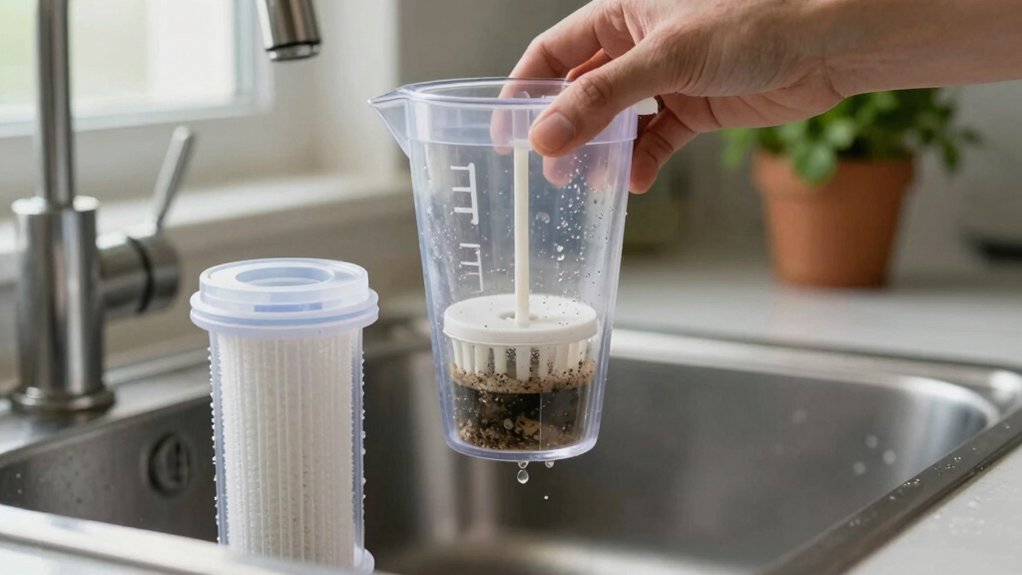
Hardness, organics and suspended sediment accelerate clogging and raise pressure differential.
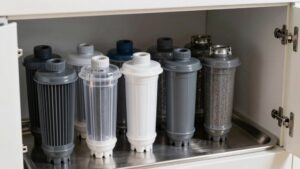
Pre‑filtration and staged media extend life; monitor baseline flow, delta‑P, and gallons treated to set change intervals.
Keep going and you’ll see how to measure thresholds and set replacement rules.
Quick Overview
- Contaminant load and particle size: higher sediment, organic matter, or fines shorten filter life and increase clogging.
- Micron rating and media type: finer (lower µm) media capture more contaminants but reduce flow and service interval.
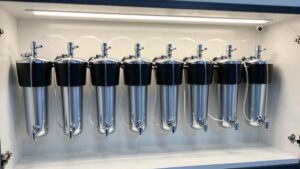
- Pre-filtration and stage design: coarse pre-filters and carbon stages protect finer membranes and extend overall capacity.
- Water chemistry and hardness: dissolved solids, chlorine, and scale formation degrade media performance and accelerate replacement.
- Flow rate and usage volume: sustained high flow or cumulative gallons drive faster fouling. Monitor percent drop to trigger changes.
Filter Micron-Rating Comparison
How small of a particle do you need to stop? You evaluate micron ratings to balance filtration chemistry, filter durability, and operational throughput. Lower micron ratings capture finer contaminants (bacteria, cysts) but increase clogging and pressure drop; this shortens service life. Higher ratings preserve flow and durability but leave finer particles.
You’ll often deploy staged filtration: coarse pre-filters protect fine membranes, extending overall filter durability while maintaining targeted chemistry removal. Choose absolute ratings only for critical sterile applications; nominal ratings suffice for most consumer needs and cost-effective maintenance. Use flow monitoring and sequential filters to optimize lifecycle and replacement timing without over-specifying microscopic retention that accelerates fouling.
| Rating (µm) | Capture Target | Impact on Durability |
|---|---|---|
| 0.5 | Bacteria, cysts | Very high wear |
| 5 | Sediment, fine particles | Moderate wear |
| 50 | Large debris | Low wear |
Filter Change Interval Chart
When should you replace each filter element to maintain performance and avoid system strain? You’ll use a filter change interval chart that maps expected service life against contaminant impact thresholds and real usage. Set a baseline filter replacement cadence from manufacturer life and adjust for measured contaminant load, water hardness, and volume.
Monitor pressure drop and scheduled gallons to refine intervals. Document changes and calibrate the chart annually.
- Visualize a timeline: sediment pre-filter at 3–6 months, carbon at 6–12 months, RO membrane at 2–5 years.
- Imagine a matrix: rows for filter type, columns for low/medium/high contaminant thresholds.
- Picture a workflow: test water → update cadence → replace components on planned dates.
Flow Rate Reduction Thresholds
You should monitor for sustained flow drops as an early indicator of media fouling and imminent capacity loss. Quantify reductions using percent benchmarks: commonly 10–20% for routine inspection and 30–50% to trigger cartridge replacement or cleaning. Measure with baseline flow tests and timed-volume checks.
Correlate those drops to contaminant loads and visible media clogging to identify whether sediment, organics, or mineral scaling is the primary cause.
Recognizing Flow Drop
Why does a sudden drop in flow often signal a filter nearing the end of its service life? You should treat abrupt flow rate declines as primary clogging indicators: particulate accumulation, resin bed compression, or media saturation all increase hydraulic resistance.
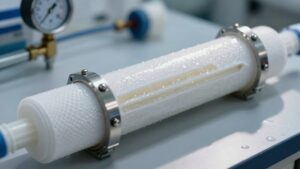
Measure baseline flow under controlled pressure, then record deviations. A rapid drop of operational flow typically reflects localized blockage or exhausted adsorption sites rather than systemic plumbing issues. Use differential pressure gauges or timed-volume tests to quantify reduction and correlate with expected capacity curves.
Act when pressure differentials exceed manufacturer thresholds or when flow loss accelerates nonlinearly over short intervals. Prompt replacement or cleaning prevents bypass, channeling, and degraded contaminant removal efficiency that follows advanced clogging.
Percent Reduction Benchmarks
How much flow loss should prompt action? You should treat a sustained 10–15% drop in flow as an early warning. A 20–30% reduction commonly indicates significant clogging or media exhaustion requiring service or replacement.
Set replacement triggers based on baseline flow, expected water hardness, and sediment load: harder water and higher sediment loads will accelerate decline, so use tighter thresholds. For critical systems, use a 10% threshold plus calendar limits; for noncritical household filters, 20% may be acceptable if quality remains within spec.
Document percent reduction over time and correlate with contaminant trends to refine thresholds. Conservative benchmarks prevent capacity overruns and protect downstream performance without relying solely on elapsed time.
Measurement Methods Explained
After monitoring percent reduction benchmarks, you’ll need concrete measurement methods to detect when flow loss signals filter exhaustion. You’ll use timed flow tests and inline flow meters to quantify volumetric decline: measure baseline liters per minute. Then record intervals weekly to compute percent decrease.
Set a flow rate reduction threshold, commonly 20–30%, as the actionable trigger for cartridge replacement. Pressure differential gauges provide corroborating data; a rising delta-P beyond manufacturer limits confirms media blockage. Log readings in a simple table and apply linear regression to predict time-to-threshold under current usage.
Automated alerts from smart meters can flag threshold crossings in real time. These measurement methods give you objective, reproducible criteria to schedule maintenance and avoid performance failure without guessing.
Impact Of Contaminants
What happens to your filter’s flow when contaminant load increases? You’ll observe a predictable decline: particulate and dissolved contaminants reduce effective pore volume and increase pressure differentials, driving flow rate down. Quantify thresholds by monitoring flow versus cumulative gallons or contaminant mass. A common operational trigger is a 20–30% flow reduction from baseline as the point for intervention.
This metric links directly to impact contaminants on filter lifespan because earlier intervention prevents irreversible media saturation and structural stress. Use real-time flow meters and periodic conductivity or turbidity checks to map degradation curves. Correlate those curves to manufacturer-rated capacity to forecast replacement timing precisely, rather than relying solely on calendar intervals.
Filter Media Clogging
Why does filter media clog in a predictable way as contaminant load rises? You can model clogging as pore-filling and cake-layer growth: particulate capture reduces effective porosity, which increases head loss and reduces flow rate nonlinearly.
You’ll observe an initial slow decline; then an inflection occurs where pressure drop accelerates and throughput falls below operational thresholds. Establishing flow rate reduction thresholds (e.g., 10–30% decline) gives objective end-of-life triggers tied to contaminant concentration and volume filtered.
Implement clogging awareness by tracking differential pressure or flow decline against baseline. This quantifies remaining capacity and informs replacement timing without guessing. Different media types and particle size distributions shift the threshold curves; therefore, calibrate thresholds for your filter media and local water quality.
Maintenance Timing Indicators
How will you know precisely when a filter needs replacing? Monitor flow rate reduction thresholds: quantify baseline flow under known pressure, then log percentage drop over time. You’ll set a maintenance cadence tied to a conservative threshold; commonly 20–30% reduction for household systems and 30–50% for commercial systems. This threshold is adjusted for contaminant load and filter type.
Use inline flow meters or periodic timed-volume tests. Automated alerts work best for high-volume sites. Integrate threshold triggers into your replacement strategy so a reduction event prompts pre-filter checks, backwashing, or cartridge swap according to protocol. Correlate flow decline with water quality data to refine intervals.
This analytical approach prevents capacity loss, avoids premature replacements, and optimizes lifecycle cost versus performance.
Frequently Asked Questions
Can Filter Materials Leach Chemicals Into Drinking Water Over Time?
Yes, you can experience leaching risk: some filter materials release trace compounds over time, especially if they’re incompatible with water chemistry. You should assess material compatibility (resins, plastics, activated carbon binders, or treated ceramics) against pH, temperature, and contaminants.
Monitor effluent quality, follow manufacturer replacement intervals, and prefer certified media with low extractables. Regular testing and proper maintenance minimize leaching and ensure long-term safety and performance.
How Does Water Temperature Affect Filter Microbial Growth?
Higher temperatures accelerate microbial growth in filters: you’ll see faster biofilm formation and increased metabolic rates that clog media and reduce capacity.
Temperature effects raise reproduction and enzyme activity, especially between 20–40°C. This promotes heterotrophic bacteria and opportunistic pathogens. You should monitor temperature, perform more frequent backwashing and disinfection at elevated temperatures, and replace cartridges sooner to prevent fouling, ensure performance, and limit microbial breakthrough.
Can Ultraviolet (UV) Systems Extend Filter Lifespan?
Yes, UV systems can extend filter lifespan by reducing microbial load and biofilm formation, which preserves membrane integrity and delays clogging. You’ll still monitor cartridge compatibility concerns: some cartridges aren’t UV-stable or may degrade under UV exposure or post-treatment chemistry.
You should pair UV with compatible pre-filters, maintain lamp intensity, and schedule membrane inspections. Doing so lets you analytically optimize replacement intervals and sustain filtration performance longer.
Are Refurbished or Third-Party Cartridges Safe to Use?
Yes, refurbished cartridges and third-party cartridges can be safe, but you’ll need to verify technical compatibility, refurbishment quality, and certification.
Inspect media type, flow rates, and contaminant reduction specs; demand NSF/ANSI or equivalent test reports. Poor refurbishment or mismatched materials can lower capacity, increase breakthrough risk, and shorten lifespan.
When in doubt, choose certified replacements or retain OEM parts and maintain routine monitoring and scheduled sensor checks.
How Do Seasonal Water Quality Changes Impact Replacement Schedules?
Seasonal variations force you to adjust replacement scheduling because contaminant loads, sediment, and biological activity fluctuate. In spring and after heavy rains, you’ll see higher turbidity and particulate breakthrough. So, replace pre-filters sooner and monitor carbon/RO stages.
During dry seasons, replacement intervals can lengthen but still require testing. Implement a seasonal inspection protocol, track gallons filtered, and tighten scheduling when water tests show increased TDS, organics, or microbial indicators.
Conclusion
You’ll extend filter life by matching micron rating and media to your water’s contaminants, monitoring flow reduction thresholds, and following manufacturer change intervals. Track percent reduction benchmarks and use measured pressure drop or timed flow tests to detect clogging early.
Adjust maintenance when you hit validated reduction limits rather than arbitrary dates. In short, quantify performance (micron, flow, pressure); target media to contaminants; and act on measured decline to preserve capacity and safety.
You may also like: Water Filtration Glossary Of Terms — a related guide worth bookmarking.