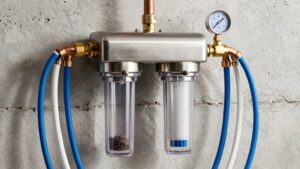
Water Filter Flow Rate Vs Pressure Drop Basics
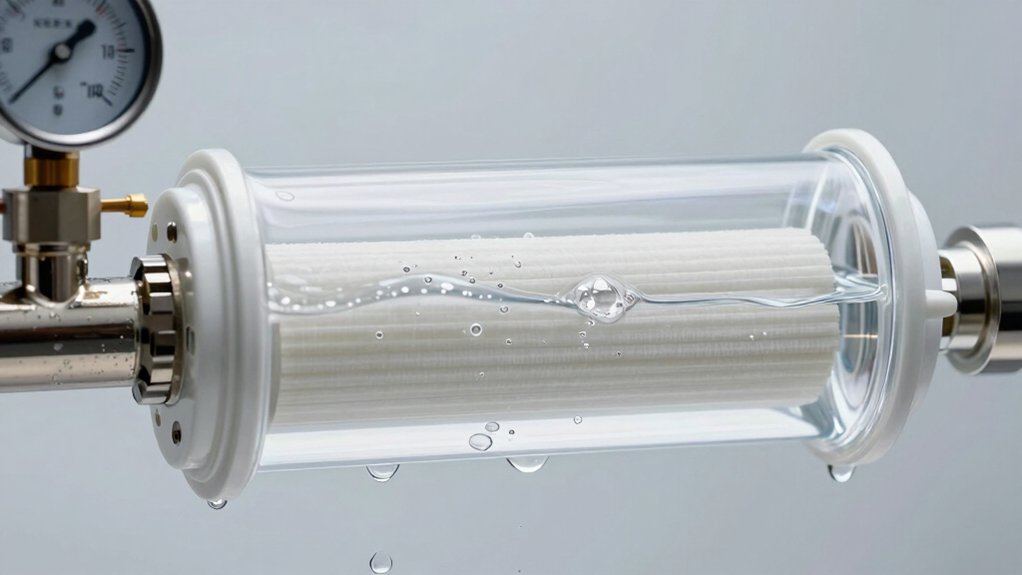
You’ll see pressure drop rise nonlinearly as flow increases, roughly with Q². Small increases in gpm cause much larger ΔP and energy use. Micron rating, media permeability, surface area and dirt loading all steepen that curve. Tighter media or higher loading shifts the gpm/ΔP curve down and left.
Watch inlet velocity limits, max allowable pressure, temperature effects and transients. Use regulators and surge protection to maintain margins. Continue for practical calculation steps and controls.
Quick Overview
- Pressure drop rises nonlinearly with flow; typically approximating ΔP ∝ Q². Small flow increases cause much larger ΔP increases.
- Finer micron ratings and loaded media increase resistance; this shifts the flow-vs-ΔP curve down and left.
- Measure ΔP at multiple flows and plot a gpm curve to interpolate operating flow at a target pressure drop.
- Keep inlet velocity within 6–10 ft/s. Include safety margins for maximum rated inlet pressure and transients.
- Use pressure regulators, surge protection, and gauges upstream and downstream to control inlet pressure and protect the filter.
Flow vs Pressure Curve
Why does pressure jump so quickly as flow rises? You see a non-linear flow curve where pressure behavior follows roughly a squared (or higher) relation to velocity. Small flow increases demand disproportionately more energy. You’ll use ΔP ∝ Q² (or empirical third-order fits) to predict rapid pressure rise near capacity.
Factor in filter media, surface area, and dirt loading: these steepen the curve over time. Monitor inlet velocity limits (6–10 ft/s) to avoid unexpected pressure spikes. Use measured points to fit a curve and estimate remaining service life, since midpoint ΔP often signals advanced clogging.
| Parameter | Effect |
|---|---|
| Flow rate (Q) | Quadratic/exponential ΔP |
| Dirt loading | Accelerates pressure behavior |
Filter Micron-To-Gpm Guide
How does micron rating translate to the gallons-per-minute you’ll actually get through a filter? You’ll map filter micron to expected throughput by combining media permeability, packing density, and system ΔP characteristics to derive a gpm curve. Smaller micron ratings raise resistance; flow falls roughly with the square of velocity for a given geometry. To assess performance, measure ΔP at multiple flows and plot gpm curve. Then interpolate operational points.
- Determine clean-media permeability and geometry. Calculate initial gpm at target ΔP using ΔP = Q² × R.
- Generate gpm curve by measuring Q vs ΔP as media loads. Tighter microns shift curve down and left.
- Use curve to size pumps and confirm downstream pressure requirements under loaded conditions.
Max Allowable Inlet Pressure
Check the filter’s maximum rated pressure and apply an appropriate safety factor so you don’t exceed material or seal limits. You’ll usually install a pressure regulator and account for temperature-related strength changes and thermal expansion. While designing for transient pressure spikes (water hammer) that can momentarily exceed steady-state values, verify specifications and include surge protection or relief valves if inlet conditions approach those limits.
Maximum Rated Pressure
What maximum inlet pressure can your filter safely handle without risking seal failure, media compaction, or accelerated wear? You’ll use the manufacturer’s maximum pressure rating as the upper limit and verify it against the system’s operational envelope.
Compare the stated maximum pressure to the expected peak pressures from pump starts, water hammer, and elevation head. Map operating points onto the filter’s flow curve to see where pressure drop and local stresses concentrate. If your normal operation approaches the maximum pressure, you’ll reduce flow or add pressure regulation to avoid nonlinear escalation of ΔP with velocity.
Document measured inlet pressure spikes, maintain margins below the maximum pressure, and schedule inspections for seals and media when operating near rated limits.
Safety Factor Requirements
Why set a safety factor for maximum inlet pressure? You need a quantified safety margin to prevent structural failure and preserve filter performance when transient spikes occur. Specify a max allowable inlet pressure that exceeds expected operating pressure by a clear factor; this reflects material strength, joint reliability, and media containment.
Use design tolerance values from testing and standards to set that factor; don’t guess. Calculate worst-case hydraulic surges, thermal expansion, and combined loads. Then apply the safety margin to the filter housing and connections. Document assumptions, test methods, and acceptance criteria so maintenance and inspection verify compliance.
A disciplined, analytically derived safety factor reduces risk, extends service life, and maintains predictable pressure-drop behavior under realistic disturbances.
Pressure Regulator Use
Having defined a safety factor for maximum inlet pressure, you now select and set pressure regulators to enforce that limit and protect the filter assembly from transient spikes. In pressure regulator use, you’ll size a regulator to maintain inlet pressure below the filter’s max allowable value, verify response time to surges, and confirm stability across expected flow rates.
Use Flow control trims and pilot-operated designs where Q varies widely; they offer finer Pressure modulation and lower hysteresis. Calculate regulator capacity so ΔP across the regulator plus expected filter drop never exceeds system limits at peak Q. Fit gauges upstream and downstream, test at worst-case transients, and adjust setpoints conservatively.
Maintain documentation of set values and periodic recalibration intervals.
Temperature Effects Consideration
How does temperature change affect the max allowable inlet pressure for a filter assembly? You must account for temperature effects because fluid density and material strength vary with temperature, altering both hydrostatic head and allowable stress margins. As temperature rises, water density slightly decreases, reducing static head but increasing vapor pressure. As temperature falls, viscosity increases, raising dynamic pressure losses for a given flow.
You should adjust maximum inlet pressure ratings to reflect worst-case combinations of thermal expansion, material yield changes, and reduced factor-of-safety at elevated temperatures. Also include elevation considerations: installation height shifts static head and modifies the allowable working pressure at the device.
Calculate adjusted max inlet pressure using temperature-dependent material properties and corrected head from elevation differences to ensure safety and performance.
Transient Pressure Spikes
When can a brief pressure surge exceed a filter assembly’s rated inlet pressure and cause failure? You’ll see transient spikes during rapid valve closures, pump starts/stops, or water hammer events. These spikes can momentarily surpass static ratings and fracture housings or seals.
Assess peak magnitude and duration against the assembly’s max allowable inlet pressure and verify safety margins. Model the event using surge analysis that accounts for flow nonlinearity, pipe inertia, and compressibility; linear assumptions underpredict peak pressures.
Install pressure relief, surge arrestors, or rated dampers sized for expected energy and frequency. Validate with sensor logging and transient simulation. Specify filters with higher short-term pressure capability if system dynamics indicate recurring spikes that approach or exceed design limits.
Inlet Plumbing Limitations
Why must you limit the inlet pressure to a filter assembly? You control maximum inlet pressure to prevent mechanical failure, seal extrusion, and uncontrolled flow spikes that amplify pressure drop across media. Specify a max allowable inlet pressure based on filter housing rating and downstream requirements.
Assess inlet restrictions and pipe friction upstream: sharp bends, valves, and reduced-diameter fittings raise velocity and transient ΔP; this increases stress on seals and housings. Use Darcy-Weisbach or ΔP = Q²×R to quantify expected drops and ensure inlet pressure minus predicted drop meets minimum downstream needs.
Install pressure regulators, surge arrestors, and adequate-diameter supply piping to reduce pipe friction effects. Validate with static and dynamic tests at worst-case flow to confirm safety margins and compliance with manufacturer limits.
Frequently Asked Questions
How Does Water Temperature Affect Pressure Drop Through a Filter?
You’ll see a temperature impact because warmer water lowers viscosity, reducing frictional losses and pressure drop. Colder water raises viscosity, increasing drop. Viscosity effects alter Reynolds number and the Darcy-Weisbach loss term (ΔP ∝ V²f). So at the same flow, you’ll need more driving pressure when temperature falls.
Quantify by using fluid properties at temperature. Re-evaluating f and flow velocity will help to predict the changed ΔP accurately.
Can Air Entrainment Change Measured Flow and Pressure Readings?
Yes, air entrainment can skew flow measurement and pressure readings. When air mixes into liquid, you’ll get compressible pockets that alter velocity profiles, create pressure pulsations, and cause meters (especially volumetric or differential types) to under- or over-report flow.
Entrained bubbles increase apparent pressure drop across filters by inducing turbulence and flow blockage. You should purge air, use degassing, or install sensors tolerant of multiphase flow to ensure accurate diagnostics.
How Often Should Pressure Gauges on Filter Housings Be Calibrated?
You should calibrate pressure gauges on filter housings at least annually. Increase calibration frequency to quarterly if you see wide pressure swings, high flow rates, or critical downstream requirements. Use a documented calibration frequency and gauge maintenance program; log results and replace gauges that drift beyond specified tolerance.
Perform zero checks, span verification, and leak tests during each maintenance cycle to ensure reliable ΔP readings and protect system performance.
Do Chemical Additives Alter Filter Resistance and Pressure Drop?
Yes, chemical additives can change filter resistance and pressure drop. You’ll see additives that swell media, coat pores, or alter viscosity; all increase filter resistance and raise ΔP.
Some coagulants reduce turbidity, lowering clogging and transient pressure drop. However, others promote fouling and irreversible resistance. You’ll need to monitor ΔP versus flow when dosing; adjust dosing or backwash frequency; and verify compatibility with media to avoid excessive pressure penalties.
Can Pipe Fittings and Bends Dominate Total System Pressure Loss?
Yes, pipe fittings and bends can dominate total system pressure loss when you have many of them, high flow velocity, or narrow piping. Each fitting adds local losses that scale roughly with velocity squared. Summed losses may exceed straight-pipe friction or filter drop.
You should quantify fittings using loss coefficients (K) and convert to equivalent length. Then compare to filter ΔP to decide if re-routing, larger diameter, or gentler bends will reduce overall pressure loss.
Conclusion
You’ve seen how flow vs. pressure curves, micron-to-GPM rates, and maximum-rated pressures interact to define a filter’s usable range. Apply safety factors, pressure regulators, and temperature corrections to avoid exceeding the max allowable inlet pressure or transient spikes.
Check inlet plumbing limits and derate flow for finer micron ratings. In practice, size filters and regulators to expected peak conditions; validate with manufacturer curves, and inspect for pressure transients routinely to maintain performance and avoid failure.
You may also like: Water Filter Has Low Flow — a related guide worth bookmarking.