Micron Rating for Water Filters Explained
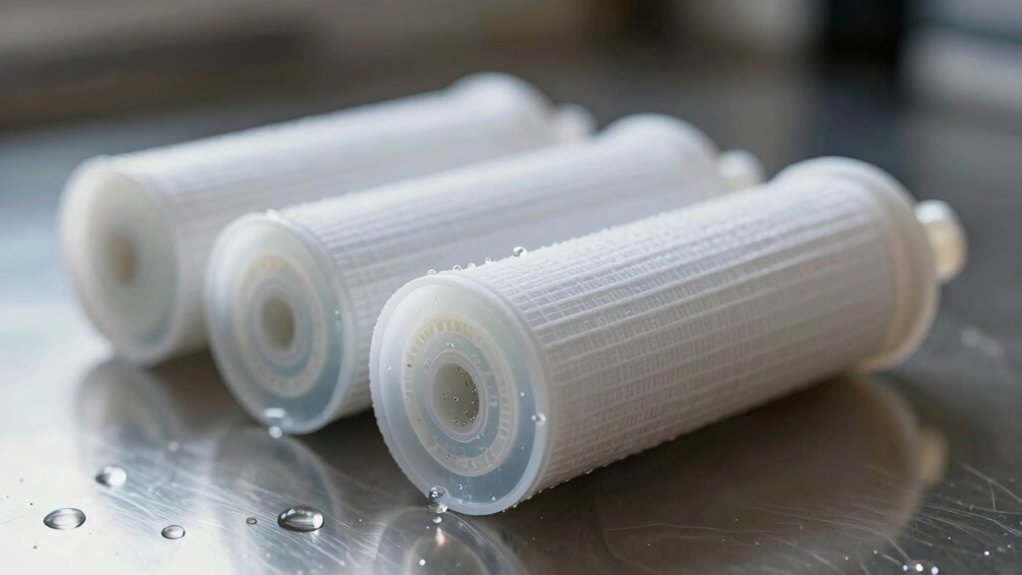
Micron rating tells you the smallest particle size a filter will catch: lower microns trap finer contaminants (0.5–1 µm for bacteria/cysts, ~5 µm for sediment/spores) but increase pressure drop and reduce flow.
Check whether ratings are nominal or absolute; confirm certification and tested flow curves. Match micron to target contaminants, system pressure and temperature, and allow burst margin and safety relief for spikes.
Keep going and you’ll get application examples, performance trade-offs, and sizing tips.
Quick Overview
- Micron rating indicates the smallest particle size a filter can capture; lower microns remove finer contaminants.
- Common ratings: 5 µm for sediment and spores, 1 µm for fine bacteria/protozoa, 0.5 µm for most bacteria and cysts.
- “Nominal” ratings remove a percentage of particles near the micron size; “absolute” ratings retain nearly all particles at that size.
- Lower micron filters increase pressure drop and reduce flow; thus, stage filtration balances performance and hydraulic needs.
- Verify certified test data, maximum operating pressure, and temperature derating to ensure real-world performance and safety.
Particle Size Comparison Chart
How small is a micron and why does it matter for filtration? You need to match particle size to application because micron scale defines which contaminants a filter captures and directly impacts filtration efficiency. Use the chart below to compare common ratings and expected removals.
| Micron (µm) | Typical Particles Removed | Application |
|---|---|---|
| 5 | Mold spores, large bacteria, sediment | Whole-house, sediment prefiltration |
| 1 | Fine bacteria, protozoa | High-quality purification, drinking water |
| 0.5 | Most bacteria, cysts, fine particulates | Advanced purification, microbial protection |
Choose smaller micron ratings for higher filtration efficiency. However, expect faster clogging and reduced flow. Balance target contaminant removal with system flow requirements.
Certifications and Flow Rates
Why does certification matter when you pick a filter? You need certification clarity to verify claimed micron performance and contaminant removal. Certified filters prove lab-tested efficiencies (nominal vs absolute) and ensure materials meet safety standards. You also must weigh flow rate relevance: tighter micron ratings reduce flow and can cause pressure drop if system specs don’t match.
- Check NSF/ANSI listings for claimed particle reduction and material safety.
- Verify independent test results for absolute vs nominal performance.
- Match filter micron rating to your system pump capacity and expected demand.
Review manufacturer flow rate curves at operating temperatures and typical pressures. Opt for staged filtration to retain low micron capture without unacceptable flow reduction.
Max Operating Pressure Rating
Check the filter’s maximum operating pressure and compare it to your system pressure so you don’t exceed the rated limit. Note the burst pressure margin; how rated versus actual pressures can differ in service; and that higher temperature reduces safe operating pressure.
Also assess how pressure drop across fine micron media will affect upstream pressure and pump performance.
Maximum Pressure Limit
When will your filter perform reliably under system pressure? You must compare the filter’s maximum pressure limit to your system’s operating pressure plus transient spikes. The max operating pressure rating defines structural integrity; exceed it and media deformation or seal failure occurs.
Design margins preserve max flow while minimizing pressure drop across the element. Evaluate rated pressure at expected temperature and chemical exposure, since both reduce allowable stress. Use pressure gauges and occasional hydrostatic tests to confirm real-world conditions stay below the rating.
If your system routinely approaches the limit, select a filter with higher maximum pressure or install pressure-reducing devices. Document ratings, test results, and replacement intervals to prevent catastrophic failure and maintain filtration performance.
Burst Pressure Margin
How much extra pressure should you design into a filter before failure becomes likely? You calculate a burst margin as the difference between measured burst pressure and normal operating pressure, expressed as a safety factor. When you specify a max operating pressure rating, include a burst margin that accounts for transient spikes, material variability, and joint integrity.
Define pressure tolerance bands for steady-state and short-duration events. Typical designs use a burst margin of 2–4× operating pressure depending on application criticality. Validate margin with hydrostatic testing, cyclic fatigue tests, and temperature-conditioned trials. Document allowable pressure tolerance in the product spec and include inspection intervals.
A quantified burst margin reduces unexpected rupture risk and ensures consistent field performance under defined operating conditions.
Rated Versus Actual
Why does the stamped maximum pressure on a filter often differ from what you’ll see in service? Manufacturers quote a conservative maximum rated pressure based on material strength tests, safety factors, and short-term burst margins. In the field, you encounter variable flow, gradual wear, and cumulative fatigue that reduce the actual allowable pressure.
When you push a filter near its stamped limit, you risk accelerated media compression, seal failure, and reduced filtration efficiency. Design ratings assume new components, controlled temperature, and ideal installation; real systems introduce fittings, transient spikes, and partial clogs that change stress distribution. You should use rated vs. actual as a planning metric: design systems with a buffer below the stamped value and monitor pressure differentials to maintain consistent filtration efficiency.
Temperature Pressure Effects
Although temperature and pressure interact continuously, manufacturers publish a single “maximum operating pressure” that only applies at a specified reference temperature. You need to adjust allowable pressure as temperature changes. You must account for temperature dynamics because polymeric media, seals, and housings change strength, elasticity, and permeability with temperature.
As temperature rises, material yield strength typically decreases, reducing safe pressure. As temperature falls, brittleness can increase risk of cracking under pressure spikes. Use manufacturer temperature–pressure correction charts or apply conservative derating factors when charts are absent. Monitor system thermal excursions; avoid simultaneous high-temperature and high-pressure conditions. Design safety margins into plumbing and pump settings. Properly addressing pressure interplay preserves micron integrity and prevents catastrophic filter failure.
Pressure Drop Impact
Changes in temperature and pressure affect more than material strength; they directly influence pressure drop across filter media and the maximum safe operating pressure you can use. You must account for how micron size and media packing density alter hydraulic resistance: smaller pores increase pressure drop for a given flow rate.
As the element loads with particulates, pressure drop rises nonlinearly, reducing achievable flow rate at constant inlet pressure. Design margins require specifying a maximum operating pressure that keeps transmembrane gradients within media ratings and avoids structural collapse or bypass.
Monitor inlet and outlet pressures to track differential and replace cartridges before pressure drop degrades system performance. Calculate expected pressure loss curves for candidate micron ratings to match pump capability and service intervals.
Safety Relief Requirements
How much pressure can your filter safely withstand before you need a relief mechanism? You must assess the filter housing maximum operating pressure (MOP) and set safety relief provisions to prevent rupture or bypass. Specify a relief valve or rupture disc sized to activate below the housing MOP, accounting for pressure spikes and temperature derating.
Include a pressure gauge and differential pressure sensor to monitor clogging-induced backpressure. Design safety relief to fail-safe; venting to drain or safe location. Document setpoints and test procedures to demonstrate regulatory compliance and routine maintenance intervals.
Verify materials, connections, and relief device certification against applicable codes. Maintain records for inspections, calibration, and incident response to support compliance.
Frequently Asked Questions
How Often Should I Replace a Micron-Rated Filter Cartridge?
You should replace a micron-rated filter cartridge every 3–12 months depending on micron rating, water quality, and flow. For a replacement schedule, check pressure drop, taste/odor changes, and manufacturer specs. A filter rated at 0.5–1 µm may need changing more often.
Maintenance tips: Monitor inlet/outlet pressure, pre-filter coarse sediment, backflush if supported, and document changes. Replace immediately if flow drops significantly or contamination is suspected.
Can Micron Ratings Reduce Dissolved Minerals or Hardness?
No, micron ratings won’t remove dissolved minerals or hardness. You rely on micron basics to trap particulate matter; dissolved ions like calcium and magnesium pass through standard pore-based media.
Filtration limits mean only processes like ion exchange (water softeners), reverse osmosis, or chemical treatment remove hardness. You’ll need those technologies rather than sediment or carbon filters rated by microns to address dissolved mineral content effectively.
Do Micron Ratings Affect Water Taste and Odor by Themselves?
No, micron ratings alone don’t produce a significant taste impact or odor influence. You rely on pore size to remove particulates and microorganisms; not dissolved chemicals that cause taste or smell.
Activated carbon or chemical media remove chlorines, VOCs, and organics that change taste or odor. Very fine mechanical filters can reduce turbidity that indirectly improves perceived taste. However, true taste and odor control requires adsorptive or catalytic media.
Are Micron Ratings the Same for Air and Water Filters?
No, micron ratings aren’t identical for air and water filters. You’ll rely on different filter material and pore size designs tuned to fluid properties: Water carries suspended solids and microbes, needing tighter pores and denser media. Air filters target particulates and aerosols with fibrous media and electrostatic effects.
Nominal versus absolute ratings apply to both; however, performance, pressure drop, and clogging behavior differ because media, pore geometry, and flow dynamics vary.
Can a 0.5-Micron Filter Remove Viruses Reliably?
No, a 0.5-micron filter won’t reliably remove viruses. You’ll achieve virus filtration only if the system includes technologies (e.g., ultrafiltration, reverse osmosis, or validated viral adsorption/inactivation) certified for viral reduction. For water safety, 0.5-micron filters effectively stop bacteria, cysts, and fine particulates. However, most viruses are much smaller and can pass through.
Validate treatment trains with log-reduction testing when viral control is required.
Conclusion
You now know how micron ratings relate to particle size, certifications, and flow rates. You also understand why maximum operating and burst pressures matter. Consider rated versus actual performance. Remember that temperature changes raise internal pressure while increasing pressure drop across the element.
Design or select filters with appropriate maximum pressure limits, sufficient burst margin, and required safety relief devices. Apply certified test data and account for real-world conditions to ensure reliable, safe filtration performance.
You may also like: Water Filtration Glossary Of Terms — a related guide worth bookmarking.