Water Distillation Process for Drinking Water
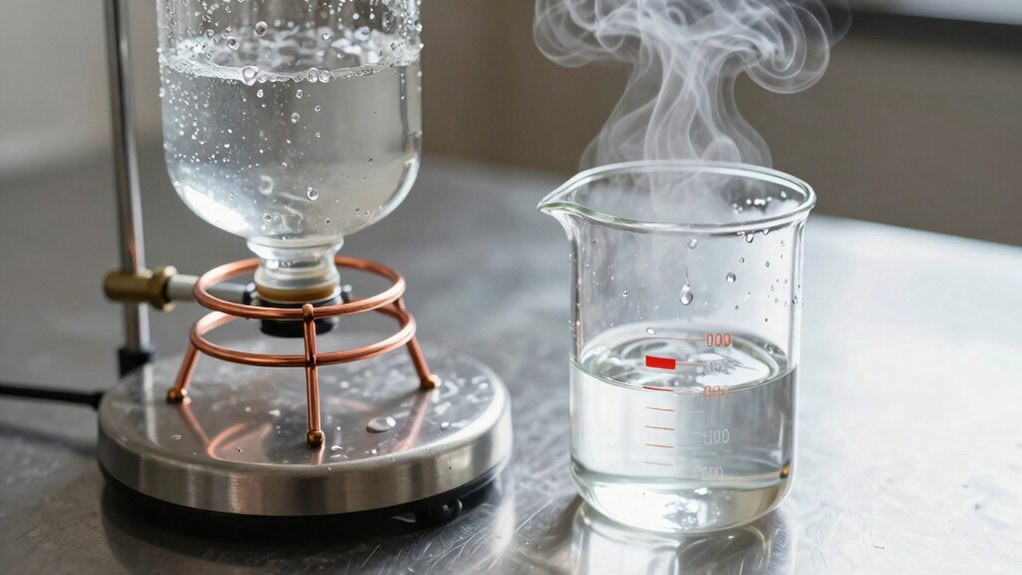
You’ll boil feedwater under controlled pressure, monitor the vapor temperature plateau near 100°C (pressure-corrected) to judge composition, and condense steam to collect low-TDS distillate (target 0–10 ppm).
Track condensate TDS and troubleshoot seals, reflux, and cooling if TDS exceeds 50 ppm.
Prevent scale by monitoring hardness, scheduling blowdown and descaling, and dosing inhibitors as needed. Log all measurements and maintenance; continue for procedural details and operational schedules.
Quick Overview
- Distillation heats feedwater to vapor, then condenses steam to separate most salts, metals, and many contaminants.
- Maintain a stable boiling plateau near 100°C (corrected for pressure) to indicate high-purity main distillate. Measure condensate TDS with a calibrated meter; target 0–10 ppm, and >50 ppm signals carryover or equipment faults.
- Prevent scaling by monitoring feedwater hardness, scheduling descaling, and using blowdown intervals based on hardness and runtime.
- If distilled water tastes flat or is ultra-low TDS, apply controlled remineralization to restore electrolytes and palatability.
Boiling Point vs Purity Chart
Why does boiling-point behavior matter for distillation purity? You monitor boiling point to infer composition: a stable plateau near 100°C indicates high purity of distilled water, while deviations signal low-boiling impurities or azeotropes affecting vapor composition.
You’ll use pressure corrections to compare observed and normal boiling points since barometric changes shift the plateau and thus purity assessment.
| Phase | Temperature indicator | Purity implication |
|---|---|---|
| Forerun | rising/unstable | contains volatiles; discard |
| Main distillate | stable ≈100°C | high purity; collect |
| Tail | rising above plateau | higher-boiling residues remain |
You calibrate sensors and apply Δt correction. You discard non-plateau fractions to maximize purity.
Distillate TDS Limits
Monitoring boiling-point behavior gives you a reliable signal about vapor composition, but total dissolved solids (TDS) in the condensate provide a quantitative check on final water quality. You’ll measure condensate TDS with a calibrated meter; acceptable limits depend on source water and intended use. For drinking water, aim for low single-digit ppm to confirm effective removal of salts and metals. However, recognize that ultra-low TDS can affect distillate taste and may prompt mineral remineralization for palatability and health.
- Target TDS: 0–10 ppm confirms high purity for most needs.
- Action threshold: >50 ppm indicates carryover or equipment issue.
- Troubleshoot: inspect seals, reflux, and condenser cooling efficiency.
- Post-treatment: controlled remineralization restores electrolytes and flavor.
Boiler Scaling Prevention Schedule
You should monitor feedwater hardness continuously and log values to trigger maintenance actions. Establish a schedule that combines routine chemical descaling, calibrated scale-inhibitor dosing, and defined boiler blowdown intervals based on hardness and runtime.
Include a surface inspection routine with measurable criteria. Record all corrective steps for trend analysis.
Feedwater Hardness Monitoring
How often should you check feedwater hardness to prevent boiler scaling? You should perform baseline hardness testing weekly during initial commissioning. Then establish a steady-state frequency based on results: typically biweekly for soft feedwater (weekly for moderate (60–180 ppm), and daily for hard feedwater (>180 ppm) or variable sources.
Use calibrated titration kits or online analyzers with data logging. Configure monitoring alerts for threshold exceedance, sudden excursions, or analyzer faults; set alert levels at 10–20% below scaling risk. Record results in a maintenance log, correlate with conductivity and solids readings, and adjust sampling points upstream of pre-treatment.
If persistent increases occur, escalate to immediate investigation and temporary shutdown to avoid scale formation.
Scheduled Chemical Descaling
When should you schedule chemical descaling to keep boilers free of scale buildup? You should set intervals based on measured hardness, operating hours, and observed deposition rates, not on arbitrary dates. Establish baseline testing protocols to quantify mineral load and detect unclear contamination sources before chemical cycles.
Schedule descaling when scaling rate exceeds the manufacturer’s threshold or when heat-transfer efficiency declines by a defined percentage. Use controlled acid concentrations, contact times, and neutralization steps documented in procedure sheets. Record pH, conductivity, and visual inspections pre- and post-descaling.
Coordinate shutdown, chemical handling, and rinsing to prevent residue carryover. Verify through follow-up testing protocols and logging that scale removal met acceptance criteria before returning the boiler to service.
Boiler Blowdown Intervals
Why schedule blowdown at specific intervals rather than arbitrarily? You establish a repeatable boiler blowdown interval based on feedwater TDS, hardness, and operating cycles to prevent scale accumulation and control suspended solids. You monitor conductivity or carry out routine TDS measurements. Then set timed or continuous blowdown actions to maintain target concentration limits.
This boiler maintenance practice preserves heat transfer surfaces, reduces fuel consumption, and sustains consistent steam quality for the condenser. Implement interval logs, automated valves, and interlocks tied to level and conductivity sensors. Adjust frequency after descaling or feedwater changes; increase intervals when softening is effective and shorten them when feedwater variability rises. Document each change and verify targets remain within manufacturer specifications.
Surface Inspection Routine
Want to prevent scale before it compromises heat transfer? You’ll perform a surface inspection at scheduled intervals: weekly visual checks, monthly tactile probes, and quarterly detailed inspections during shutdown.
Begin by isolating and cooling the boiler. Then, remove panels to expose heat transfer surfaces. Use a calibrated flashlight and magnifier to detect pitting, discoloration, or early deposit formation. Record the thickness of any film with a non-destructive ultrasonic gauge and photograph locations with timestamps.
Clean suspect areas with approved mechanical scraping or soft-bristle brushes only; avoid chemical treatments discussed later. Log findings in the routine maintenance ledger, note corrective actions, and adjust blowdown frequency if deposits recur. This methodical approach minimizes fouling and preserves thermal efficiency.
Scale-Inhibitor Dosing
Having identified early deposits during your inspections, you’ll follow a scheduled scale-inhibitor dosing program to prevent those films from hardening and degrading heat transfer. You’ll calculate the required feed rate from feedwater hardness, flow rate, and boiler surface area. Then configure an accurate metering pump.
Use a proven scale inhibitor compatible with stainless and copper alloys; confirm concentration by titration or handheld analyzer after initial purge. Implement a dosing schedule with start-up bolus, steady-state continuous injection, and corrective boosts after shutdowns or high-load periods. Monitor conductivity and visual heat-exchange efficiency; adjust dosing to maintain inhibitor residual within manufacturer limits.
Flush and replace inhibitor solution on a fixed interval to prevent microbial growth and chemical depletion.
Recordkeeping And Trends
How will you maintain reliable records to detect early signs of scaling and confirm inhibitor program effectiveness? You’ll implement a boiler scaling prevention schedule with standardized logs: dosing volumes, timestamps, feedwater hardness, conductivity, and inhibitor lot numbers. Use digital spreadsheets or CMMS entries to enable automated recordkeeping trends analysis and flag deviations.
Integrate drinking water monitoring data—distillate conductivity, flow rates, and recovery percentages—into weekly summaries. Perform statistical trend analysis monthly to identify slope changes indicating cumulative scale formation or inhibitor depletion. Retain raw sensor outputs and calibrated instrument certificates for two years to support audits.
Review logs after maintenance or parameter excursions; adjust dosing algorithms and document corrective actions with sign-off to close the feedback loop.
Frequently Asked Questions
Can Distilled Water Be Remineralized for Taste and Health?
Yes, you can remineralize distilled water for taste and health. Use remineralization strategies like adding measured salts (calcium carbonate, magnesium chloride) or using a commercial remineralization cartridge.
For taste enhancement, dissolve 1/8–1/4 teaspoon of a balanced mineral mix per gallon or pass water through an alkaline/remineralization filter. You’ll restore electrolytes, buffering capacity, and a more natural mouthfeel while controlling mineral concentrations precisely.
Is Distilled Water Safe for Babies and Infants?
Yes, distilled water safety for infants is acceptable for short-term use, but you should be cautious. Distilled water lacks minerals and electrolytes. Therefore, infant hydration using formula should follow manufacturer guidance; powdered formulas often require water with adequate mineral content. If you use distilled water for baby formula, ensure proper preparation and consult your pediatrician.
For long-term drinking, consider remineralization or using suitably mineralized water to support infant electrolyte balance.
How Do Distillers Handle Volatile Chemicals Like Benzene?
Distillers reduce benzene poorly on their own because distillation effectiveness drops for volatile compounds that co‑vaporize with water. You should treat handling volatile compounds by adding activated carbon post treatment considerations to adsorb benzene and other low‑boiling organics.
Combine pre‑screening and vapor compression designs to limit carryover. Monitor condensate with sensors and replace carbon regularly. That methodical combo restores safety when dealing with volatile contaminants.
Can Distilled Water Corrode Plumbing or Appliances?
Yes, distilled water can increase corrosion risk in plumbing and appliances because its lack of dissolved minerals and low conductivity makes it slightly more aggressive. You’ll notice mineral depletion effects where seals, solder joints, or metal surfaces leach ions to re-establish equilibrium.
To mitigate, use appropriate materials (stainless steel, compatible polymers); control contact time and temperature; add corrosion inhibitors; or re-mineralize water to reduce aggressiveness and protect systems.
How Often Should Carbon Post-Filters Be Replaced?
You should replace carbon filters every 6–12 months depending on usage and feed-water quality. Monitor for taste, odor, or flow changes. For high VOC or chlorinated sources, use the shorter end (6 months) and consider capacity-rated cartridges.
Track gallons treated versus manufacturer’s rated capacity and log replacement dates. If you detect any off-flavor, cloudiness, or reduced output, swap the carbon filter immediately to maintain performance.
Conclusion
You’ll maintain safe, potable distillate by following the charted boiling point vs. purity correlations and keeping distillate TDS within prescribed limits. Monitor feedwater hardness and follow the scheduled chemical descaling, blowdown, and surface inspection routines to prevent boiler scaling.
Dose scale inhibitors per protocol and adhere to boiler blowdown intervals. Keep precise records and trend analyses to verify effectiveness and prompt corrective actions. This ensures consistent system performance and regulatory compliance.
You may also like: To Interpret Tds Meter Readings — a related guide worth bookmarking.