Reverse Osmosis Vs Carbon Filtration Differences
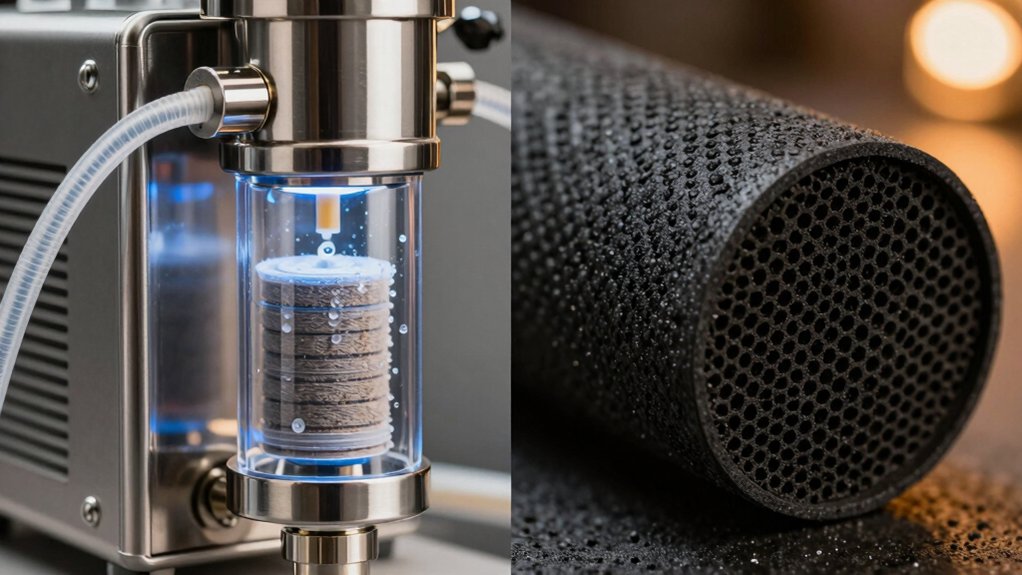
You’ll choose reverse osmosis when you need high rejection of dissolved solids, microbes, fluoride and nitrates (typically ≥97%); it uses a semi‑permeable membrane and needs pre‑treatment to remove chlorine.
You’ll pick carbon filtration when you need rapid adsorption/catalytic removal of chlorine, organics and taste/odor compounds but not reliable TDS reduction. Carbon protects RO membranes from oxidants; RO removes salts carbon can’t.
Continue for system sizing, monitoring and replacement guidance.
Quick Overview
- Reverse osmosis uses a semi-permeable membrane to reject dissolved salts and most contaminants, while carbon filtration adsorbs chlorine and organic compounds.
- RO typically removes 97–99.9% of TDS; carbon removes only ~10–15% of dissolved salts but excels at taste and odor improvement.
- Carbon (activated or catalytic) is required upstream of RO to remove free chlorine and protect the RO membrane from damage.
- RO is effective against microbes, fluoride, nitrates, and heavy metals. Carbon is unreliable for these contaminants unless specially treated.
- Choose RO when source TDS >200–300 ppm or for broad contaminant removal. Choose carbon for chlorine, VOCs, and improving taste/odor.
RO Membrane vs Carbon Removed
How do RO membranes and carbon filters actually differ in what they remove? You’ll see the RO membrane rejects dissolved salts, fluoride, nitrates, heavy metals, bacteria, viruses, PFAS, and microplastics by size and charge. Carbon targets chlorine, chloramine, VOCs, pesticides, taste/odor, and some organics via adsorption.
Consider operational compatibility: RO needs pre-carbon to protect the membrane from chlorine; carbon can’t reliably remove high TDS or microbes.
| Contaminant/Property | RO membrane | Carbon filter |
|---|---|---|
| TDS/Dissolved salts | High (97–99.9%) | Low (10–15%) |
| Chlorine/Chloramine | Needs post-carbon | Excellent (99.99%) |
| Microbes/Fluoride/Nitrates | Effective | Not reliable |
Use RO+carbon hybrids for broad removal and optimized carbon compatibility.
TDS Reduction Quick Checklist
Having compared RO membranes and carbon filters by contaminant type and operational needs, you’ll now focus on actionable steps to reduce TDS effectively. Use this TDS reduction quick checklist to evaluate system selection, installation, and verification with measurable criteria.
- Select: Choose RO if source TDS >200–300 ppm; specify membrane rejection ≥97% and pre-filter sequence (sediment, carbon) to protect the membrane.
- Install: Ensure feed pressure ≥40 psi, proper tubing and backflow prevention, and a drain line for reject flow. Size storage to match recovery rate and demand.
- Verify: Test influent and product with a calibrated TDS meter. Target product TDS reduction ≥95%; document periodic checks and replace membranes and filters per manufacturer schedule.
Chlorine Exposure Limits Guide
You should compare chlorine health limits and regulatory exposure standards to determine safe concentration thresholds for drinking water and short-term occupational exposure.
Assess acute effects like respiratory irritation and gastrointestinal upset versus chronic risks such as increased cancer markers and altered gut microbiota. Note how allowable limits differ by agency (EPA, WHO, OSHA).
Finally, measure free and total chlorine with colorimetric kits or digital sensors to confirm compliance. This information will inform whether carbon or RO treatment is required.
Chlorine Health Limits
Why does chlorine in drinking water matter for your health and system design? You need precise limits because chlorine is an oxidant that reacts with organics to form disinfection byproducts and can corrode plumbing. When chlorine exceeds aesthetic or health-based thresholds, you’ll see taste, odor, and possible long-term exposure risks that influence system choice.
Design-wise, an RO membrane won’t tolerate free chlorine. Pre-treatment must ensure carbon removed residuals to protect membrane integrity. Activated or catalytic carbon will reduce chlorine efficiently; you should size contact time and bed depth to target >99% removal where required. Quantify inlet residuals, breakthrough curves, and service life. Monitor chlorine concentration regularly and replace carbon at manufacturer-recommended capacities to avoid membrane damage or DBP formation.
Regulatory Exposure Standards
Because chlorine is both a useful disinfectant and a reactive oxidant, regulators set clear numeric exposure limits you should use when evaluating water treatment needs and system design. You’ll rely on regulatory exposure criteria such as Maximum Contaminant Levels (MCLs), Acute Reference Concentrations, and occupational short-term limits to size treatment and select media.
In a standards comparison, municipal MCLs (typically 4 mg/L as free chlorine residual limits vary) focus on chronic ingestion and disinfection byproduct control. Workplace guides prioritize inhalation and dermal routes. You should compare local drinking-water regulations, NSF/ANSI performance claims, and OSHA/NIOSH values to determine acceptable residuals and required removal efficiency.
Use those combined targets to specify carbon bed volumes, contact time, or RO pretreatment features.
Short-Term Chlorine Effects
Regulatory exposure criteria and MCLs set the numerical targets you use to size treatment for chlorine removal. However, short-term chlorine exposures pose different risks and require rapid-response guidance. You must assess acute concentration spikes, which typically last minutes to hours, that can produce respiratory irritation, mucosal effects, and taste/odor complaints well below chronic thresholds.
Design decisions should prioritize technologies that remove free chlorine immediately, such as activated or catalytic carbon pre-filters, and provide verification via rapid residual testing. In emergency scenarios, flushing, point-of-use carbon cartridges, or temporary RO units reduce short-term chlorine exposure effectively.
Document exposure duration, peak concentration, and mitigations. Use conservative safety factors when sizing carbon contact time. Your operational protocols should include response timelines, test methods, and replacement criteria tied to measured residuals.
Long-Term Chlorine Risks
How should you account for chronic chlorine exposure when setting long-term water-quality goals? You should quantify long term exposure by defining time-weighted average concentrations and comparing them to regulatory reference doses and lifetime health benchmarks.
Assess cumulative chlorine risks from ingestion, inhalation during showering, and dermal absorption. Model dose-response using conservative safety factors. Prioritize mitigation where projected concentrations exceed chronic guidelines or where vulnerable populations (infants, pregnant people, immunocompromised) are present.
Choose treatment that reliably reduces sustained chlorine levels: carbon adsorption typically removes free chlorine effectively, while RO eliminates residuals and byproducts as part of broader ion rejection. Implement monitoring triggers and filter maintenance schedules that statistically ensure exposure remains below target limits over decades.
Measuring Chlorine Levels
Why measure chlorine precisely? You need quantitative chlorine measurement to evaluate exposure against regulatory thresholds and system performance. Use DPD colorimetric kits or handheld photometers for free and total chlorine; meter readings give mg/L (ppm) you can compare to limits.
Calibrate instruments before sampling, collect samples downstream of stagnation points, and note temperature and pH since they affect chlorine speciation. Combine objective measurement with taste testing to detect perceptible residuals that impact palatability despite low readings. Record results, sampling location, date, and instrument ID for traceability.
For treatment selection: carbon versus RO, use measured chlorine species and concentrations to size pre-treatment and verify carbon capacity or the need for catalytic media without relying on subjective judgments.
Reducing Chlorine Exposure
Concerned about chlorine in your drinking water? You should quantify chlorine exposure, then select treatment based on concentration and goals. Carbon filtration adsorbs free chlorine efficiently; block carbon can remove up to 99.99%. This is the pragmatic option for municipal supplies where organoleptic and disinfection-byproduct concerns dominate.
Reverse osmosis provides secondary removal of residual chlorine when paired with pre- and post-carbon stages. RO membranes don’t target chlorine chemically but protect membrane integrity. For tactical implementation, test free and total chlorine, compare to regulatory limits, size contact time and flow rate for carbon beds, and include catalytic carbon if chloramine is present.
Monitor breakthrough indicators and replace media per manufacturer specifications to maintain low chlorine exposure.
Frequently Asked Questions
Does RO Waste Water Increase My Utility Bill Noticeably?
Yes, RO waste water impact on your utility cost concerns is usually minimal. You’ll pay slightly more for the extra water discarded (typically 2–4 gallons wasted per purified gallon); however, that consumption adds only a few dollars annually for most households.
If you’re on metered municipal water with modest use, the cost rise is negligible. Higher local water rates or heavy RO usage could make the increase noticeable.
Can Carbon Filters Remove PFAS Without Certification?
No, you shouldn’t rely on carbon filtration to remove PFAS without PFAS certification. PFAS certification (e.g., NSF listings) verifies tested reduction levels. Uncertified carbon may adsorb some PFAS variably depending on chain length, contact time, and carbon type.
You’ll need certified media or an RO system to ensure consistent PFAS removal. Check lab reports and NSF/ANSI standards before assuming a carbon filter protects you from PFAS.
How Often Should I Replace RO Vs Carbon Filters?
You should replace RO membranes every 2–3 years and pre/post carbon stages every 6–12 months. RO lifespan depends on feed water quality and usage.
Carbon replacement cadence is as follows: granular/sediment pre-filters should be replaced approximately every 6–12 months, post- and taste carbon around every 6–12 months, and block carbon possibly every 3–6 months under heavy use.
Monitor TDS, flow rate, and pressure drop. Replace sooner if performance degrades or manufacturer recommends a shorter interval.
Can RO Systems Be Installed on an RV or Tiny Home?
Yes, you can install RO systems in an RV or tiny home filtration setup. However, you’ll need to plan plumbing, space, and waste management. You’ll mount pre- and post-filters, secure the RO membrane, and allocate room for the storage tank and drain line.
Consider water pressure (pump or booster), waste water ratio, electrical needs for pumps, and periodic filter replacements to maintain performance and compliance with RV installation constraints.
Do Either System Affect Water pH for Plants or Aquariums?
Yes, both can alter water pH. You’ll need to monitor pH stability and plant watering effects. Carbon filtration generally leaves pH near source values; sometimes it buffers slightly toward neutral.
Reverse osmosis produces very low TDS water that’s typically slightly acidic. You’ll need remineralization or dosing to stabilize pH for aquariums or sensitive plants. Test regularly and adjust with carbonate buffers or controlled mineral additions for consistent plant watering and aquatic stability.
Conclusion
You’ve seen how RO membranes and carbon filters differ: RO strips nearly all dissolved solids while carbon targets chlorine, taste, and organics. Use the TDS checklist to judge when RO’s precision matters, and the chlorine guides to stay within regulatory and health limits. Measure chlorine with reliable kits and cut exposure by carbon polishing, activated-carbon prefilters, or full RO systems.
Choose based on contaminant profile, required removal rates, maintenance burden, and regulatory compliance.
You may also like: Osmosis Vs Under Sink Carbon — a related guide worth bookmarking.