Activated Carbon Water Filtration How It Works
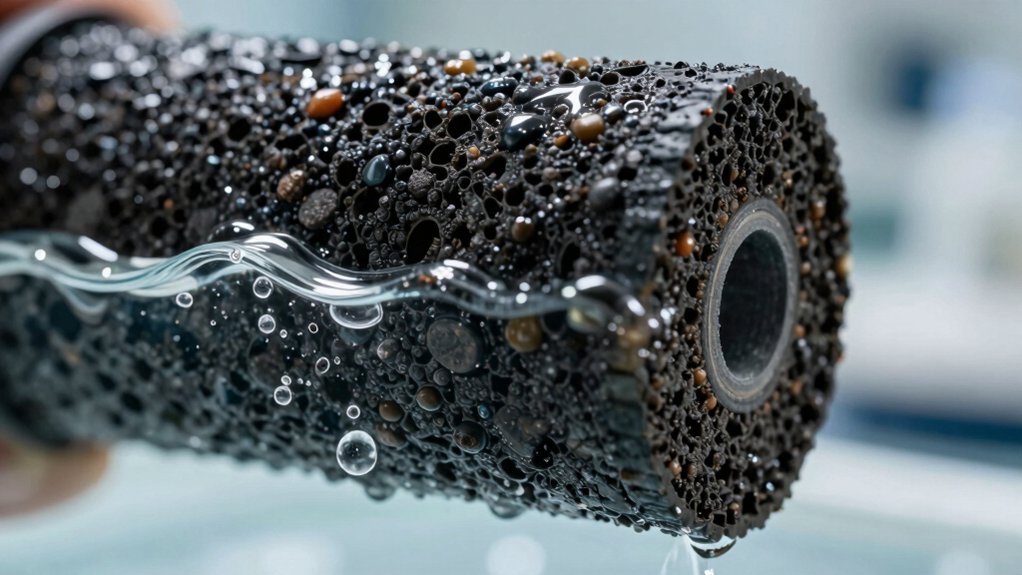
You use activated carbon filters to adsorb chlorine, taste-and-odor compounds, and many organics onto a high-surface-area carbon bed. Pore size and micron rating control particle capture, while granular or powdered carbon and block formats set flow and contact characteristics.
Removal depends on empty-bed contact time, bed depth, turbulence, and adsorption kinetics. Higher flow shortens residence time and speeds breakthrough. Monitor influent/effluent concentrations and pressure drop to schedule replacement; more technical details follow.
Quick Overview
- Activated carbon adsorbs dissolved organic compounds and chlorine onto its high-surface-area pores, reducing taste, odor, and color.
- Contact time (EBCT) and bed depth control adsorption efficiency; longer EBCT improves removal of slow-adsorbing contaminants.
- Particle size and pore structure determine kinetics: GAC gives higher flow; PAC blocks provide tighter contaminant removal.
- Breakthrough curves and influent/effluent chlorine tests validate capacity and indicate when media replacement is needed.
- Pre-filtration for 20–50 μm sediment prevents channeling and extends carbon life by preserving adsorption surface area.
Micron Ratings Comparison Table
Curious which micron rating you should pick for an activated carbon stage? You’ll match micron ratings to your water profile: Whole-house systems use 5–20 μm for sediment protection, while point-of-use carbon blocks run 0.5–1 μm for taste, VOCs and chlorine.
Absolute vs nominal matters: Absolute gives ≥99% capture at rating; nominal 85–95% with lower pressure drop. Choose GAC for higher flow; PAC blocks for tighter removal. Use pre-filters (20–50 μm) to extend carbon life when sediment’s high. Validate with particle counts and contaminant analysis before specifying cartridge type and pore size distribution. Contact time and bed depth remain critical for adsorption efficiency.
| Rating class | Typical use |
|---|---|
| 0.5–1 μm | Drinking polish |
| 5–20 μm | Whole-house pre-carbon |
Chlorine Removal Performance Checklist
You picked the right carbon micron rating for sediment protection and polishing. Now verify chlorine removal performance with a focused checklist that ties media, contact time, and operational conditions to measurable outcomes. Use quantitative checks and testable criteria to confirm compliance with target residuals and removal efficiencies.
- Measure influent and effluent free chlorine concentration; confirm ≥99% reduction or target ppm removal under design conditions.
- Validate adsorption kinetics via breakthrough curves and residence time estimates. Document bed capacity and slope of breakthrough to predict service life.
- Inspect media quality, bed depth, and operating temperature. Log pressure drop and scheduled media replacement based on measured chlorine removal decline.
Follow these steps to ensure reproducible chlorine removal and defensible performance data.
Flow Rate Vs Contact Time
Consider how flow rate controls contact time: higher flow shortens the residence time of water in the carbon bed and reduces the opportunity for adsorption. You’ll assess adsorption kinetics: fast external-film mass transfer and slower intraparticle diffusion. You will also examine how turbulence and bed depth alter those rates.
Use measurable parameters (L/min, empty-bed contact time, and bed height) to predict removal efficiency for target contaminants.
Flow Rate Basics
How fast should water flow through an activated carbon filter to remove contaminants effectively? You must balance flow rate and contact time: higher flow rates reduce contact time and lower adsorption efficiency, while slower rates increase uptake of VOCs and chlorine.
Design targets often specify hydraulic loading (m/h or m³/h) matched to bed depth and particle size to achieve required residence time for target compounds. Use empirical isotherms and breakthrough curves to set operational flow rates that keep effluent concentrations below limits.
In point-of-use systems, you’ll select cartridges rated for specific L/min; in industrial units, you’ll calculate empty-bed contact time from bed volume and flow. Monitor pressure drop and breakthrough to validate chosen flow rate and adjust as needed.
Contact Time Defined
Why does contact time matter? You control the residence time water spends in the carbon bed, and that time directly governs adsorption dynamics. Short residence times at high flow rates reduce molecular diffusion into micropores, limiting pore accessibility and lowering removal efficiency for small organics.
Design targets empty bed contact time (EBCT) based on contaminant type, bed depth, and expected loading. Empirical studies show increased removal with longer EBCT until equilibrium approaches. You should balance flow rate and EBCT to meet throughput requirements without sacrificing performance. Lower flow increases diffusion-driven uptake; however, too low a flow may be impractical.
Monitor breakthrough to adjust EBCT in situ. Real-world matrices and competing constituents alter effective adsorption dynamics and pore accessibility.
Adsorption Kinetics
When you speed up flow through an activated carbon bed, adsorption kinetics shift from diffusion-limited to mass-transfer-limited regimes; removal efficiency drops because molecules have less time to enter micropores. You must balance flow dynamics and contact time: higher volumetric flow raises superficial velocity, reduces residence time, and increases external film resistance.
Practically, breakthrough curves steepen and equilibrium capacities aren’t reached for slow-diffusing species. You’ll see faster uptake with powdered activated carbon due to shorter intraparticle diffusion paths. Granular beds need lower flows or deeper beds to approach equilibrium.
Design calculations use rate-limited adsorption models (e.g., linear driving force, film-and-pore diffusion) to predict performance under given flow dynamics. Empirical pilot tests validate models and set operational flow limits for target contaminants.
Effect Of Turbulence
Although increasing flow rate can boost throughput, it reduces contact time and raises turbulence; these factors together shorten the residence time available for molecules to diffuse into micropores and lower adsorption efficiency. You must balance flow velocity against required contact time. Higher velocities increase turbulence impact and eddy diffusion, enhancing external mass transfer but diminishing pore diffusion into micropores critical for VOC and chlorine removal.
Measure mixing dynamics to identify the transition from laminar to turbulent regimes. Reynolds number and tracer tests quantify dispersion and dead zones. In practice, you should size systems to maintain sufficient residence time or employ staged beds and flow distributors to control mixing dynamics, minimize channeling, and preserve adsorption kinetics tied to pore-size-dependent uptake.
Bed Depth Influence
How deep should the carbon bed be to meet your target removal at a given flow? You determine bed depth by balancing residence time against adsorption kinetics: deeper beds increase contact time and allow approach to equilibrium for slower-adsorbing contaminants.
Calculate empty bed contact time (EBCT = bed volume / flow) and match it to kinetic rate constants for the target compound. Design EBCT several times the characteristic adsorption time to ensure breakthrough margin. Use laboratory column tests to derive mass transfer coefficients and scale them with bed depth to predict breakthrough curves.
Note diminishing returns: beyond a certain depth, incremental removal per added depth falls as external mass transfer limits dominate. Specify bed depth with safety factors for variable flows and contaminant loads.
Optimizing Throughput
Why does flow rate matter so much for adsorption performance? You must balance throughput optimization against required contact time: higher flow increases throughput but reduces residence time inside micropores, lowering removal efficiency for VOCs and chlorine. Quantify using empty bed contact time (EBCT); design for target contaminant kinetics and pore size distribution.
Ensure uniform flow distribution across the bed to avoid channeling that shortcuts contact time and decreases capacity utilization. You’ll select bed depth, particle size (GAC vs PAC), and flow path to achieve desired EBCT while meeting system throughput.
Monitor breakthrough curves and adjust flow or replace media when breakthrough occurs. In industrial systems, validate performance at design flow rates and map flow distribution under operational conditions.
Frequently Asked Questions
Can Activated Carbon Remove Microbial Pathogens Like Bacteria or Viruses?
No: Activated carbon won’t reliably remove bacteria or viruses. Its activated carbon efficiency targets chemical adsorption, not microbial removal. You’ll use it to remove organics, chlorine, and VOCs. However, microbial removal limits arise from pore sizes and lack of disinfecting action.
If you need pathogen control, pair carbon with proven barriers or treatments such as UV, membrane filtration, or chlorination. Verify system validation and maintenance to meet microbial safety standards.
How Often Should Activated Carbon Cartridges Be Replaced in Homes?
You should replace activated carbon cartridges every 6–12 months depending on use, water quality, and flow rate. Establish a replacement schedule based on manufacturer specs, measured pressure drop, and taste/odor return.
Maintenance tips: pre-filter sediments, monitor flow reduction, and log service dates. In high-contaminant or heavy-use situations, replace quarterly. In low-use, low-contaminant cases, annual replacement often suffices to preserve adsorption efficiency and water quality.
Can Activated Carbon Filters Be Regenerated at Home?
No, you generally can’t regenerate activated carbon filters at home effectively. Home regeneration risks incomplete desorption, reduced pore structure, and safety concerns from releasing trapped contaminants.
Industrial regeneration uses high-temperature steam or chemical processes to restore surface area and pore distribution; these require controlled atmospheres and equipment. For household use, you should replace cartridges per manufacturer guidance or use professional regeneration services to ensure performance and avoid health hazards.
Does Activated Carbon Affect Water Mineral Content or pH?
No, activated carbon typically won’t change water pH or remove significant minerals. You’ll see activated carbon drawbacks mainly as limited effectiveness for dissolved inorganic salts and some heavy metals.
Mineral removal is minimal because adsorption favors organic compounds, chlorine, and VOCs. You’ll need ion exchange or reverse osmosis for true demineralization or pH shifts.
Monitor cartridge life and flow rate to maintain adsorption performance and avoid breakthrough of target contaminants.
Are There Health Risks From Carbon Dust or Fines in Filtered Water?
You’re unlikely to face serious health risks from occasional carbon dust or fines in filtered water; they’re inert and pass through the gut.
However, dust exposure can irritate lungs if aerosolized during cartridge handling. Therefore, follow manufacturer instructions and rinse new cartridges to reduce fines. For consumer safety, use certified products, replace cartridges on schedule, and avoid ingesting visible carbon particles.
Consult a clinician for persistent symptoms.
Conclusion
You’ve seen how activated carbon’s pore structure, micron ratings, and bed depth govern adsorption kinetics and chlorine removal. To optimize throughput, balance flow rate and contact time. Slower flows increase removal efficiency; turbulence and shallow beds reduce performance.
Design choices should match target contaminants and required micron ratings. Use empirical data to size bed depth and residence time. Follow validated test results and standards to ensure predictable, evidence-based filtration outcomes.
You may also like: Tastes Bad After Changing Filter — a related guide worth bookmarking.