Microbial Contamination in Drinking Water Basics
You get microbes into drinking water from contaminated sources, leaks, or stored tanks where biofilms form and protect bacteria like E. coli, Legionella, and Pseudomonas. Routine monitoring (coliforms, E. coli), maintaining disinfectant residuals, controlling nutrients and stagnation, and cleaning or retrofitting tanks reduce risk.
Boiling and proper disinfection inactivate most pathogens. However, biofilms and dead zones resist treatment. Keep following for practical monitoring, remediation, and prevention steps.
Quick Overview
- Microbial contamination means water contains disease-causing bacteria, viruses, or protozoa that pose health risks if ingested or contacted.
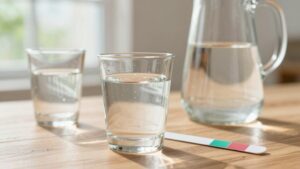
- Routine monitoring uses indicators like total coliforms and E. coli to detect possible fecal or microbial intrusion.
- Contamination occurs at source, during treatment, in distribution systems, or in storage tanks and private wells.
- Biofilms on pipe and tank surfaces protect microbes and reduce disinfectant effectiveness; this requires targeted cleaning.
- Risk reduction relies on protecting sources, maintaining disinfectant residuals, regular testing, and proper storage management.
Coliform Counts by Source
Where do coliforms concentrate in household water systems? What does that mean for your well or stored water? You’ll see higher coliform presence in private wells: about 35% test positive for total coliform. Shallow wells have a greater risk, and E. coli is found in ~15% of wells, indicating fecal intrusion.
Storage regrowth magnifies counts; source-to-tap increases (197→1,046 CFU/100 mL), and container biofilms (1.85 CFU/cm²) drive rapid rises. You should monitor well construction, seasonal risks, and storage hygiene to limit contamination.
| Point | Typical finding |
|---|---|
| Private wells | 35% total coliform positive |
| Shallow wells | Higher contamination risk |
| Stored water | Rapid regrowth; CFU escalate within days |
Boiling & Disinfection Times
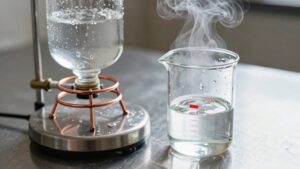
Given the higher contamination and regrowth risks in wells and stored water, you need clear guidance on how long to boil or chemically disinfect water to reliably kill or inactivate pathogens. You’ll prioritize boiling effectiveness and evidence-based disinfection timing: Bring water to a rolling boil for at least 1 minute at sea level; extend to 3 minutes above 2,000 meters, and allow cooling before storage.
For chemical disinfection, use appropriately dosed chlorine or iodine and respect contact times: Typically 30 minutes at clear water; longer if turbid or cold. Monitor residual free chlorine when available. Follow these precise practices:
- Boil: rolling boil 1 min (sea level); 3 min >2,000 m
- Chlorine dose: 2–4 mg/L, 30 min contact
- Iodine: follow manufacturer timing
- Increase time if turbid
- Verify residuals when possible
Storage Tank Biofilm Risks
You need to recognize that biofilms form when microbes attach to tank surfaces and produce extracellular polymeric substances, creating structured communities that resist shear and disinfectants. These communities can harbor pathogens like Legionella and Pseudomonas; they are fed by low residual disinfectant, organic carbon, and corrosion products. Colonization patterns are strongly influenced by surface material and roughness.
Controlling nutrients, selecting smooth, inert materials, and understanding disinfectant penetration limitations are thus central to reducing infection risk.
Biofilm Formation Mechanisms
Because storage tanks sit between treatment and tap, they create conditions that let biofilms rapidly establish and persist if not managed. You should assess nutrient gradients, surface chemistry, hydraulic shear, and temperature stratification: all drivers of distinct biofilm phenotypes.
Cells arriving from supply water adhere, secrete extracellular polymeric substances, and transition from planktonic to sessile states. Monitor quorum sensing signals that coordinate EPS production, dispersal, and antimicrobial tolerance. Disruption of signaling reduces maturation. Measure residual disinfectant decay and stagnation zones to predict colonization hotspots.
Use methodical sampling (coupons, swabs, bulk water) and molecular assays to characterize community structure and resistance traits. Intervene with targeted cleaning, mixing to prevent stratification, and maintaining disinfectant residuals to limit establishment and persistence.
Pathogen Harboring Risk
How, when, and where storage tank biofilms become pathogen reservoirs depends on measurable factors you can monitor and control: residual disinfectant decay, hydraulic stagnation, temperature stratification, nutrient loading, and surface materials. You should sample at multiple depths and locations to detect hotspots where disinfectant falls below target and temperatures rise into Legionella-friendly ranges.
Measure hydraulic patterns to identify dead zones promoting attachment and biofilm resistance. Inspect tank materials, welds, and coatings for roughness that aids colonization. For private water systems, document flushing frequency, storage turnover, and residuals after maintenance. Use disinfectant decay curves and decay-corrected contact times to evaluate regimen effectiveness.
If monitoring shows persistent niches, schedule targeted cleaning, disinfection, or retrofit to reduce surface area and eliminate stagnation pathways.
Nutrient Source Control
Why do nutrients matter inside storage tanks? You’ll find that even low concentrations of organic carbon, iron, or ammonia act as a nutrient source fueling biofilm formation on tank walls. You should inspect tanks for residuals after maintenance, measure assimilable organic carbon, and track disinfectant decay because those metrics predict biofilm risk.
Control actions include removing debris, flushing stagnant zones, and maintaining disinfectant residuals to limit contamination pathways into distribution. You’ll also minimize inflow of nutrient-laden source water by using pre-treatment and screened vents. Document routine sampling at inlet, outlet, and dead-legs to detect early shifts.
Surface Material Influence
After you limit nutrient inputs and maintain disinfectant residuals in storage tanks, the materials lining those tanks determine how microbes actually attach and persist. You should assess surface material because rough, porous, or corroded substrates—concrete, aged steel, and some plastics—promote initial adhesion and accelerate biofilm formation.
Smooth, inert coatings like epoxy or stainless steel reduce microscopic shelter and limit microbial niches. Inspect welds, seams, and repaired areas where detachment and localized corrosion create hotspots. Monitor biofilm development with targeted sampling and ATP or molecular assays to detect early colonization.
Prioritize materials compatible with disinfectants and cleaning regimes; otherwise, cleaning efficacy drops and regrowth risk rises. Document material selection, maintenance schedules, and test results to guide risk-based tank management.
Disinfection Efficacy Challenges
Because biofilms embed microbes within an extracellular matrix, standard disinfectant dosing and contact-time calculations that work in bulk water often fail to inactivate organisms attached to tank surfaces. You must account for mass-transfer limitations and protective niches when evaluating efficacy.
You should evaluate disinfection limitations quantitatively: measure biofilm thickness, assess diffusion rates, and model reactive uptake to predict residual penetration. Recognize that chlorine residuals in bulk water may not reflect concentration at the biofilm interface; decay, demand, and shielding create gradients.
Use controlled bench tests and literature-derived CT adjustments for surface-associated organisms. Prioritize risk by pathogen type and temperature, since Legionella and other biofilm-associated microbes tolerate lower oxidant exposure. Document methods and uncertainty so operational decisions are evidence-based.
Monitoring And Remediation
Having quantified how disinfection underperforms against surface-associated microbes, you now need targeted monitoring and remediation strategies for storage tank biofilms that acknowledge mass-transfer limits and protective niches. You should map tank hydraulics, inspect dead legs, and sample both bulk water and swabs at interface zones. Correlate heterotrophic plate counts, qPCR for Legionella/NTM, and ATP to detect viable biomass.
Remediation uses mechanical cleaning, targeted flushing, and localized thermal or high-dose oxidant application where diffusion limits chemical exposure. Validate by post-treatment sampling and routine sentinel sites. Integrate risk communication emphasizing non-waterborne transmission pathways (aerosols, fomites) and consumer education on outlet maintenance.
Establish frequency based on load trends, temperature, and prior outbreak data. Coordinate with public health for verification.
Frequently Asked Questions
Can Legionella Grow in Household Hot Water Heaters?
Yes, legionella growth can occur in household hot water. You’re more at risk when temperatures sit between about 20–50°C (68–122°F); especially near 30–40°C, water is stagnant, or biofilms form on heater surfaces and piping.
You should keep stored water ≥60°C (140°F) or circulate at ≥50°C (122°F). Additionally, flush unused taps, maintain heater condition, and control residual disinfectant to reduce legionella growth in household hot water.
How Do Private Wells Become Contaminated by Nearby Septic Systems?
You get private well contamination when septic system spread moves pathogens and nutrients through soil and groundwater into your well. Contaminants travel via preferential flow paths, shallow groundwater mounding, cracked septic components, or poor setback distances. This is especially true in sandy soils, high water tables, or after heavy rain.
You should test wells regularly, maintain septic systems, ensure proper leach field design, and increase separation distances to reduce contamination risk.
Can Aging Pipes Increase Lead and Copper Levels in Tap Water?
Yes, aging pipes can raise lead and copper levels in your tap water. Corrosion of old lead solder, brass fittings, and iron pipes releases metals. Slower flows, changes in chemistry, and lost protective scales accelerate the release. Utilities use corrosion inhibitors and pH adjustment to form stable films; however, service-line aging or disrupted coatings from work or pressure changes still elevate levels.
You should test your water, flush your taps, and contact your utility about inhibitors and pipe replacement.
What Symptoms Indicate Waterborne Infection Versus Foodborne Illness?
You’ll distinguish waterborne infection versus foodborne illness by focusing on symptom comparison and exposure pattern. Waterborne often causes profuse, watery diarrhea, vomiting, fever, or respiratory symptoms (Legionella) with wider, simultaneous exposure. Foodborne typically has rapid-onset nausea, abdominal cramps, and vomiting.
Diagnosis challenges include overlapping symptoms, incubation variability, and mixed exposures. Therefore, you’ll need timed exposure histories, stool/respiratory testing, culture/PCR, and epidemiologic clustering to reach an evidence-based conclusion.
Are Point-Of-Use Filters Effective Against Viruses and Protozoa?
Yes, you can remove protozoa reliably with many point-of-use filters. However, viruses are harder to eliminate. Filter effectiveness depends on pore size, media, and maintenance. Failure modes include bypass, clogging, and exhausted cartridges.
Use certified true-micron or absolute-rated filters (≤1 µm or 0.1 µm for Giardia/Cryptosporidium). Additionally, use activated carbon plus certified viral removal or UV/disinfection for viruses. Test and replace cartridges per manufacturer instructions to avoid reduced performance.
Conclusion
You’ve seen that coliform counts vary by source, and that boiling or chemical disinfection requires specific contact times to reliably inactivate microbes. You’ll need to address tank and pipe biofilms. Their formation mechanisms and nutrient reservoirs let pathogens persist despite treatment.
Control surface materials and nutrient inputs. Verify disinfection efficacy against biofilm-embedded organisms, and monitor systematically. Remediate by combining mechanical cleaning, targeted biocide use, and ongoing surveillance to sustain safe drinking water.
You may also like: Water Bottles And Hydration Bladders — a related guide worth bookmarking.