What Are Heavy Metals in Drinking Water
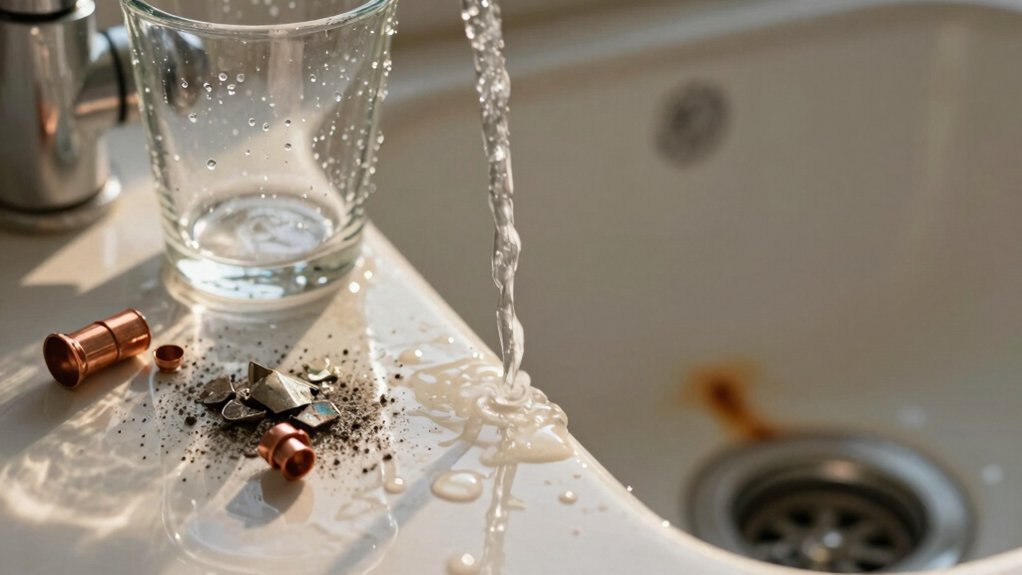
Heavy metals in drinking water are elements like lead, arsenic, cadmium, and copper that can enter your tap from geology or plumbing; they can cause health harm at microgram-per-liter levels. Regulatory limits (for example EPA’s arsenic 10 µg/L) guide testing and treatment.
Corrosion, galvanic contacts, pH, alkalinity, and inhibitors control release from pipes and fixtures. You should test and use verified corrosion control or filtration when levels exceed guidelines. If you keep exploring, you’ll find practical monitoring and remediation steps.
Quick Overview
- Heavy metals are naturally occurring metallic elements (e.g., lead, arsenic, cadmium) that can contaminate drinking water and harm health. They enter water from natural sources, industrial discharges, aging pipes, plumbing solder, and contaminated groundwater.
- Regulatory agencies set maximum contaminant levels (e.g., arsenic 10 µg/L) to protect public health. Health effects vary by metal and dose, including cancer risk (arsenic); kidney/bone damage (cadmium); and neurological harm (lead).
- Control measures include corrosion control, source treatment, filtration, pipe replacement, and regular monitoring and public reporting.
Lead, Arsenic, Cadmium Levels
Why should you care about lead, arsenic, and cadmium in drinking water? You face measurable risks: lead harms neurodevelopment at very low levels. Arsenic raises cancer and cardiovascular risks. Cadmium injures kidneys and bones. Historical exposure amplifies lifetime risk; therefore, you should prioritize testing and consumer education to reduce intake.
The following snapshot shows typical standards and sources.
| Contaminant | Typical Standard (µg/L) | Common Sources |
|---|---|---|
| Lead | 10–15 | Corroded plumbing, urban runoff |
| Arsenic | 10 | Geological, industrial discharge |
| Cadmium | 3–5 | Industrial effluent, fertilizer runoff |
Interpret results with labs that test metals. Act on confirmed exceedances to protect children and other vulnerable groups.
EPA Maximum Contaminant Levels
How do EPA Maximum Contaminant Levels (MCLs) protect you and what do they actually mean for drinking water safety? You rely on epa standards that set enforceable numeric limits for contaminants, including heavy metals. MCLs reflect risk assessments, feasible treatment, and monitoring requirements; they don’t eliminate all risk but reduce population exposure.
You’re entitled to Consumer Confidence Reports showing compliance and testing frequency. Know that some regulatory decisions balance health goals with practical detection and treatment limits.
MCLs are legal limits; Maximum Contaminant Level Goals (MCLGs) are health-based. Compliance uses certified laboratory testing and specified methods. Exceedances trigger public notification and corrective action. Small systems may use variances or exemptions under defined conditions.
Plumbing Pipe Corrosion Limits
When you assess plumbing pipe corrosion limits, focus first on lead release mechanisms from solder, lead pipes, and disturbed scales, since even low-level mobilization raises blood-lead risk.
Evaluate copper corrosion effects: pitting, increased dissolved copper, and potential aesthetic and health impacts. Account for galvanic corrosion risks where dissimilar metals contact; this can accelerate metal loss.
Finally, factor in pipe age and materials, plus water chemistry variables (pH, alkalinity, chloride, and dissolved oxygen), because they deterministically control corrosion rates and metal release.
Lead Release Mechanisms
What causes lead to leach from plumbing into your tap water is primarily electrochemical corrosion of lead-containing materials: lead service lines, leaded solder, brass fixtures and older pipes, when water chemistry creates a corrosive environment. You should know that pH, alkalinity, dissolved oxygen, chloride-to-sulfate ratio and orthophosphate presence control corrosion rates. Lower pH and low alkalinity increase solubility, while orthophosphate inhibits release by forming protective films.
Physical disturbances, pressure changes and abrasive particulate can dislodge scales, suddenly raising lead. Monitoring programs must target point-of-use and point-of-entry samples because system averages mask hotspots. In the context of emerging contaminants, heightened consumer awareness drives testing and corrosion-control investments. Regulators use lead action levels and passivation strategies to limit exposure.
Copper Corrosion Effects
Copper corrosion in plumbing occurs when water chemistry and physical conditions promote oxidation and dissolution of copper metal, releasing ions into tap water and degrading pipe integrity. You should monitor pH, alkalinity, dissolved oxygen, chloride-to-sulfate ratio, and temperature because each parameter accelerates corrosion kinetics and increases copper solubility.
Corrosion scales and particulate release create variable tap concentrations; acute spikes often follow stagnation or disturbances. For mitigation strategies, adjust source water chemistry, apply corrosion inhibitors, maintain protective scale, and replace severely degraded piping.
Be aware of filtration limitations: standard carbon filters reduce taste and particulates but won’t reliably remove dissolved copper ions without certified ion-exchange or reverse-osmosis units. Regular testing and targeted remediation keep concentrations within health guidelines and preserve plumbing function.
Galvanic Corrosion Risks
Although dissimilar metal contacts in plumbing systems may seem minor, they can set up galvanic cells that accelerate corrosion and drive metal ions into your drinking water. You should know that when metals with different electrochemical potentials touch in an electrolyte, the anodic metal corrodes faster; this raises localized concentrations of lead, copper, or nickel.
Measured potential differences, water pH, and conductivity predict corrosion rates. Stagnant zones amplify irreversible ionization of metal surfaces, releasing persistent ions.
Magnetic susceptibility of ferrous components can indicate microstructural changes from corrosion; this is useful in inspections. Mitigation includes isolating dissimilar metals with dielectric fittings, controlling water chemistry (pH, alkalinity, orthophosphate dosing), and routine monitoring for metal ion spikes to protect health.
Pipe Age And Materials
How old are the pipes in your building, and what materials are they made from? You should assess pipe age because older systems, such as lead soldered copper, galvanized steel, and cast iron, have higher corrosion-driven metal release. Documenting materials type (lead, copper, brass, galvanized steel, PVC) lets you predict likely contaminants and prioritize testing for lead, iron, or copper.
Typical service lives are as follows: galvanized steel 20–50 years; lead plumbing pre-1986 is indefinite but hazardous; copper lasts 50+ years if water is non-corrosive. Inspect fittings, solder, and fixtures for mixed materials that create galvanic couples.
Replace identified lead components and consider full-material inventories to set sampling points and remediation timelines. Use certified plumbers and lab-verified tests to confirm corrosion limits and metal concentrations.
Water Chemistry Influence
Why does water chemistry control whether your pipes release metals into drinking water? You assess pH, dissolved oxygen, water hardness, and salinity dynamics because they dictate electrochemical corrosion rates and scale formation. Low pH and high dissolved oxygen accelerate metal oxidation. Elevated chloride from salinity dynamics increases localized pitting on stainless steel and copper.
Hard water encourages protective carbonate scale that can limit metal release; yet fluctuating hardness causes deposit detachment and episodic contamination. Ionic strength and conductivity modify corrosion cell currents. Higher salinity raises conductivity and corrosion potential.
You should interpret these parameters quantitatively: Langelier saturation index, chloride-to-sulfate mass ratio, and corrosion potential measurements predict pipe stability and likely metal mobilization into tap water.
Corrosion Control Methods
What specific steps will keep your plumbing from leaching metals into drinking water? You should focus on targeted corrosion control: maintain pH buffering to keep water slightly alkaline (typically 7.5–8.5) to minimize metal solubility and apply orthophosphate dosing to form protective scale on lead and copper surfaces.
Implement water softening where hard water exacerbates scale instability and galvanic corrosion between dissimilar metals. Regularly test stagnation samples for lead, copper, and pH; monitor conductivity and alkalinity to detect changing corrosion potential.
Replace high-risk components (lead solder, brass with high lead) and electrically isolate dissimilar metals with dielectric fittings. Document treatment rates and pipe replacement timelines; follow EPA and AWWA guidance to verify that interventions consistently keep metal release below regulatory limits.
Frequently Asked Questions
How Can I Test My Well Water for Multiple Heavy Metals at Once?
You can send a well-water sample to a certified lab that uses ICP-MS or ICP-OES for multi-metal testing; these testing methods detect dozens of metals at low ppb levels.
Collect samples following lab instructions to avoid contamination. Request EPA Metals or MNM panels. Be aware of measurement challenges like matrix interference, detection limits, and sample preservation. Labs will report limits of detection and quality-control data so you can interpret results.
Do Home Water Filters Remove All Types of Heavy Metals Effectively?
No, home filtration won’t remove all heavy metals effectively. You should match home filtration technology to specific metals: reverse osmosis and ion exchange excel at metal uptake for lead, arsenic, and cadmium. Activated carbon helps some organic-metal complexes but not all metals. Standard pitchers or basic filters often miss dissolved metals.
Get lab testing. Choose certified systems for targeted contaminants, and follow maintenance and filter replacement schedules for reliable removal.
Can Heavy Metals in Water Affect Indoor Plants or Pets First?
Yes, heavy metals can affect indoor plants and pets first. You’ll see plants show stunted growth, chlorosis, leaf necrosis, or root damage from metals like copper, lead, or manganese accumulating in soil.
Pets ingesting tainted water or soil can develop gastrointestinal, neurological, or renal signs earlier than humans due to smaller body mass. Test water and soil, monitor symptoms, and use filtration or soil replacement based on lab-confirmed metal levels.
How Long Do Heavy Metals Remain in the Human Body After Exposure?
It depends on the metal: some clear from blood in days to weeks, while others persist in tissues for years or decades. You’ll see short half-lives for blood mercury and lead. However, bone-stored lead or cadmium in kidneys show long heavy metals persistence.
Medical chelation and elimination speed vary; so human body emptying can range from days (acute) to lifelong retention without intervention. Get testing to gauge your exposure.
Are There Natural Remediation Methods for Heavy-Metal Contaminated Groundwater?
Yes, you can use natural remediation for heavy-metal contaminated groundwater. You’ll apply phytoremediation, biochar adsorption, permeable reactive barriers with zero-valent iron, and microbially enhanced immobilization for groundwater treatment.
Each method’s effectiveness depends on metal speciation, redox conditions, and hydrogeology. You’ll need site-specific testing, monitoring, and sometimes combined approaches to meet regulatory limits reliably. Evidence-based pilot studies and long-term monitoring guide safe implementation.
Conclusion
You’ve seen how lead, arsenic and cadmium in drinking water exceed health-based EPA limits when plumbing and source water aren’t controlled. Corrosion, particularly from old pipes, incompatible metals and aggressive water chemistry, releases lead and copper and accelerates metal mobilization.
Evidence shows effective corrosion control: pH/alkalinity adjustment, orthophosphate, pipe replacement; and monitoring reduce risks. Prioritize testing, follow EPA MCLs, and address pipe material and water chemistry to protect health and comply with regulations.
You may also like: Water Filter Certifications And Recalls — a related guide worth bookmarking.