What Is Chloramine in Drinking Water
Chloramine is a stable disinfectant you’ll find in many water systems. It is formed deliberately by combining free chlorine and ammonia to produce mainly monochloramine (typically ~1.5–2.5 mg/L). You’ll see it used to maintain a residual disinfectant that limits microbial regrowth while reducing some chlorine byproducts.
To form monochloramine only, you’ll control the ammonia:chlorine weight ratio (≈4:1), pH (≈7–8.5), temperature, and contact time. Continue for details on reaction chemistry, controls, and byproduct risks.
Quick Overview
- Chloramine is a disinfectant formed when chlorine is combined with ammonia to provide a stable residual in drinking water.
- Monochloramine (NH2Cl) is the desired form; typically about 1.5–2.5 mg/L, for ongoing microbial control. Utilities target an ammonia-to-chlorine weight ratio near 4:1 and pH ~7–8 to favor monochloramine formation.
- The EPA limits chloramine as an MRDL to 4.0 mg/L (as chlorine); this is enforced as an annual average. Chloramine reduces some regulated DBPs compared with free chlorine, but it can promote certain nitrogenous byproducts.
Chloramine Concentration Comparisons
| Species | Typical mg/L | Notes |
|---|---|---|
| Monochloramine | 1.5–2.5 (avg ~2) | Stable residual; microbial control |
| Dichloramine | Less stable; raises odor/taste threshold | |
| Trichloramine | Volatile; low odor threshold, avoided |
You’ll monitor ratios and concentrations to control taste threshold and odor threshold while maintaining disinfection.
EPA Maximum Contaminant Level
The EPA sets the Maximum Residual Disinfectant Level (MRDL) for chloramine at 4.0 mg/L (as chlorine) to limit public exposure while ensuring effective disinfection across distribution systems. This regulatory ceiling reflects an annual average and is enforced to balance microbial control with minimizing disinfectant-related risks such as taste and odor issues; it also addresses the formation of regulated byproducts.
- You Should Understand Regulatory Limits: The MRDL is a compliance metric utilities must meet on an annual average to control residual disinfectant concentration.
- You Must Consider Safety Considerations: The MRDL balances pathogen suppression against byproduct and aesthetic impacts.
- Monitoring Protocols Require Routine Total Chlorine Measurements and Reporting to Regulators.
- Exceedances Trigger Operational Adjustments and Public Notification to Restore Compliant Residuals.
Formation of Monochloramine Only
To form only monochloramine, you must control the stoichiometry and kinetics of the ammonia-chlorine reaction so that NH₂Cl predominates over NHCl₂ and NCl₃. Maintain an ammonia-to-chlorine weight ratio near 4:1 (≈1:1 mole) and operate at neutral to slightly alkaline pH (≈7–8) with moderate temperatures. Lower pH and higher chlorine excess shift speciation toward dichlor- and trichloramine.
Precise dosing, contact time, and temperature control are therefore required to suppress side reactions and maximize monochloramine yield.
Chemical Reaction Basics
How exactly does monochloramine form when you add ammonia to chlorinated water? You get a controlled, stepwise substitution: free chlorine (HOCl/Cl2 equilibrium) reacts with ammonia (NH3) to yield monochloramine (NH2Cl) plus a proton via nucleophilic attack on hypochlorous acid.
The reaction proceeds rapidly under typical treatment conditions and reaches a kinetic equilibrium influenced by pH, temperature, and reactant concentrations. At neutral pH and appropriate chlorine-to-ammonia dosing, formation favors monochloramine over dichloramine or trichloramine, yielding predictable residuals that support economical benefits in distribution.
You must control contact time and mixing to limit secondary chlorination steps. Clear communication about these mechanistic controls improves public perception and supports regulatory compliance.
Ammonia To Chlorine Ratio
One optimal target you should aim for is a chlorine-to-ammonia weight ratio of about 4:1 (≈1:1 mole) because at neutral pH and typical treatment temperatures, this dosing favors rapid, predominately monochloramine formation while minimizing conversion to dichloramine or trichloramine. You should implement ratio optimization by adjusting ammonia feed to achieve that weight ratio relative to measured free chlorine. At ~4:1, you can expect ~88% monochloramine under standard conditions.
Practical dosing strategies require calibrated feeds, frequent total and free chlorine monitoring, and accounting for ammonia demand from source water. Maintain tight control to avoid ratios above ~5:1, which shift speciation toward dichloramine, and below recommended levels, which can leave excess free chlorine and increase DBP precursors.
Reaction Conditions Required
Why does achieving the right conditions matter for forming primarily monochloramine? You must control reactant ratios, contact time, and temperature to drive the reaction toward monochloramine rather than dichlor- or trichloramine. Use a chlorine-to-ammonia weight ratio near 4:1 (≈1:1 mole) and maintain sufficient chlorine residual to consume free ammonia rapidly; this favors the desired irreversible equilibrium toward NH2Cl under typical treatment conditions.
Minimize excessive chlorine pulses and avoid catalytic surfaces in contact tanks that can accelerate unwanted side reactions or decompose intermediates. Keep contact times short to limit successive chlorination steps and monitor total and free chlorine to verify product distribution. Precise dosing, hydraulic design, and material selection ensure predominance of monochloramine.
pH Influence On Formation
pH critically governs the speciation and reaction kinetics that favor monochloramine (NH2Cl) formation: at near-neutral to mildly alkaline conditions (approximately pH 7.0–8.5), the deprotonated free ammonia (NH3) predominates and reacts with hypochlorous acid/hypochlorite in a controlled, pseudo-first-order manner to form monochloramine.
Whereas lower pH shifts the chlorine species toward molecular HOCl and increases the fraction of protonated ammonia (NH4+), promoting rapid successive chlorination that yields dichloramine and trichloramine. You’ll control pH influence by maintaining pH within that window. Reaction conditions outside it accelerate side reactions and reduce monochloramine yield.
Buffer capacity, dosing sequence, and chlorine-to-ammonia ratio interact with pH to determine kinetic pathways; so monitor and adjust these parameters to optimize monochloramine formation.
Temperature Effects On Reaction
After controlling pH to favor NH3 over NH4+, you must consider temperature because it directly alters the kinetics and equilibrium of monochloramine formation.
You’ll find that increasing temperature accelerates the amination reaction rate, shortening the contact time needed to reach target NH2Cl levels. However, it also shifts equilibrium slightly toward more dichloramine at equivalent chlorine-to-ammonia loadings. Quantitatively, reaction rate constants show Arrhenius dependence; thus, a few degrees change produces measurable yield differences.
You must consequently adjust dosing and contact time based on observed temperature impact and system hydraulics. Because ratio sensitivity remains critical, maintain the optimal ~4:1 chlorine-to-ammonia weight ratio while compensating for temperature-driven kinetic changes to preserve monochloramine selectivity.
Byproduct Formation Risks
How might forming largely monochloramine influence the suite of disinfection byproducts you need to monitor? You’ll see a distinct shift: monochloramine minimizes regulated carbonaceous DBPs like THMs but can promote nitrogenous DBPs (N-DBPs) such as NDMA, haloacetonitriles, and nitrosamines under certain conditions.
Because monochloramine is more stable, byproduct cross contamination across distribution networks becomes a concern. Trace precursors transported downstream can react slowly to form N-DBPs.
Monitor both carbonaceous and nitrogenous analytes, especially where organic nitrogen or high ammonia residuals exist. Pay attention to storage tank hazards: long residence times, thermal stratification, and biofilm colonization increase N-DBP formation risk.
Control strategies include strict Cl2:NH3 dosing, minimizing residence time in tanks, and targeted precursor removal to limit hazardous byproduct emergence.
Frequently Asked Questions
Can Chloramine Affect Aquarium Fish or Pets?
Yes, chloramine can harm aquarium fish and pets if not removed. You’ll need aquarium safety measures because chloramine is more stable than chlorine and persists in treated tap water. This causes prolonged toxic exposure to gill-breathing fish and sensitive amphibians.
You should use certified dechloraminating products or activated carbon filtration to neutralize chloramine. Additionally, monitor total and combined chlorine, and prevent pet exposure by conditioning water before use.
How Does Chloramine Impact Dialysis Patients?
You’re at high risk if dialysis water contains chloramine. Dialysis safety demands removal because chloramine exposure causes hemolytic anemia and methemoglobinemia during extracorporeal therapy. You must use validated carbon and/or chemical dechloramination and routine total chlorine testing to ensure chloramine
Facilities follow strict maintenance, monitoring, and alarmed polishing systems to prevent patient harm.
Can Chloramine Be Removed by Home Filters?
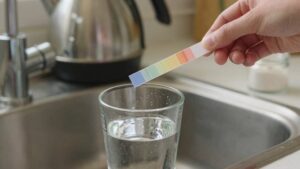
Yes, you can remove chloramine with proper home filtration: catalytic carbon or KDF-plus-carbon systems effectively reduce chloramine. Standard activated carbon alone often fails. You should test by detecting chloramine using total chlorine tests (subtract free chlorine) before and after filters to verify removal.
Expect subtle taste differences when chloramine’s removed versus chlorine-treated water. Follow manufacturer flow-rate, contact time, and media replacement specs for reliable performance.
Does Chloramine Cause Skin or Hair Irritation?
Yes, chloramine can cause skin irritation and hair irritation in some people. You’ll usually see mild, nonspecific dermatitis, dryness, or worsening of preexisting eczema and scalp irritation after repeated exposure.
Evidence shows chloramine is less reactive than free chlorine; however, it still alters skin lipids and hair proteins, potentially increasing irritation risk. Sensitive individuals and those with compromised skin barriers are most likely to experience symptoms.
Are There Odor or Taste Differences From Chlorinated Water?
Yes, you’ll notice subtle odor differences and taste differences with chloraminated water. Compared with chlorine, chloramine produces a milder, less pungent smell and a slightly flatter taste because it’s less volatile and forms fewer volatile byproducts.
Technical analyses show reduced free chlorine volatility and lower formation of chlorinated volatile organics. This diminishes olfactory intensity but can leave a persistent, slightly medicinal or metallic mouthfeel.
Conclusion
You’ve seen how chloramine forms when utilities dose ammonia into chlorinated water to produce mostly monochloramine. The controlled ammonia-to-chlorine ratio, pH (typically 7–8.5), temperature, and contact time determine conversion efficiency and byproduct profile.
Monochloramine concentrations are kept below the EPA MCL for disinfectants and disinfection byproducts. However, elevated temperature or improper ratios can increase unwanted dichloramine/nitrogen trichloride and organic chlorinated byproducts.
Monitor and adjust dosing and pH to minimize risks.
You may also like: Vs Chloramine In Tap Water — a related guide worth bookmarking.