Reverse Osmosis Membrane Lifespan and Care
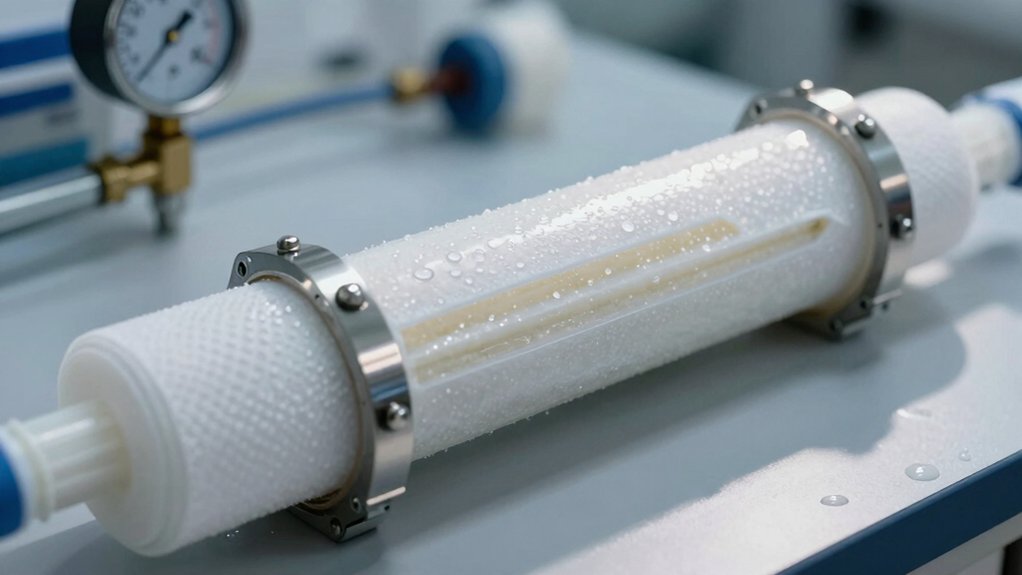
You’ll get about 2–5 years from a well-maintained RO membrane. However, actual lifespan depends on feed salinity, pressure control, and pre-treatment. Monitor permeate flux, rejection, and stage differential pressures. Replace proactively when flux and salt rejection drop or ΔP rises.
Control recovery, use antiscalants, softening and pH 6–8 chemistry, and design for high-pressure duty with staged arrays. Track conductivity and normalized flow for early warning. Keep going to see specific maintenance and replacement triggers.
Quick Overview
- Replace membranes every 2–5 years based on flux decline, rejection drop, and rising pressure differential.
- Monitor permeate flux, conductivity, and normalized flow to detect fouling and loss of selectivity early.
- Maintain feed pH 6–8, control temperature, and limit recovery to prevent osmotic stress and scaling.
- Implement robust pre-treatment (antiscalant, softening, filtration) and validated sanitization to extend membrane life.
- Design for high-salinity feeds with higher-pressure-rated membranes; use staged recovery and brine management to protect performance.
Permeate Flow & Salt Rejection
How does pressure, feed composition and temperature combine to set your permeate flow and salt rejection? You’ll raise permeate flux by increasing hydraulic pressure and temperature; however, salt rejection falls with higher temperature and feed salinity. Balance pressure against osmotic and concentrate pressures to maintain target flux without sacrificing rejection.
| Variable | Permeate Flux | Salt Rejection |
|---|---|---|
| Pressure | Increases (direct) | Improves (reduces passage) |
| Feed TDS | Decreases (osmotic opposition) | Decreases (higher passage) |
Control recovery to avoid concentrate-driven flux loss. Operate near pH 6 to 8 to preserve polyamide charge. Monitor average Cf/Cp for real-time rejection calculation. Adjust pressure and temperature together: raising pressure compensates for higher TDS; however, watch increased salt permeability at elevated temperatures.
Change Membrane Every 2–5 Years
Having set operating pressure, feed composition, and temperature to meet your target permeate flux and salt rejection, you should plan membrane replacement on a 2–5 year schedule based on operating conditions. You’ll schedule membrane replacement proactively rather than waiting for catastrophic failure.
Track flux decline, rejection drop, and pressure differential; these quantitative triggers beat lifespan misconceptions. Document pre-treatment efficacy and adjust intervals for hardness, TDS, and duty cycles. When replacement is due, follow validated flush and sanitization protocols to avoid biofilm carryover.
- Monitor normalized permeate flow monthly.
- Record salt passage and rejection rates.
- Log differential pressure across the element.
- Correlate replacement history with feedwater quality.
- Use vendor life-prediction data and field validation.
High-Saline Feedwater Precautions
When you handle high-saline feedwater, prioritize pre-treatment to lower salinity and remove scale-forming ions before the membrane. Choose membranes with verified salt tolerance and design the system for higher operating pressures. Implement antiscalant dosing and periodic flushing to control precipitation.
Plan brine disposal or management: volume minimization, dilution, or recovery to meet environmental limits and protect long-term membrane performance.
Pre-Treatment Salinity Reduction
Why treat high-salinity feedwater before it reaches the RO membrane? You need a clear pre-treatment overview that defines salinity benchmarks, practical limits, and unit operations to protect membrane life. For feed above your benchmark TDS, deploy staged mixing, brackish pretreatment, or blending to drop osmotic load and reduce flux demands.
Use inline conductivity monitoring and automatic divert when salinity exceeds setpoints. Implement anti-scalant dosing adjusted to measured ionic strength, and ensure particulate filtration to prevent concentration polarization at the membrane surface. Validate performance by tracking permeate conductivity and pressure differential trends versus benchmarks. Document control setpoints, maintenance intervals, and corrective actions so you can consistently maintain conditions that minimize accelerated wear and preserve expected RO lifespan.
Membrane Salt Tolerance
How much salt can your RO membrane tolerate before performance and lifespan are compromised? You should treat feeds above ~500 ppm TDS as high risk: elevated osmotic load reduces flux, stresses membrane polymer, and shortens service life toward the 2–3 year range.
Design and operation must preserve membrane selectivity by controlling differential pressure and recovery rates; higher recovery increases salt concentration at the membrane surface and accelerates salt fouling. In practice, lower recovery, staged recovery, or targeted dilution keep surface salinity within material limits.
Monitor permeate conductivity and normalized permeate flow to detect selectivity loss early. If you see rising rejection decline or pressure changes, reduce recovery and implement brine management or upstream salinity reduction to avoid irreversible polymer compaction and premature failure.
Scaling And Precipitation Control
What should you do to prevent scaling and precipitation when treating high-saline feedwater? You must assess saturation indices and adjust pre-treatment to maintain ions below scaling thresholds. Implement targeted antiscalants; dose based on feed TDS and composition, and monitor residuals to confirm efficacy.
Use acidification to control carbonate equilibrium when alkalinity and calcium promote scale. Stabilize pH within membrane-safe limits. Employ inline monitoring for rapid detection of nucleation events and adjust recovery to reduce supersaturation.
Periodic chemical cleaning tuned to precipitation chemistry removes early deposits before crystallization hardens. Combine softening or ion exchange where hardness dominates. Document feed analyses, antiscalant type and dose, and cleaning intervals to optimize scaling control and extend membrane life.
High-Pressure System Design
When treating high-saline feedwater, design your high-pressure RO system to manage elevated osmotic pressures and increased scaling risk by specifying pumps, vessels, and controls that sustain higher differential pressures and allow for controlled recoveries. Size pumps for continuous duty at required shutoff head. Select corrosion-resistant pressure vessels rated above expected operating psi, and fit variable frequency drives for ramp control.
You’ll implement staged arrays to limit per-stage recovery, monitor differential pressure and conductivity on each stage, and add automatic flush cycles when thresholds are reached. Use bypass valves and pressure reliefs to prevent overpressure. For planning and commissioning, document two word discussion ideas for team alignment (e.g., “stage sequencing”). Verify instrumentation accuracy under high pressure to protect membranes and maintain lifespan.
Brine Disposal Strategies
Why does brine management demand as much engineering attention as the RO train itself? You’ll assess brine concentration, flowrate, and seasonal variability to protect membranes and meet regulations. For high-saline feedwater, optimize recovery to limit concentration polarization and scaling potential. Use staged RO or reject blending to control peak brine concentration.
Evaluate disposal options: deep-well injection, evaporation ponds, zero-liquid-discharge (ZLD) crystallizers, or controlled sewer discharge with pretreatment and permits. Prioritize options by site footprint, permitting complexity, and cost per cubic meter of concentrate. Implement monitoring for conductivity, metals, and pH. Include contingency for brine spills.
Properly designed disposal preserves RO performance, reduces fouling/scaling frequency, and extends membrane lifespan through predictable operating conditions.
Frequently Asked Questions
How Does Chlorine Exposure Affect Membrane Materials Long-Term?
Chlorine exposure degrades many RO membranes by oxidizing their polymer structure. You’ll see reduced rejection and mechanical strength over time. Check chlorine compatibility of each membrane chemistry: TFC/TFC polyamide is highly sensitive, while some polymeric or ceramic chemistries tolerate oxidants better.
You should avoid continuous chlorination, use dechlorination or compatible materials, and monitor performance. Periodic oxidation accelerates fouling, embrittlement, and shortens operational life.
Can Ceramic Membranes Replace TFC in Residential Systems?
Yes, ceramic membranes can replace TFC in many residential systems, offering superior fouling resistance and chemical durability. You’ll gain longer service life and tolerance to chlorine and harsh cleaning. This improvement enhances residential viability where feed water is abrasive or high in organics.
However, you’ll face higher upfront cost, larger module size, and potential need for system redesign for pressure and flow. Evaluate cost, space, and performance trade-offs before switching.
What Are Best Sanitization Practices to Prevent Biofouling?
Use regular sanitization: flush membranes weekly, shock-clean monthly with approved biocides, and maintain pre-filter changes to cut biofouling risks. You will verify sanitizer compatibility with membrane type (TFC vs ceramic) and system seals before use.
Employ low-concentration chlorine or peroxide where allowed, or glutaraldehyde/iodine for resistant biofilms. Record contact time, temperature, and pH; then rinse thoroughly and retest rejection and pressure to confirm effectiveness.
How Do Usage Patterns Change Expected Membrane Lifespan?
Usage patterns directly affect membrane longevity: heavy continuous flow, frequent high-TDS spikes, or long idle periods accelerate fouling and degradation. You’ll shorten life by skipping system maintenance, delaying pre-filter changes, or running without softening.
Conversely, steady moderate use, timely pre/post-filter replacement, routine sanitization and scheduled flushing extend service life. Monitor throughput, pressure and rejection rates; adjust operation cycles and maintenance frequency to optimize membrane longevity.
Are There Signs of Subclinical Membrane Damage Before Performance Drops?
Yes, you can detect subclinical indicators before clear performance drops. You should use preemptive monitoring: track small rises in differential pressure, subtle conductivity drift in permeate, incremental flux decline, and microscopic biofilm or colloid presence via particle counts.
Log pH and chlorine transients and inspect for gradual salt passage increases. These technical, regular checks let you intervene before rejection or flow falloff necessitates membrane replacement.
Conclusion
You’ll get reliable permeate flow and salt rejection only by replacing RO membranes every 2–5 years, monitoring performance, and tailoring pre-treatment to feedwater salinity. For high-saline sources, reduce salinity before the membrane. Control scaling with antiscalants and softening; design systems for higher pressures.
Account for membrane salt tolerance and plan brine disposal that meets regulations. Follow these practical steps to maximize membrane life and maintain consistent product water quality.
You may also like: Osmosis Membrane Gpd Ratings Explained — a related guide worth bookmarking.